Get Full Government Meeting Transcripts, Videos, & Alerts Forever!
Get email alerts on the Civil Rights Affirmative Action topic
No spam. Unsubscribe anytime.
Senate approves SB3 limiting race‑based preferences in state hiring, procurement and higher education
Summary
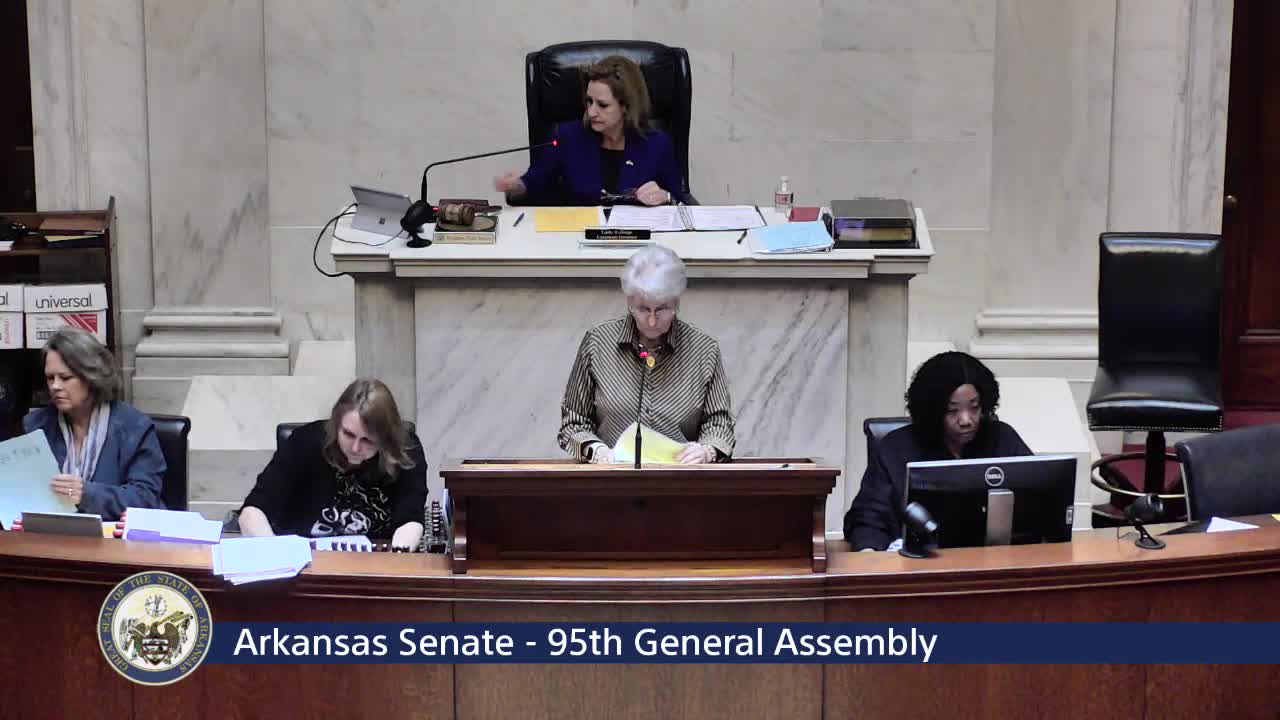
After an hourlong debate, the Arkansas State Senate passed Senate Bill 3 on Jan. 29, 2025, a measure that prohibits state and public entities from giving preferential treatment on the basis of race, color, ethnicity or national origin in procurement, hiring and higher education; the bill passed 24–7 (with 2 not voting and 2 present).
The Arkansas State Senate on Jan. 29, 2025 passed Senate Bill 3, a measure that prohibits state and public entities from providing preferential treatment on the basis of race, color, ethnicity or national origin in state procurement, hiring and higher education, the bill’s sponsor, Senator Sandra Sullivan, said on the Senate floor.
Senator Sandra Sullivan said the measure “only affects procurement, hiring, and higher ed. That's all it affects,” and told colleagues the draft strikes language she said required affirmative‑action programs and replaces several references to “minority” with the broader phrase “critical needs.” The chamber voted 24 yes, 7 no, with 2 not voting and 2 present; the bill was ordered transmitted to the House.
Supporters framed SB3 as enforcing a merit‑based standard for public employment and contracts. Sullivan told the Senate the measure preserves veterans' preferences, narrows the protected characteristics addressed to race, color, ethnicity and national origin, and creates criminal and civil accountability for knowing violations. She said the bill removes reporting and planning requirements tied to affirmative‑action programs and that the measure aligns Arkansas policy with recent presidential executive actions noted by the sponsor.
Opponents said SB3 would eliminate longstanding, narrowly tailored programs designed to expand opportunity and retain students and workers from groups historically underrepresented in state institutions. Senator Flowers said he would “vote against this bill. I don't think it's necessary. I think it's mean spirited. I think it ignores the history of Arkansas.” Senator Murdoch described programs aimed at recruiting and retaining minority teachers and scholars as opportunity measures and urged colleagues to consider whether those programs remain necessary to achieve equal access. Senator Tucker noted historical context and asked colleagues to consider whether the state has yet remedied long‑running inequities; “When Terrence Roberts speaks, I listen,” he said, recounting testimony urging caution.
During floor debate senators cited named programs and institutions they said could be affected, including minority‑teacher recruitment and retention scholarships, higher‑education minority retention initiatives, the Minority Health Commission, and support programs that encourage participation by minority‑ and women‑owned businesses. Senator Tucker warned that the change could create both civil liability and criminal liability for people found to knowingly effect preferential treatment, and raised concern that the bill lacks an explicit statutory definition of “preferential treatment.”
Sullivan said the bill limits criminal exposure by requiring that a person knowingly violate the law — and that knowledge would be assessed individually rather than imputed up a chain of command. The sponsor also said the bill preserves veterans' preferences and does not target private‑sector practices.
The attorney general’s office was cited on the floor as having reviewed the bill and as “comfortable” defending it if challenged, though senators on both sides warned the measure could prompt litigation about how courts would interpret specific programs and institutions under the new law.
Votes at a glance (selected items from the same session): • Senate Resolution 6 (recognizing Jan. 29, 2025 as Mental Health Day at the State Capitol): adopted by voice vote. • Senate Bill 63 (reports by cabinet‑level department secretaries to ALC): passed by recorded vote, 34–0 with 1 present; transmitted to the House. • Senate Bill 97 (authorizing additional retail liquor permits in counties with 200,000+ population): passed 23–10–1 not voting, 1 present; transmitted to the House. • House Bill 1050 (separate sheriff and tax collector offices in Poinsett County): passed 35–0; returned to the House. • House Bill 1137 (separate sheriff and tax collector offices in Searcy County): passed 35–0; returned to the House.
What the bill would do and open questions SB3 focuses on three public functions listed by the sponsor — procurement, public employment and higher education — and removes statutory language the sponsor characterized as tied to affirmative‑action obligations. The measure keeps veterans' preferences intact, makes knowing violations a misdemeanor for individuals who intentionally create a discriminatory outcome, and creates a private right to sue with damages and fee shifting where applicable. The sponsor said the bill replaces multiple statutory references to “minority” with the phrase “critical needs.”
Opponents pressed for specifics about scope and unintended consequences. They pointed to programs described in statute or established administratively that encourage participation by minority‑ or women‑owned businesses, scholarships targeted at underrepresented students, retention programs on college campuses and cultural museums and commissions focused on African‑American history — saying those efforts were crafted over decades to address structural barriers and would be at risk of challenge under the new language. Several senators asked how the bill would affect local and quasi‑governmental entities and whether court rulings would be required to sort contested cases.
What happens next After the Senate vote SB3 was sent to the Arkansas House for consideration. The Senate debate on Jan. 29 concluded with senators on both sides warning of litigation and advocating for their contrasting visions of how state policy should address past disparities.
Ending note Floor debate ran more than an hour and included several extended statements from both supporters and opponents. Sponsors said the bill aims to end government practices that favor groups on the basis of race, while critics said the bill would undercut targeted efforts that expand access and opportunity for historically underserved Arkansans.