Get Full Government Meeting Transcripts, Videos, & Alerts Forever!
Get email alerts on the Raw Milk Sales topic
No spam. Unsubscribe anytime.
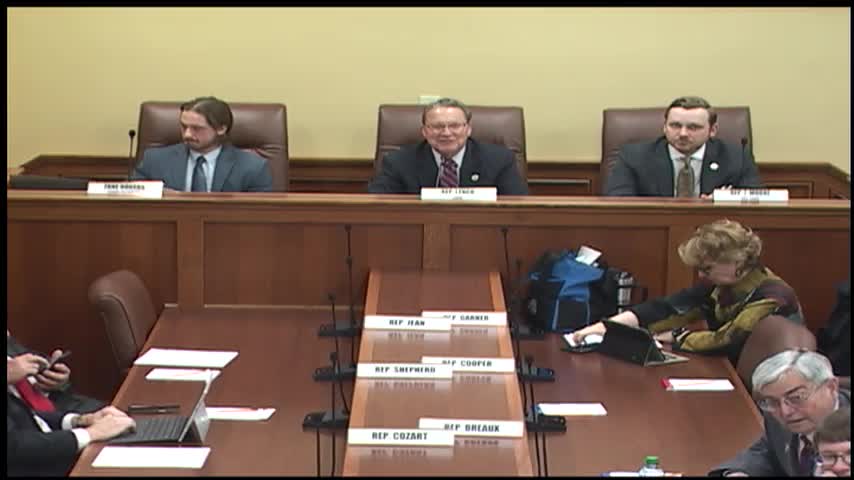
Arkansas committee approves bill to allow on‑farm unpasteurized milk sales to be offered at farmers markets and by delivery
Summary
The House Agriculture, Forestry & Economic Development Committee voted to pass Representative Cameron Cooper's bill to permit producers to sell unpasteurized (raw) milk at farmers markets and via delivery, while retaining existing labeling, point‑of‑sale signage and the limit on incidental sales.
Little Rock — The House Agriculture, Forestry & Economic Development Committee on Thursday voted to pass legislation that would let Arkansas producers sell unpasteurized (raw) milk at farmers markets and deliver it to customers, in addition to continuing on‑farm sales.
Representative Cameron Cooper, R‑District 57, told the committee he introduced an amendment to add cosponsors and to clarify that the bill’s intent is to permit sales at the farm where the milk is produced, at farmers markets, and by delivery from the producing farm. “That just clarifies that I want to be able to sell unpasteurized milk at the farm where the milk is produced, at a farmer’s market, or via delivery from the farm where the milk is produced,” Cooper said.
Cooper said unpasteurized milk has been legal in Arkansas since 1995 under restrictions that initially limited sales to goat milk and capped producer sales at 100 gallons per month; a 2013 change expanded the law to include sheep and cow milk and raised the limit to 500 gallons per month. Cooper said the bill does not change the required warning label or signage that must state the farm’s name and address and notify the consumer that the product “has not been pasteurized” and “has not been inspected by the state of Arkansas.”
Why it matters: Supporters said the change will improve market access for small and rural producers who now must rely on customers traveling to the farm. Opponents did not appear at the committee for this bill. Supporters also said the change could help new and small‑scale farmers find revenue streams without removing existing consumer warnings or inspection requirements.
Supporters included the state director for Americans for Prosperity and several Arkansas farmers and farming advocates who testified in favor. Ryan Norris, state director for Americans for Prosperity, told the committee that expanding market access could help attract new farmers and that small family farms make up a large share of Arkansas agriculture. “Any way they can create new forms of revenue, we believe that's good for the state and that's good for them as well,” Norris said.
Luke Wilson, representing Wilson Ranch Dairy, described the geographic disadvantage faced by rural dairies and said the bill would increase consumer access. “What this law does is it expands the access to where dairies like my family's dairy would now be able to tap into those metropolitan areas,” Wilson said. He said his farm sells raw milk at about $10 a gallon and that access—not price—is the barrier for many small producers.
Steve Grapp of Stand Up Arkansas and homestead farmer at Forevermost Farms said family farms are under financial pressure and that market access is important to their viability. Dan Quadros, assistant professor and small ruminant specialist with the University of Arkansas System Division of Agriculture, spoke as a private citizen and provided production statistics for small ruminants, saying dairy goats and sheep have grown in Arkansas and that marketing constraints limit producers.
What stays the same: Cooper emphasized the bill leaves intact the existing limit on incidental sales (the statute’s 500‑gallon monthly cap), the mandatory product warning label and signage, and the prohibition on third‑party resale — the producer must sell the milk. “We are leaving the required signage at the point of sale… We are leaving the prohibition on third party sales. It has to be sold by the farmer,” Cooper said.
Committee action: The committee approved Cooper’s amendment and later approved the bill as amended by voice vote. No recorded roll‑call tally was provided at the committee meeting.
Next steps: The bill was reported favorably out of committee and will proceed through the House legislative process for further consideration.