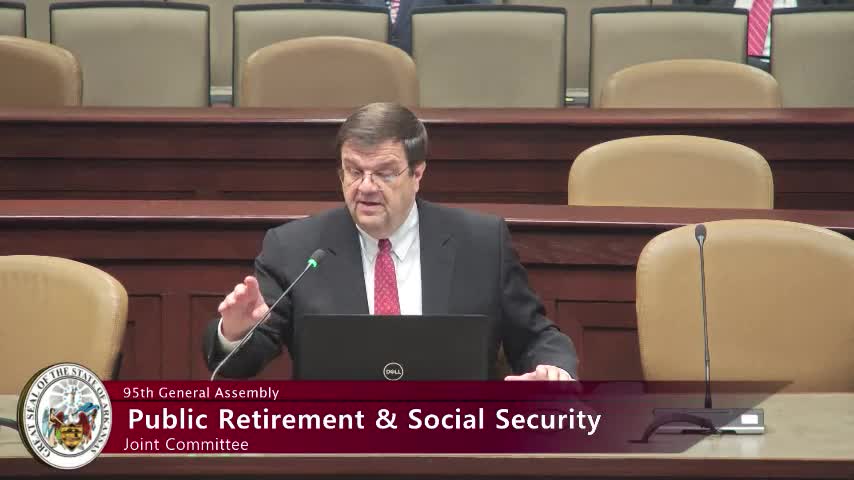
Arkansas retirement systems report improved funding, committee told; two bills filed to adjust administration
Loading...
Summary
State and local pension officials briefed the Joint Public Retirement & Social Security Programs Committee on funding levels, investment returns and program details. Officials said two administration bills (House Bill 1119 and House Bill 1118) will be pursued and reminded members that actuarial studies will accompany any bill affecting benefits.
Members of the Joint Public Retirement & Social Security Programs Committee heard presentations on the financial health and administration of Arkansas’s major public pension systems and were told lawmakers will see two administrative bills this session.
Jody Carrero, the committee actuary, opened with an overview of common pension terms and the basic financial premise for defined‑benefit plans: "The money in comes from the contributions from the employer and employee and investments and that equals the benefits plus the expenses," she said. Carrero explained how assumptions, funding periods and smoothing methods affect contribution rates and the measurement of unfunded actuarial liabilities.
The committee then received system‑by‑system briefings. David Clark, executive director of the Local Police and Fire Retirement System (LOPP) and executive director of the Arkansas Fire and Police Pension Review Board, said LOPP paid $16.4 million to 9,328 recipients in January and paid about $214,000,000 in benefits in fiscal year 2024. Clark said the system’s funded ratio was 76% at the end of 2023 and that paid‑service amortization was about 17.7 years while the volunteer side was 28.5 years. Clark also told the committee that two bills tied to his offices will be filed this session: House Bill 1119 (to amend the delinquency section of code) and House Bill 1118 (to transfer premium‑tax administrative functions from the Pension Review Board to DFNA); he described the latter as planning for an eventual consolidation of some local plans.
Amy Fetcher, representing the Arkansas Public Employees Retirement System (APERS), said APERS administers three systems and that the systems rely heavily on investment returns. She reported APERS’ funded status at 84%, the judicial system at 95% and the state police system at 79%. Fetcher said APERS earned 10.4% in 2024 and 8.8% in 2023 and reminded lawmakers that member contribution rates are scheduled to rise from 5.75% toward 7.0% by July 1, 2029 under prior legislation.
Robin Smith, executive secretary for the Arkansas State Highway Employees Retirement System (ASHERS), summarized ASHERS’ strategic plan and metrics. She said ASHERS was 83.6% funded as of June 30, 2024, had an equivalent funding period of 18.5 years and reported investment returns of 11.72% for the most recent year (above median peer returns). Smith said ASHERS paid nearly $110,000,000 in benefit payments during calendar 2024.
Mark White of the Arkansas Teacher Retirement System (ATRS) outlined ATRS’ portfolio and recent investment performance. White said ATRS had net assets of about $22.7 billion, paid roughly $120,000,000 in benefits in December to more than 57,000 retirees and reported a funded ratio of about 85% with a 20‑year amortization period. He added ATRS holds about $982,000,000 in investments in Arkansas and that the system’s long‑term assumed investment rate used for actuarial projections is 7.25%.
Committee members asked questions about volunteer fire department coverage and the effect that changes in volunteer membership could have on employer contribution rates. Clark said the volunteer membership figure is about 6,500 and cautioned that a materially lower volunteer count would place upward pressure on contribution rates; he also said roughly 300 volunteer departments are not currently covered and that adding them would be positive because coverage would begin prospectively without adding unfunded liabilities.
Representative Warren, the committee chair, and other members urged colleagues to get to know system directors and staff because those offices regularly field constituent questions. Committee staff and panelists reiterated that actuarial studies accompany bills that change benefits and that the committee will not meet next Tuesday to allow time for required actuarial reports. Members were reminded that the committee’s bill‑filing deadline is Friday, January 31, and that the panel will reconvene two weeks later after both chambers adjourn.
The meeting produced no formal votes. Presenters provided background material and asked members to consider the fiscal impacts of any benefit or eligibility changes.