Get Full Government Meeting Transcripts, Videos, & Alerts Forever!
Get email alerts on the Blue Envelope Autism topic
No spam. Unsubscribe anytime.
House committee gives do-pass to bill creating voluntary "blue envelope" for people with autism
Summary
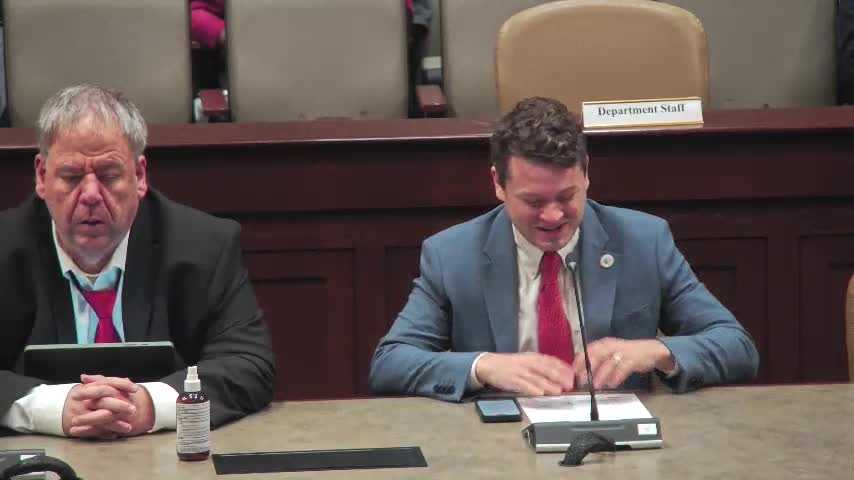
A House committee of the House of Representatives voted to give House Bill 1046 a do-pass recommendation after testimony from people on the autism spectrum, law enforcement and a state revenue official who described how a voluntary "blue envelope" packet would work.
A House committee of the House of Representatives voted to give House Bill 1046 a do-pass recommendation after testimony from people on the autism spectrum, law enforcement and a state revenue official who described how a voluntary "blue envelope" packet would work.
Representative Pilkington, sponsor of House Bill 1046, told the committee the idea came from a constituent and is intended to help officers recognize and communicate with drivers who have autism. "It helps officers recognize that the driver may have a disability that affects their behavior," Pilkington said in presenting the bill.
The bill's backers described use cases and implementation questions. Ludwig Koslowski, a self-advocate from North Little Rock, said the packet would give a "clear tool to explain their situation without having to verbally communicate under stress." Logan Collins, a fuel truck driver from Jacksonville, described a recent traffic stop during which he said communication difficulties increased tension and that a blue envelope could reduce misunderstanding.
Sergeant Jared Kemp of the Mississippi County Sheriff's Office, who has trained on responses to people with autism, said officers can misread behaviors such as freezing or limited eye contact as noncompliance or concealment and that training and tools to reduce escalation are important. "My fear was these individuals being hurt," Kemp said, describing a mock traffic stop during training.
Alicia Austin Smith, chief counsel for the Revenue Division of the Department of Finance and Administration (DFA), told the committee DFA issued a fiscal impact statement and would work with stakeholders to create and operate the program. As described by Smith, under the bill an individual could go to a DFA revenue office, state that they have autism spectrum disorder and be provided a blue envelope upon request. Smith said DFA would enforce the bill as written and develop implementation rules.
Committee members asked how eligibility would be determined and whether existing driver-license markers address the problem. Pilkington said he intended to leave qualification and specific procedures to DFA rulemaking, and several members said public outreach and training for law enforcement would be needed. Testimony indicated some revenue-office options to flag communication challenges exist but are "not well publicized," and witnesses urged outreach so both officers and people who might use the envelopes know about the program.
At the conclusion of testimony, Representative Whitaker moved a "do pass" recommendation. The committee approved the motion by voice vote; the committee record contains only an affirmative voice response and does not list a roll-call tally.
The committee closed the hearing after approving the recommendation for House Bill 1046. No amendments or budgetary amounts for the program were specified in the committee discussion.