Get Full Government Meeting Transcripts, Videos, & Alerts Forever!
Get email alerts on the Corrections Data Technology topic
No spam. Unsubscribe anytime.
Idaho DOC seeks ongoing funding for data tools; director says nonprofit partner leverages philanthropy
Summary
The Department of Correction asked lawmakers to fund continuing development and subscriptions for case management and transparency tools, including a renewed contract with nonprofit Recidiviz and subscriptions for public‑records and legal research platforms.
The Department of Correction urged the committee on Feb. 4 to continue and expand funding for case‑management analytics and public‑access technology, saying the tools automate staff work and help surface data previously locked in disparate systems.
Why it matters: DOC officials told legislators that data tools have accelerated case triage, helped supervisors identify outliers and freed staff from repetitive tasks; DOC argued the next step is to embed the functionality now used in probation and parole into prison case management.
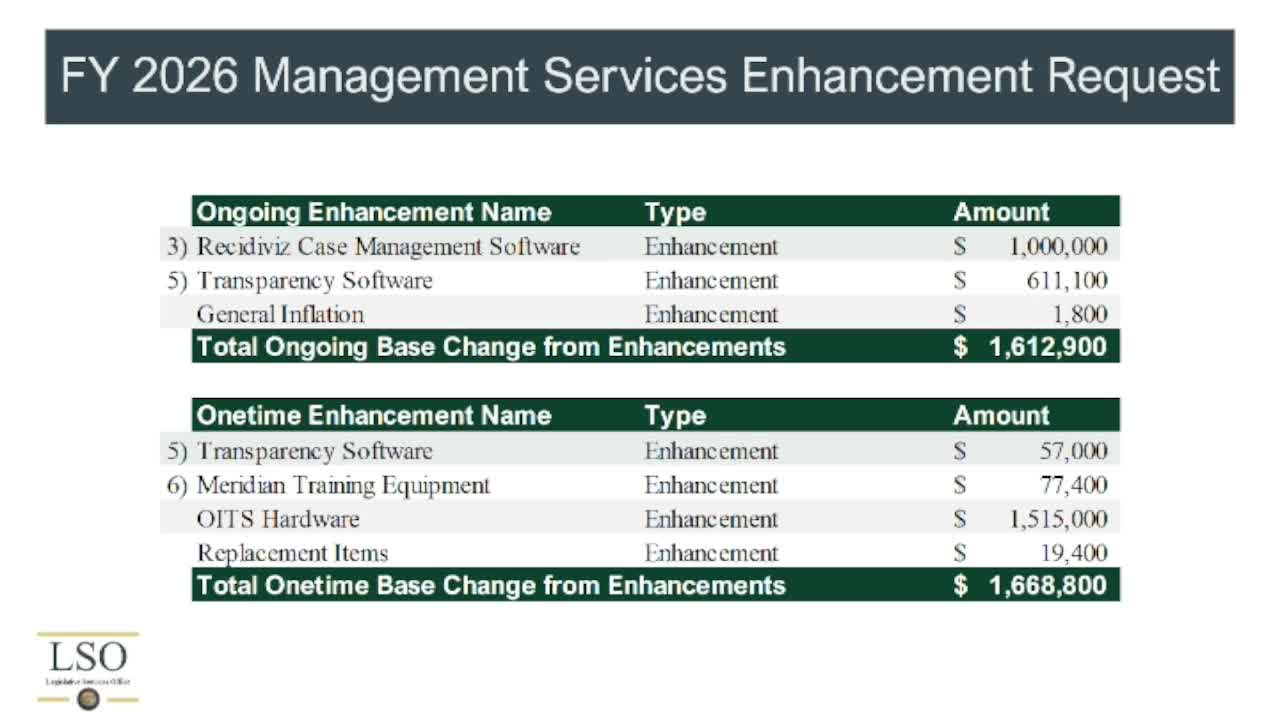
What lawmakers heard: Budget analyst Noah Peterson summarized the management services requests, including an appropriation that ‘‘gained an appropriation of $910,000 from the general fund for recidivism case management software.’’ Director Josh Tewalt described Recidiviz, the nonprofit partner, as ‘‘probably the most transformative partnership we've entered into as an agency in my entire tenure there.’’ He said Recidiviz does not merely provide ‘‘a piece of software’’ but helps identify and join data from outdated systems and produces overlays and dashboards that guide staff workload and classification decisions.
On data control and benefits: Tewalt told the committee the state controls the source data and that Recidiviz operates under data sharing agreements. ‘‘I don't have any interest in manipulating outcomes. I have interest in understanding what the outcomes are and how we can get better at the work,’’ Tewalt said, adding that Recidiviz leverages philanthropic matching so ‘‘for every dollar we spend, they match with private foundation money.’’
Subscriptions and related items: The management services division also requested $668,100 for transparency software (about $611,000 ongoing, $57,000 one‑time) to cover GovQA for public records, LexisNexis legal access ($69,700 ongoing), and an access‑to‑courts database (ATC) with a combination of ongoing and one‑time expenses. The agency asked for $77,400 one‑time for training mannequins and $1.515 million for IT replacement (about $665,000 for laptops and $850,000 for other hardware). The budget materials show prior Recidiviz appropriations of about $1.5 million in 2021 and 2023, mostly federal funds.
Lawmakers’ concerns: Committee members asked for return‑on‑investment data and whether comparable commercial products were reviewed. Peterson said hard data on ROI was not immediately available from the analyst’s table but that the agency could provide it; Tewalt said dashboards and regular visualizations could be shared. Representative Tanner and others asked whether the federal funding that launched the work will leave the state responsible for general‑fund maintenance. Tewalt acknowledged the transition and said the agency seeks federal grants for initial innovation and then will ask the legislature to scale effective pilots.
Ending: DOC officials said they will provide usage dashboards and further details on comparative alternatives and philanthropic matching to help lawmakers evaluate ongoing general‑fund commitments. No formal appropriation vote occurred at the hearing.