Get Full Government Meeting Transcripts, Videos, & Alerts Forever!
Get email alerts on the Corrections Security Operations topic
No spam. Unsubscribe anytime.
Idaho DOC seeks digital mail scanning, drone detection and a staffed transport unit after staff shootings
Summary
Following a spring ambush that left three Idaho Department of Correction staff shot, officials told a legislative committee they want to fund mail digitization, drone detection, phone‑call transcription and a permanent transport bureau to reduce emergency‑transport vulnerabilities.
The Idaho Department of Correction asked a joint finance preparations committee on Feb. 4 for new technology and staff to harden prisons and reduce the chance of another attack on staff.
Agency officials said the request stems from an incident last spring, when an inmate being escorted after emergency medical care was ambushed and three DOC staff were shot. ‘‘These supplementals and enhancements . . . are proposed by the agency to address vulnerabilities that were discovered within the agency,’’ agency analyst Noah Peterson told the committee.
Why it matters: DOC told lawmakers that the ambush exposed weaknesses in how emergency transports were handled and how contraband and outside threats reach secure facilities. The agency emphasized a mix of technology and personnel — digital mail scanning to remove a porous contraband channel, layered drone detection, phone‑call transcription/analysis and a permanently staffed, specially trained Transport Bureau for high‑risk moves.
What the agency proposed: Noah Peterson outlined the budget requests. A supplemental for fiscal 2025 asked $795,000 to begin deployment of three tools: off‑site digital mail scanning, a layered drone detection system and a phone‑call transcription/analysis product identified in the presentation as ‘‘LEO’’ intelligence software. DOC provided usage context: ‘‘In 2023, IDOC residents made 4,000,000 phone calls for a total of 49,000,000 minutes,’’ Peterson said.
DOC asked for a second supplemental of $1,148,000 to expand the Transport Bureau to handle emergency transports statewide. The request would fund 12 positions and operating costs, including seven fully equipped vehicles (six SUVs and a wheelchair van). Peterson told the committee that the 12 positions are meant to address thousands of overtime hours DOC logged while performing emergency transports under the prior ad‑hoc model.
A separate supplemental would pilot body‑worn cameras in three locations; DOC said the initial procurement would be covered mainly with federal grant funds and a modest general‑fund match. The department also asked for a one‑time capital purchase for a skid‑steer at the St. Anthony work camp ($83,200 requested), though the governor recommended contracting snow removal for $30,000 ongoing instead.
Director Josh Tewalt explained the rationale for the Transport Bureau change: ‘‘Historically we have relied on emergency transports as being . . . other duty as assigned. . . . This was a planned event where they were able to manipulate our transport and get our staff in a really vulnerable position in ways that, candidly, as their director, I do not believe they were trained to respond to.’’ He said creating a trained transport resource was more efficient than dramatically increasing facility staffing or keeping a full tactical team constantly deployed.
On contraband and surveillance, Tewalt emphasized the growing sophistication of threats: “The level of sophistication that is being deployed today to introduce contraband into correctional facilities is unlike anything any of us in the field have ever seen,” he told the committee, citing drones and altered printed material. He said digital mail scanning ‘‘completely eliminates our most porous point of entry for contraband in our facilities’’ and lets staff be redeployed to other security tasks.
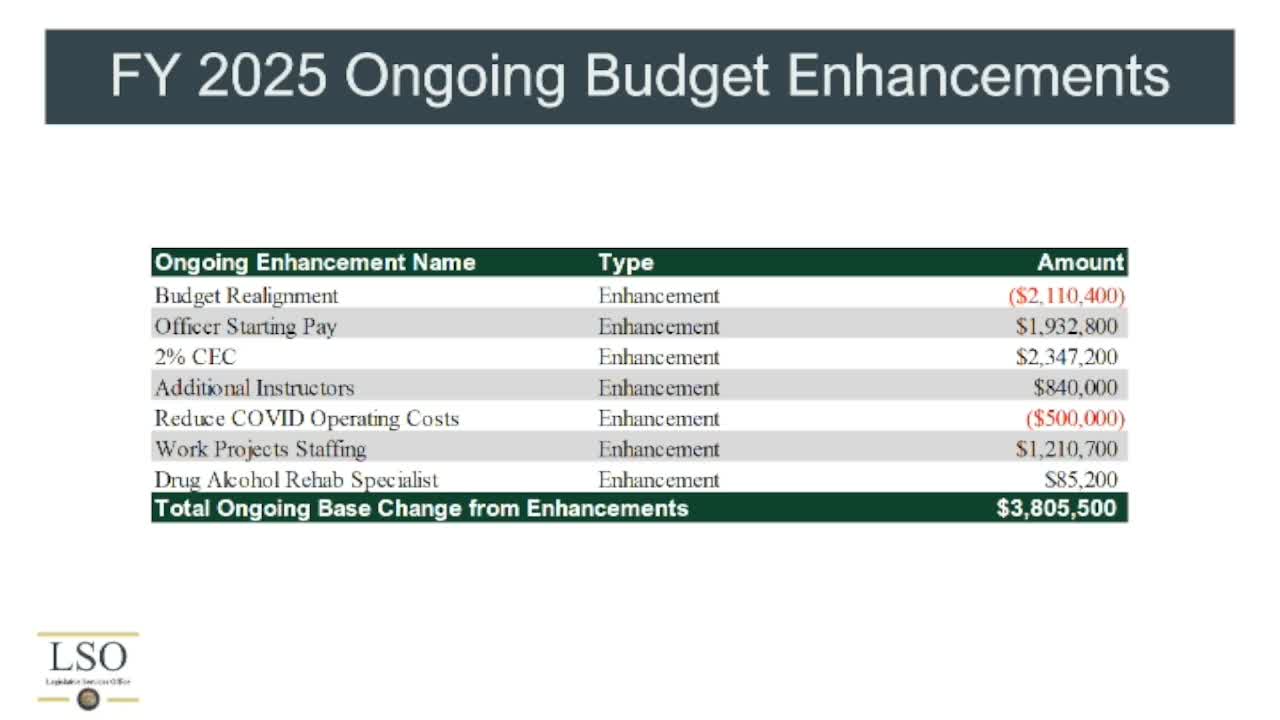
Budget context and governor’s recommendation: The LBB materials show the department asked for $2,397,000 ongoing to operate the surveillance suite (digital mail scanning $1,011,000; drone detection $385,500; phone transcription/LEO $1,000,000). The transport expansion was estimated at $965,500 ongoing (about $909,000 personnel). DOC said portions of the body‑worn camera pilot are expected to be covered by federal grants; state match costs would appear in FY2026 and FY2027 if the pilot proceeds.
Process notes and next steps: Committee members pressed for operational details and efficiency alternatives. Department of Administration staff (DFM) told lawmakers they recommended contracting winter services rather than buying a skid‑steer to avoid owning seasonal heavy equipment. Director Tewalt said DOC would provide more detail on overtime hours and the operational plan for the expanded transport unit if the committee requests it.
Ending: Lawmakers received the requests as part of the agency’s budget review; no formal votes occurred during the hearing. DOC said it will provide additional cost and implementation details to the committee on request.