Get Full Government Meeting Transcripts, Videos, & Alerts Forever!
Get email alerts on the Change Employee Compensation topic
No spam. Unsubscribe anytime.
Committee fails to adopt any CEC proposal; four compensation proposals debated and tabled
Summary
The Joint Finance‑Appropriations Committee considered four Change‑in‑Employee‑Compensation (CEC) proposals — including dollar‑amount, merit and governor‑recommended options — but did not adopt any during the Jan. 31 session and will revisit the issue later.
The Joint Finance‑Appropriations Committee spent significant time Friday, Jan. 31, debating four different Change‑in‑Employee‑Compensation (CEC) proposals but did not adopt any. Committee members argued over distribution methodology (flat dollar increase versus merit), impacts on lower‑paid workers, and whether the committee should include additional targeted adjustments for positions such as IT and engineering workers, troopers and nursing staff.
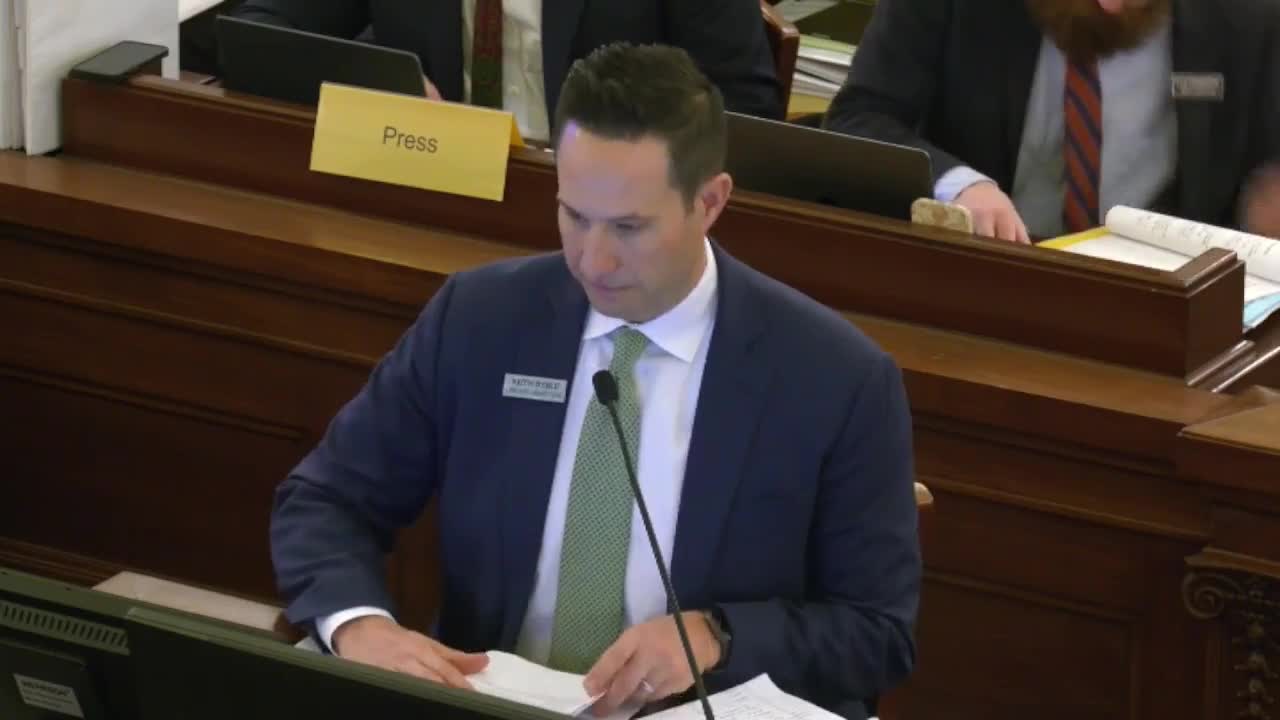
What was proposed: committee staff (Mr. Bybee) presented four distinct motions in the packet.
- Motion 1 (Representative Miller): a $1.55 per hour increase per permanent employee (state agencies and institutions), with specified allocations for community colleges and public schools and targeted adjustments; total cited in the packet $177,429,000 (funding split cited in the packet: $128,354,900 general fund; $34,266,900 dedicated funds; $14,807,200 federal funds).
- Motion 2 (Representative Furness, substitute): $1.55 per hour with a $611,500 add to guarantee a minimum 3% salary increase for all state employees (up to a salary threshold), plus the same targeted adjustments; total $178,040,500 (packet splits: $128,643,300 general; $34,527,800 dedicated; $14,869,400 federal).
- Motion 3 (Senator Cook, substitute earlier in the day): merit‑based approach providing up to 4% for state employees (or $1.55 or 4% whichever is greater in some formulations), with merit used for distribution; one version presented totaled $180,312,100 (packet splits: $129,653,700 general; $35,430,300 dedicated; $15,228,100 federal).
- Motion 4 (governor’s recommendation; Senator Wintrow read the motion from the packet): a 5% salary increase distributed on merit; packet total listed as $180,653,800, though some line items in the read‑aloud contained transcription errors and the committee declined to accept motion language not verbatim from the packet.
Debate highlights: supporters of merit‑based increases argued supervisors need tools to reward higher performance; supporters of a flat dollar bump said a guaranteed floor helps lower‑paid staff and addresses cost‑of‑living needs. Senator Cook summarized the merit argument saying a flat raise with no ability for supervisors to distinguish performance “moves toward the notion of a participation trophy.” Representative Handy cautioned that many employees self‑report high performance and that uniform treatment has administrative simplicity and equity benefits.
Procedure and votes: multiple substitute motions were put on the floor and called. In an earlier sequence, Senator Cook’s substitute (merit up to 4% variant) failed to achieve a majority in the House and was declared failed. Later in the afternoon, Representative Furness’s substitute (motion 2) was called and failed on roll call. The committee then called the original motion and it also failed. The committee recorded roll calls during those votes and, after the final tally, determined that none of the CEC motions reached the required joint majority and that members would return to the issue at a future meeting.
Why it matters: the CEC decisions determine across‑the‑board and targeted salary increases that affect state employees, educational institutions and law‑enforcement compensation lines. Committee members repeatedly said the motions are complex, that running calculations on the fly risks error, and that a later session would revisit the items with clearer language and reconciled numbers.
Votes at a glance (selected motions from the meeting record) - Motion 3 (Senator Cook; merit based / up to 4%): failed (did not achieve a majority in the House when called). - Motion 1 (Representative Miller; $1.55/hour as presented in packet): failed on roll call after substitute motions were resolved. - Motion 2 (Representative Furness; $1.55/hour plus minimum 3% up to threshold): failed on roll call. - Motion 4 (Governor’s 5% merit recommendation, as in packet): not adopted during this session; staff and members said language and downstream calculations require further work.
Next steps: the committee adjourned the CEC debate to a later date, noting several members had further obligations and that the motions’ complexity requires additional time to reconcile counts, language and downstream fiscal calculations.