Get Full Government Meeting Transcripts, Videos, & Alerts Forever!
Get email alerts on the Idaho State Liquor Division topic
No spam. Unsubscribe anytime.
Idaho State Liquor Division outlines spending requests as FY2024 distributions top $118M
Summary
The Idaho State Liquor Division told the Joint Finance‑Appropriations Committee that FY2024 distributions from liquor sales totaled about $118.3 million and outlined FY2026 requests for store upgrades, IT and security equipment, a website accessibility project, and modest increases to temporary retail staff pay.
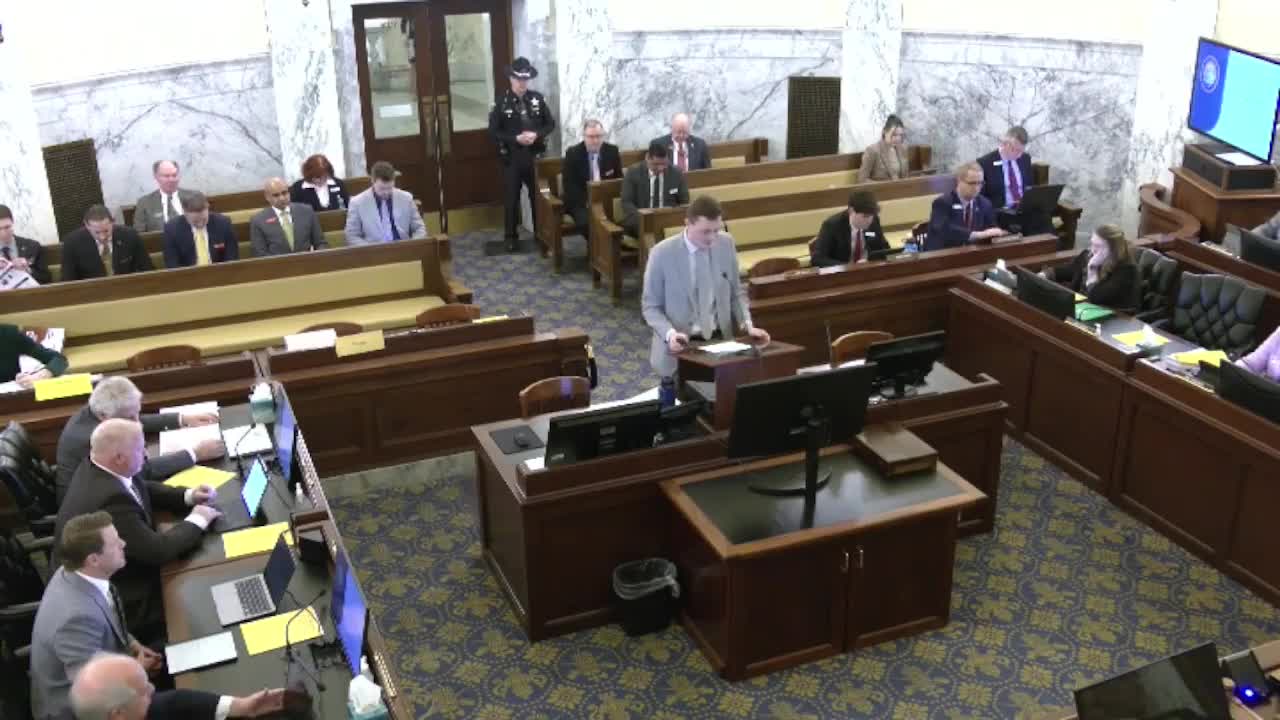
Kellen McGurkin, a budget and policy analyst with the Legislative Services Office, presented the Idaho State Liquor Division budget to the Joint Finance‑Appropriations Committee, saying the agency’s FY2024 distributions totaled about $118,300,000. McGurkin told the committee these distributions are governed by Idaho Code and the division’s statutory charter to control importation and distribution of beverage alcohol and to “responsibly optimize the net revenues to the citizens of Idaho.”
The presentation and subsequent questioning focused on how those distributions are calculated, the agency’s staffing model, and several FY2026 requests. McGurkin explained that a 2% surcharge on liquor sales goes to the court services fund (about $6.7 million in FY2024); after operating costs and fund‑balance requirements the remaining revenues are split, with roughly $56.3 million of FY2024 going to cities, counties and magistrate courts. He also described fixed and statutory sub‑distributions (including a portion to the Peace Officer Standards and Training Fund) before any remainder transfers to the general fund.
Director Andrew Arulanandam, who appeared with senior staff, said the agency operates from a mix of appropriated and continuous (dedicated) funds and that net income and accounting adjustments explain small differences between reported net income and the total statutory distribution. Director Arulanandam noted the division’s five‑year average sales totaled about $319.1 million and that net income represented about $116.6 million (roughly 36%).
Committee members pressed the division on retail staffing. Tony Grama, the division’s chief deputy and CFO, told the committee, “our temporary store clerks are state employees. We don't hire them through an agency,” and that temporary clerks are not eligible for automatic cost‑of‑living adjustments (CEC). The division described historic turnover in those temp positions — from roughly 140% per year previously to about 84% after a prior pay increase — and requested $57,400 ongoing in FY2026 to raise the temporary hourly rate from $15.00 to $15.45, plus $72,000 for shrink‑wrap equipment required by a new freight contract.
The agency outlined capital and one‑time equipment requests. Among the IT and security items, the division requested a one‑time $200,000 appropriation to purchase 70 network security firewalls and 70 managed network switches to complete a planned network modernization led by the state Office of Information Technology Services (OITS). The director said the upgrade follows a $201,000 investment in Cradlepoint routers in FY2024 and that combining routers with firewalls and managed switches would “optimize cost, functionality and security,” projecting a roughly $100,000 upfront hardware savings and an estimated $10,000 monthly reduction in operating costs versus a hardwired alternative.
The division also asked for $100,000 in dedicated funds to bring its public website into compliance with the Americans with Disabilities Act (ADA). Senator Cook questioned whether that amount was necessary, asking, “is it really going to cost a hundred grand to fix a menu or am I missing something?” Director Arulanandam replied that the agency consulted an accessibility expert who identified multiple items needing work and said the agency viewed the request as “a prudent one‑time expenditure.”
Replacement and store improvement requests include a one‑time package of $980,300 for store improvements (about $775,000) and motorized equipment and vehicles (about $205,000), plus separate IT and security replacement requests totaling $235,000. McGurkin and agency staff pointed the committee to detail pages in the Legislative Budget Book for line‑by‑line back‑up.
The director closed with a brief statement that the division sees itself as a revenue‑generating agency with many front‑line employees who serve as ambassadors to the state and expressed appreciation for the committee’s questions.
Questions and clarifications from committee members focused on turnover in temporary clerk positions, the mechanics of contract liquor stores (which the division supplies but which pay their own employees under contract terms), the composition of the division’s FTP cap (257.25 authorized FTP, with a reported filled rate near 93% and significant part‑time clerks not included in the FTP count), and the operating-versus‑distribution split in agency revenues.