Get Full Government Meeting Transcripts, Videos, & Alerts Forever!
Get email alerts on the Juvenile Justice Miranda topic
No spam. Unsubscribe anytime.
Appeals court weighs whether police questioning of 17-year-old required Miranda and an interested adult
Summary
The court heard argument over whether two stationhouse interviews of a 17-year-old after a shooting were custodial and whether the second interview was tainted by the first; parties disputed waiver and the presence of an interested adult.
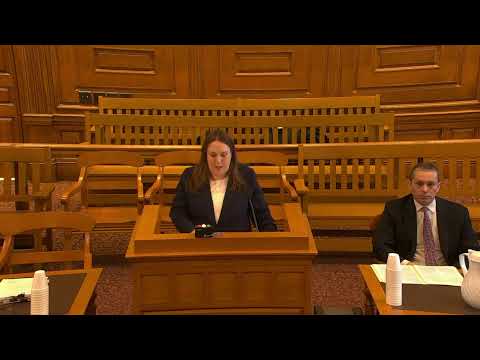
The Massachusetts Appeals Court heard argument in an appeal of a suppression ruling in Commonwealth v. Juvenile (docket 23P1458), focused on whether police violated Miranda and related protections for a 17-year-old who was questioned after a shooting.
Michelle Minkin, representing the juvenile, told the panel that both recorded interviews should be suppressed because the first was a custodial interrogation conducted without an interested adult or Miranda warnings and the second interview'despite a Miranda form and the mother's presence'was not sufficiently attenuated from the first.
Minkin described the scene: a nighttime shooting in which the juvenile'who had called 911'had a friend in the driver's seat shot in the head. She argued the police knew early that a gun had been in the car and that knowledge transformed questioning from "humanitarian" to custodial and investigative. She said the juvenile was 17, traumatized, taken by uniformed officers to the station, photographed and placed in repeated controlled interviews. Minkin argued that any incriminating statements in the second interview flowed from the first interview'a coercive environment lacking Miranda protections and an appropriate adult.
Assistant District Attorney Jacqueline Martinelli, arguing for the Commonwealth, urged the court to affirm the trial judge's denial of the suppression motion. Martinelli said the first interaction was noncustodial and investigatory in an emergency; the juvenile was a 911 caller and a possible victim eyewitness. The Commonwealth also argued the second interview included a knowingly executed Miranda waiver with the mother present and that an hour-plus break and the different subject matter of the second interview dissipated any taint.
The panel questioned counsel about the custody analysis for a juvenile in an emergency, whether police should delay initial identification questions until an adult arrives, and whether the silence and later answers constituted an implied waiver. Counsel debated case law on interrogation, the functional equivalent test and the standard for attenuation after a break.
The oral argument concluded with the court noting the matter was submitted to the panel. The transcript records that the motion judge had denied suppression; the parties debated preservation and standards of appellate review during argument.