Get Full Government Meeting Transcripts, Videos, & Alerts Forever!
Get email alerts on the Criminal Law Oui Per Se topic
No spam. Unsubscribe anytime.
Appeals court hears challenge to Massachusetts—OUI per-se 0.08 rule
Summary
Attorneys argued whether the 2003 statutory amendment that treats a 0.08 blood-alcohol reading as a separate theory of conviction under the OUI law undermines the prosecution's burden to prove impairment beyond a reasonable doubt.
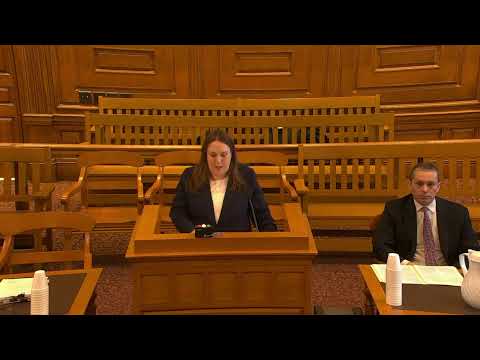
The Massachusetts Appeals Court heard oral argument in Commonwealth v. Saban Saqib (docket 24P0154) over whether the state's OUI statute and post-2003 amendments permit conviction based solely on a blood-alcohol concentration of 0.08 percent.
Scott Martin, counsel for the defendant, told the three-judge panel that the statute's per-se 0.08 theory effectively lowers the Commonwealth's burden of proof in criminal trials and should be treated as a civil regulatory limit rather than a separate criminal theory. "We're not arguing that it cannot be regulated," Martin said, "but it's more appropriately regulated as a civil regulatory scheme."
Catherine Jansen, arguing for the Commonwealth, said the Legislature reasonably set 0.08 as a threshold level and that Culturi and related precedent support the statute as written. Jansen told the court that the Legislature had access to expert testimony when it adopted the amendment and that the per-se reading is a rational policy to reduce the risk to public safety.
The defense urged that the amendment allows a "second bite at the apple" for prosecutors who fail to prove impairment beyond a reasonable doubt on the impairment theory, framing the 0.08 theory as one that can nullify a jury verdict. Martin argued that using 0.08 as a per-se criminal basis circumvents the jury's fact-finding role: "To legislate that away, alleviates the prosecution of a necessary burden of establishing with real facts and real evidence at a trial."
The panel repeatedly asked whether the issue was one for the Legislature or the courts to decide, and whether existing Supreme Judicial Court precedent (discussed in argument as "Hebb," "Culturi," and related authorities) forecloses the defense's claim. The justices also queried the appropriate standard of appellate review for constitutional and preserved/unpreserved claims raised in the briefing.
The argument concluded with the court taking the matter under advisement; the clerk announced the case "stands submitted." The transcript does not record a ruling.
If the Appeals Court were to endorse the defense view it could narrow the Commonwealth's ability to rely on per-se BAC evidence in OUI prosecutions; if it affirms existing precedent, the per-se theory will remain a separate pathway for criminal charges even when juries acquit on impairment.