Get Full Government Meeting Transcripts, Videos, & Alerts Forever!
Get email alerts on the State Police Expenses topic
No spam. Unsubscribe anytime.
State police tell Joint Budget Committee taxpayer funds can cover governor protection, confirm 40 troopers sent to D.C. inauguration
Summary
Arkansas State Police officials told the Joint Budget Committee the state pays for executive protection details in some cases and confirmed the agency sent 40 troopers to Washington, D.C., last year for the presidential inauguration; the department said most costs for that deployment will be reimbursed by the federal government.
Arkansas State Police officials told the Joint Budget Committee that state taxpayer dollars do pay for the governor’s executive protection detail in certain circumstances and that the agency sent 40 troopers to Washington, D.C., last year for the presidential inauguration.
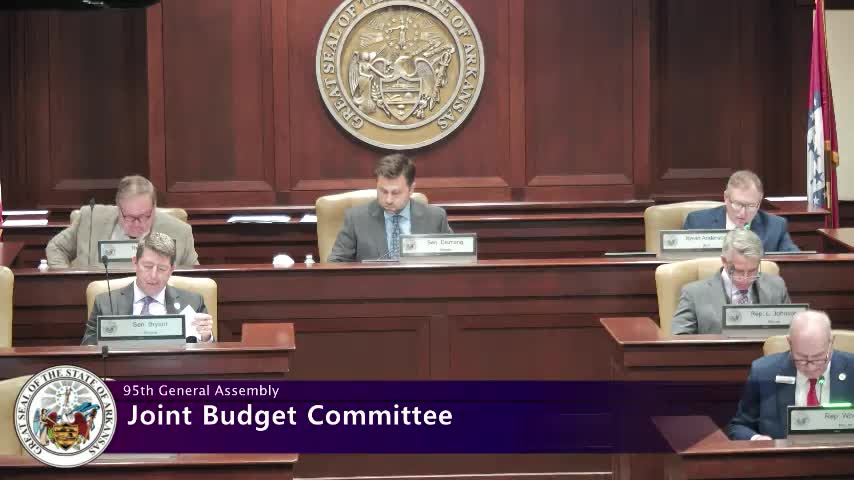
The committee heard the Department of Public Safety’s executive protection report as item B3. Mike Hager, secretary of the Department of Public Safety and director of state police, and Karen Perry, the department’s chief financial officer, answered questions from senators and representatives about trip costs and reimbursements. Hager said he could not provide an average historic cost without further analysis but confirmed that “taxpayer dollars pay for the protection detail.”
Hager also described a deployment of 40 state troopers to support the inauguration in Washington, D.C. The agency said the deployment predated knowledge of which candidates would win and was in response to a federal request for assistance; the troopers were deputized by the U.S. Marshals Service and the deployment was reimbursed by the federal government. “We agreed to send those 40 troopers, which are reimbursed by the federal government,” Hager said.
Committee members asked about reimbursement and overtime. Hager said the “overwhelming share” of costs will be reimbursed, but the state may incur some limited costs, such as overtime and equipment transport; one example given was that some troopers drove to move equipment rather than fly, which could create a small state cost. He said the agency has budgeted for routine fluctuations and did not expect to request supplemental appropriation for those costs.
Other items discussed: November payroll was higher than a typical month due to an extra pay period; the department attributed one month’s higher expense in part to three pay periods and to overtime and fringe for salaries.
The committee recorded B3 as reviewed; no appropriation or policy change was adopted during the meeting.
Ending: Committee members thanked the troopers who deployed and requested any additional cost breakdowns be handled offline or in follow-up submissions.