Get Full Government Meeting Transcripts, Videos, & Alerts Forever!
Get email alerts on the State Parks Budgeting topic
No spam. Unsubscribe anytime.
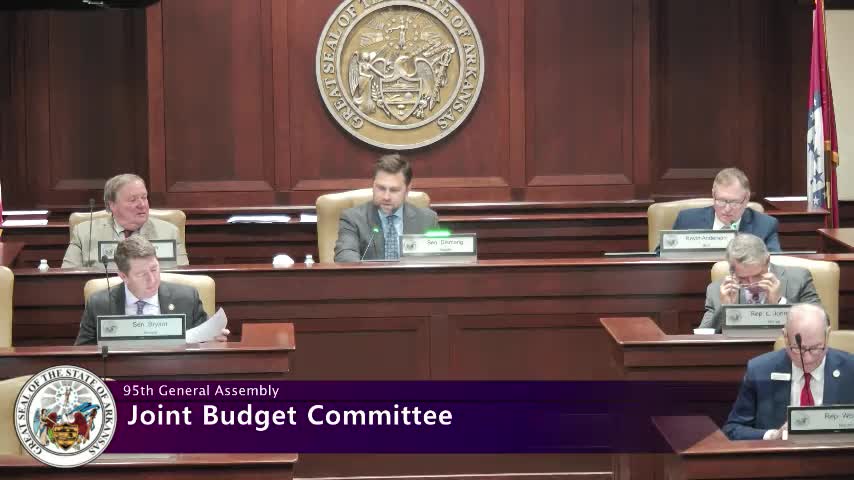
Joint Budget Committee reviews Arkansas State Parks allocations, hears staffing and maintenance explanations
Summary
The Joint Budget Committee reviewed the Department of Parks, Heritage and Tourism’s park-by-park allocation report and heard officials say gaps in reported general revenue reflect alternate funding sources and vacant positions are driving under‑spending in some park budgets.
The Joint Budget Committee reviewed a Department of Parks, Heritage and Tourism report showing park-by-park allocations and heard officials explain why several parks showed no general‑revenue allocations and why many parks are underspending against budgets.
Committee members questioned why the Arkansas Museum of Natural Resources and several smaller sites showed no amounts in the report. Marty Rao, director of legislative affairs for the Department of Parks, Heritage and Tourism, and Mike Wilson, assistant director of Arkansas State Parks, said the document presented to the committee reflects general‑revenue use only and does not include money from Amendment 75 (the state’s conservation tax) or other dedicated conservation funding. “The report reflects general revenue use only, not amendment 75 or our conservation tax,” Wilson said.
Why it matters: the appearance of zeros in the committee packet prompted members to ask whether sites had been defunded. Department officials said in many cases operations are supported by other revenue streams or by maintenance performed by neighboring parks rather than by a dedicated staff at the smaller site.
Committee members also pressed park officials about personnel shortfalls. Wilson told the committee the agency is having difficulty filling positions, particularly in remote areas, and said that vacancies are the primary reason some parks’ expenditures are under budget. He gave the committee an example of a park superintendent position that took about nine months to refill. Committee members requested follow‑up data on long‑term vacancies.
The committee recorded that some small features — cited in the packet as Conway Cemetery, Poison Springs, White Oak and Woodrow Springs — are maintained by neighboring state parks rather than staffed as independent units. Rao said those sites do not have full‑time personnel and receive maintenance support from nearby parks.
There was no action requested or taken on the allocation report; the committee marked the item as reviewed.
What the committee asked to follow up: members requested (a) clarity on which parks’ budgets are paid from dedicated conservation funding versus general revenue, and (b) a count or list of positions vacant longer than two years (Wilson said he would “get back with you on that number”).
Ending: The committee moved to the next agenda item after noting the report was for review only and that parks officials were available to answer follow‑up questions.