Get Full Government Meeting Transcripts, Videos, & Alerts Forever!
Get email alerts on the Military Division Hazmat Communications topic
No spam. Unsubscribe anytime.
Military Division asks JFAC for hazmat equipment, public safety communications upgrades and vehicle backlog relief
Summary
The Idaho Military Division told Joint Finance Appropriations Committee members it needs $8.6 million to equip regional hazmat teams, supplemental funds and IT infrastructure to modernize public safety communications and to clear a backlog of vehicle installations for Idaho State Police vehicles.
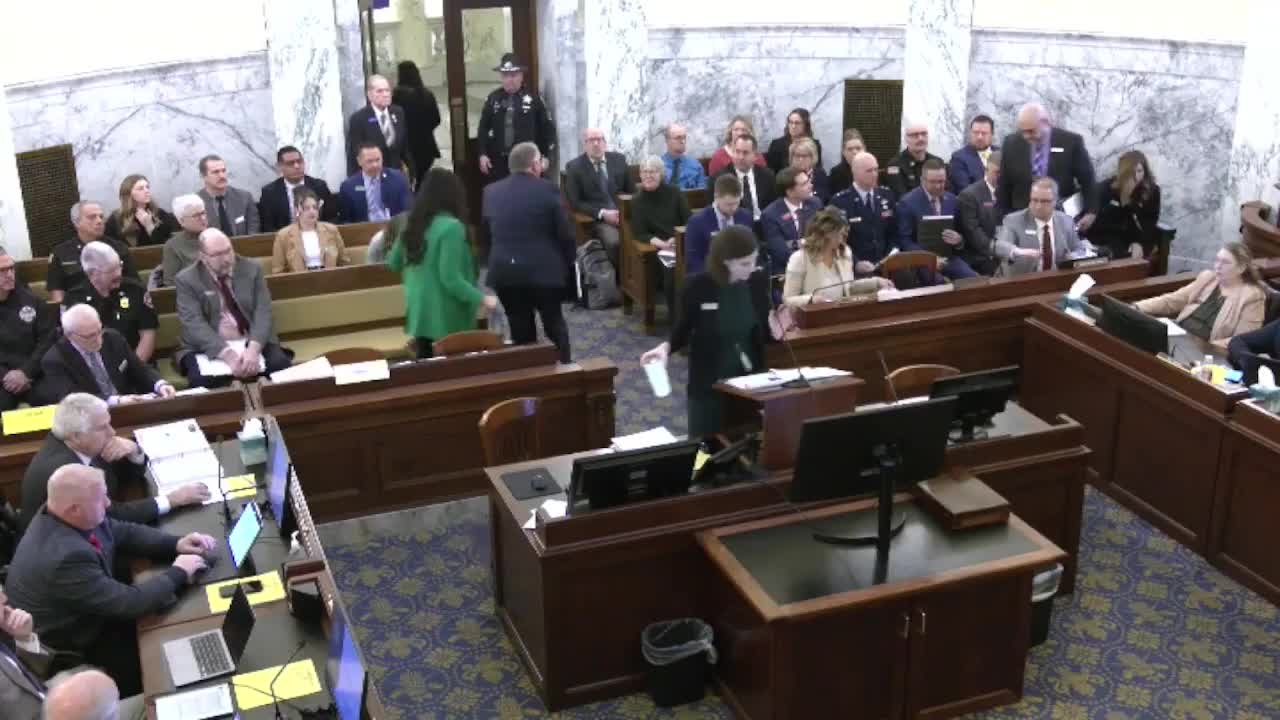
The Idaho Military Division requested supplemental and enhancement funding at a Joint Finance Appropriations Committee hearing focused on fiscal year 2026 needs, including an $8.6 million cash transfer to support regional hazardous materials response teams, upgrades to public safety communications and funding to reduce a vehicle communications backlog.
Frances Lippett, budget and policy analyst for the Legislative Services Office, reviewed the division’s appropriations history and highlighted the governor’s recommendations: a supplemental to install communications equipment on 40 Dodge Durango vehicles owned by the Idaho State Police, $759,200 for IT infrastructure and licensing to allow public safety communications to build an independent network, and $8.6 million to distribute to regional hazmat teams through a cash transfer from the state emergency relief fund.
Major General Tim Donnellan, the adjutant general and commander of the Idaho National Guard, told the committee the state’s hazmat equipment inventory has not been updated since about 2005 and described seven regional teams that respond to incidents across the state. “We have not updated our hazardous response equipment since 02/2005,” Donnellan said, and he told the committee the requested funds would modernize equipment and be procured and distributed through the Idaho Office of Emergency Management.
Donellan also explained that a part of the supplemental addresses a backlog of vehicles delivered without required communications packages. He said the backlog reflects nationwide supply‑chain issues and a recent surge of vehicles once computer chips became available. For the vehicle work he described two components: a private contract estimated at $240,000 to clear the immediate backlog and $300,000 for construction to add installation bays and prevent future backlogs.
Representative Petzke asked why the governor recommended the $8.6 million transfer instead of the division requesting the funding in its base budget; Donnellan said the division had not requested the full amount originally because the sum would have exceeded the 3% cap on enhancements and that the governor submitted it as a supplemental to address urgent public‑safety needs.
The division also described a $34,200 deficiency warrant request tied to hazardous substance response costs it could not recoup from incident originators and asked for funding to replace aging cybersecurity and public‑safety communications hardware. Lippett noted a prior federal Infrastructure Investment and Jobs Act award provided funding for cybersecurity work and a proposed shift in FY2026 from federal to dedicated funds to hire a network administrator for public safety communications.
Senator Cook and others questioned timing and execution; Donnellan said the division expects to be able to execute the vehicle and IT work quickly and that expanding installation capacity will allow parallel work and reduce future delays. On hazmat composition, Donnellan said seven regional teams are tied to area fire departments and that teams handle incidents ranging from small chemical spills and meth lab cleanups to large propane spills.
The committee asked for additional detail on execution timing and capital work; no final appropriations were made during the hearing.
The military division emphasized that requested supplemental and enhancement funding supports first responders and regional readiness and that authority for continuous hazardous substance response funds and deficiency warrants exist when incident costs cannot be recouped from responsible parties.