Get Full Government Meeting Transcripts, Videos, & Alerts Forever!
Get email alerts on the Education Policy topic
No spam. Unsubscribe anytime.
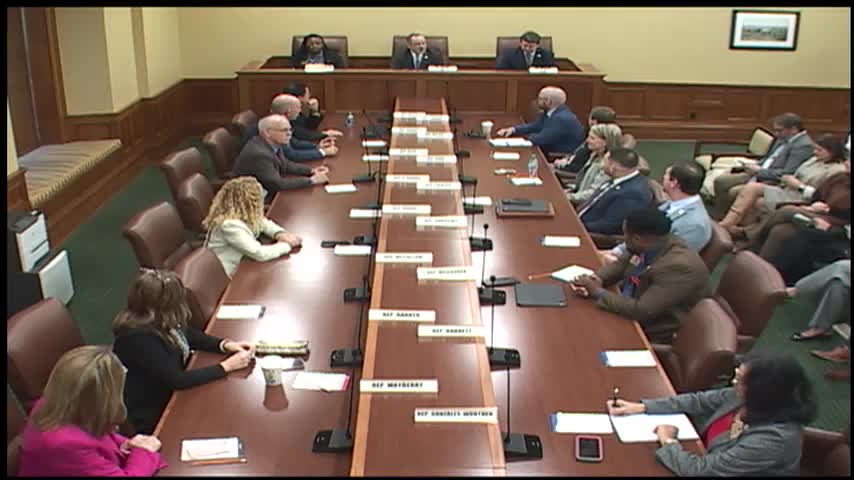
Ark. House Education Committee opens organizational session; secretary previews Arkansas Learns implementation
Summary
The House Education Committee met for an organizational session that included committee housekeeping, scheduling and a presentation from Jacob Alleva, secretary of the Arkansas Department of Education, on implementation of the 2023 Arkansas Learns Act.
LITTLE ROCK, Ark. — The House Education Committee met for an organizational session that included committee housekeeping, scheduling and a presentation from Jacob Alleva, secretary of the Arkansas Department of Education, on implementation of the 2023 Arkansas Learns Act.
The committee’s chair, Chair Brooks, opened with procedural guidance for members, including regular Tuesday and Thursday meetings at 10 a.m., a committee photograph scheduled for Jan. 23 at 9:45 a.m., and a reminder that fiscal‑impact statements are required for K‑12 education legislation and certain scholarship measures funded from lottery proceeds or higher‑education grant funds. “We will meet every single month” during the adequacy process, Brooks said, noting the time commitment for committee members outside regular session.
Why it matters: Secretary Alleva told the committee that the Arkansas Learns Act represents a comprehensive, cradle‑to‑career effort signed into law in March 2023 and that the state is already seeing initial implementation steps. He described work on a new statewide assessment, expanded early learning and teacher pay adjustments, and efforts to simplify college credit transfer and expand short‑term credentialing to improve economic mobility.
Alleva said the state has implemented ATLAS, the Arkansas Teaching, Learning and Assessment System, and is building a coordinated progress‑monitoring system intended to give teachers real‑time student performance data. “We started laying the foundation to build more pathways for students through career and technical education,” Alleva said.
Committee operations and expectations were a focus. Chair Brooks and Vice Chair Bridal McKenzie reviewed decorum and logistics: members should route questions through committee staff, submit written amendments in advance, and expect bills to carry fiscal impacts. Brooks said staff members Kristen Washington (committee analyst), Riley Sewell (administrative assistant) and Taylor Lloyd (BLR attorney) would support the committee’s workflow. He also encouraged members to consult department staff Courtney Salasfor and Greg Rogers on legal and fiscal issues.
On policy priorities, Alleva highlighted three main goals for students leaving high school: “ready to be enlisted, ready to be employed or ready to be enrolled,” and emphasized tailoring pathways beyond a single degree track. He discussed possible state funding model changes to support colleges and non‑degree credential programs, and said the department is exploring ways to simplify credit transfers and applications.
Alleva and staff noted several specific priorities that the department will bring to the committee: expanding access to universal breakfast programs; supporting teacher training and professional development tied to student achievement; and examining school policies on student access to cell phones, which the department has heard many districts view as classroom distractors. “There’s a harsh reality … our students are lagging behind the nation in reading and math at those very key metrics,” Alleva said.
Arkansas State University Assistant President Dr. Bridal Kelly, who introduced himself after arriving from Malvern, told the committee ASU intends to be a strategic partner in workforce and economic development across the state.
The session included introductions of department and higher‑education officials: Sarah Kemeny (education policy consultant, governor’s office), Stacy Smith (deputy commissioner, Department of Education), Dr. Ken Warden (commissioner of higher education) and Greg Rogers (chief financial officer, Department of Education).
No formal votes or motions were taken during the meeting. The committee adjourned after members heard the department’s overview and brief introductions.
Members who want to testify at future hearings were reminded to sign the public testimony sheet outside the meeting room; the chair said the committee will hear every person who signs up.
Ending: Chair Brooks closed by urging members to engage with local superintendents, principals and teachers as the committee proceeds with adequacy work and implementation oversight: “When we include local voice, we get it right,” Alleva said. The committee will meet again in its regular schedule to begin consideration of bills and fiscal analyses.