Get Full Government Meeting Transcripts, Videos, & Alerts Forever!
Get email alerts on the Education Finance topic
No spam. Unsubscribe anytime.
Minnesota school leaders warn cuts to nonpublic pupil aid, transportation would hit low‑income and special‑needs students
Summary
Principals and heads of Catholic, Lutheran and independent schools testified to the Senate Education Finance Committee that proposed elimination of nonpublic pupil aid and transportation funding would force cuts to nurses, counselors, textbooks and bus service and could push low‑income and special‑needs students out of their schools.
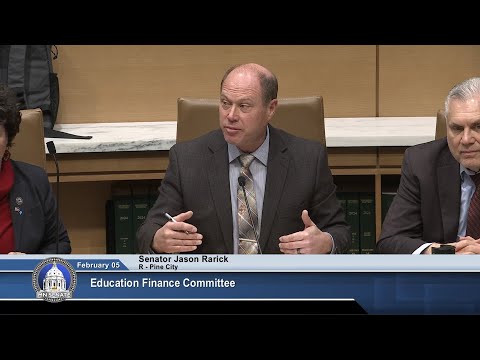
Meg Forgette, associate director for the Archdiocese of Saint Paul and Minneapolis Office for Catholic Education, and more than a dozen leaders of Catholic, Lutheran and independent schools told the Senate Education Finance Committee on Feb. 5 that Governor Tim Walz’s proposed budget cut of nonpublic pupil aid and transportation funding would remove critical services from students who do not attend public schools.
Those services include part‑time nurses, counseling, textbooks and bus transportation that many schools said are essential for low‑income families, students with disabilities and English learners to attend and succeed in their chosen schools. “Please do not allow the governor’s budget to discriminate against non‑public students and their families,” Meg Forgette said, identifying herself as associate director for the Archdiocese of Saint Paul and Minneapolis Office for Catholic Education.
The testimony came at a public hearing of the Senate Education Finance Committee where school leaders from the Twin Cities metro area and greater Minnesota described how state aid covers nursing and counseling hours, provides transportation for families without cars and pays for textbooks and learning materials used by students in nonpublic schools. They argued the supports are matched in many places by local public school staff who provide the services under contract or partnership.
“Bus transportation is essential for all students to learn,” said Andrew Hillacre, president of Stella Maris Academy in Duluth, describing a family whose military deployment left them unable to drive their children to school until they learned bus service was available. Tricia Manshuber, principal of Saint John Paul II Catholic School in Northeast Minneapolis, said her school’s state‑funded nurse is on site roughly three hours a week and that a guidance counselor’s four hours a week for middle graders is critical to students’ academic progress. “We only have one to two sections of each grade, so teachers need to differentiate to help each scholar make growth,” Manshuber said.
Speakers gave multiple examples of students served by those dollars: a Duluth child with cerebral palsy supported by a nurse and an IEP team; an urban school that provides internships and supports for first‑generation college students; a school that relies on state textbook aid to buy consumables used under the Minnesota Read Act; and specialized programs that use state funds to buy curricula designed for students with dyslexia or other learning differences. Several speakers noted that nonpublic schools enroll many students from low‑income families and that eliminating the aid would hit those families hardest.
Testimony included data points offered by witnesses: the Archdiocese’s system serves more than 30,000 students; Hope Academy serves 700 students and operates 15 buses; Groves Academy reports that 61% of new students arrive with an IEP and that many return to public schools after remediation; and statewide figures cited by Tim Benz, president of MN Independent (an advocacy organization), that about 460 nonpublic schools educate roughly 73,000 students. Witnesses also cited historical statutory commitments: some testimony referenced Minnesota statute 123B.40 and the state’s 1975 commitment to aiding nonpublic pupils.
Committee members asked about budgets, cost‑sharing and federal funding. Witnesses said nonpublic schools also receive some federal equitable‑services funds under the Elementary and Secondary Education Act (Title I–IV) and special‑education services under the Individuals with Disabilities Education Act, but that those federal dollars do not replace state transportation funding and often do not cover the same scope of services. Several speakers urged lawmakers to preserve the state aid or expand counseling eligibility to younger grades.
No formal action or vote occurred during the hearing. Committee chairs and members closed by noting the complexity of funding education across sectors and by asking staff and witnesses to continue supplying detail to help lawmakers weigh the fiscal and policy tradeoffs.
The testimony illustrates the stakes for families who choose nonpublic schools: officials said eliminating these targeted aids would likely force reductions in nursing and counseling hours, cut bus routes, reduce access to specialized curricula and shift those costs onto families or local schools.