Get Full Government Meeting Transcripts, Videos, & Alerts Forever!
Get email alerts on the Collective Bargaining topic
No spam. Unsubscribe anytime.
Senate approves bill to allow collective bargaining for most state and local public employees
Summary
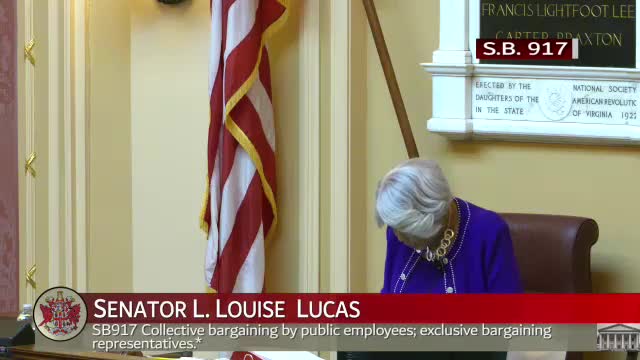
The Virginia Senate voted 20-19 to approve SB 9 17, creating a new public employee collective bargaining framework that allows local and state workers to form exclusive representatives, sets out bargaining units and procedures, and prohibits strikes.
The Virginia Senate approved SB 9 17 on Tuesday, voting 20-19 to create a statewide framework allowing collective bargaining for state and local public employees.
The bill, carried on the floor by Senator Serval (Eastern Fairfax), authorizes a new public-employee bargaining structure that defines 17 potential bargaining units, sets rules for representation elections, requires employers to bargain in good faith, establishes an impasse process, and creates a public-employee board to oversee disputes. The bill specifically prohibits strikes and bars employer lockouts. Firefighters have a separate arbitration process and existing agreements are grandfathered.
Supporters argued the change would give public workers a stronger voice over working conditions and retention. “Our public servants are the backbone of our community,” Serval said on the floor, and he cited a census estimate that roughly 750,000 state and local employees work in Virginia, of whom about 58,000 currently participate in collective bargaining under local options.
Opponents raised questions about scope and fiscal impact, pressing the sponsor on an inclusion in the bill for consumer-directed care services funded by the Commonwealth Coordinated Care program. Senator Head asked whether the bill would make privately hired, consumer-directed caregivers employees of the Commonwealth if they gained collective bargaining rights. Serval replied the bill as drafted would not make those caregivers state employees but would allow those caregivers who are paid under the commonwealth’s programs to bargain over wages and benefits the commonwealth funds.
Senator McDougall and others warned that allowing those providers to bargain with the commonwealth without carefully calibrated funding could create budget pressure; one senator estimated industry concerns that expanded coverage could cost hundreds of millions of dollars annually if reimbursement rates were increased across the board.
The bill contains multiple exemptions (elected officials, certain confidential or managerial staff, judicial branch employees and some behavioral health workers) and includes a prohibition on strikes to address public-safety concerns. Supporters said firefighters’ negotiated protections were preserved through a separate arbitration track the bill includes.
Action: The Senate recorded a roll-call vote on the motion to pass SB 9 17. The tally was 20 yes, 19 no; the motion passed and the bill was reported as passed to the next stage.
Ending: The measure now proceeds through the legislative process; senators signaled during floor remarks that further refinement could be expected as the bill moves to conference or the other chamber.