Get Full Government Meeting Transcripts, Videos, & Alerts Forever!
Get email alerts on the Resiliency Centers topic
No spam. Unsubscribe anytime.
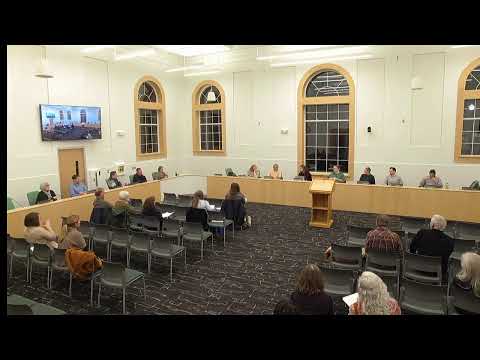
Residents urge Bowling Green to design new fire stations and police building as resiliency centers
Summary
Speakers at a Bowling Green City Council meeting urged the council to require tornado shelters, backup power, floodproofing and other resiliency features in planned new fire stations and a police building renovation; the mayor said designs are in early stages and the city currently relies on county emergency agreements for mass sheltering.
Two residents told the Bowling Green City Council during public comment that new public safety facilities should be designed to operate as resiliency centers capable of sheltering residents and supporting emergency response.
Jim Evans, one of the authors of the Bowling Green Climate Action and Resiliency Improvement Plan, told the council the city’s planned new fire stations and the police building renovation should include energy-efficiency upgrades and features to serve as tornado shelters and resiliency centers. "These buildings should have safe rooms that are structurally competent to act as tornado shelters protecting critical first responders," Evans said. He listed measures such as reflective roofs, high-efficiency HVAC, improved insulation, electric-vehicle rechargers, native landscaping, water recycling, backup power and redundant communications.
The plan Evans described would also require buildings to be able to store and distribute food and water, provide basic medical care, and have floodproofing measures including raising utilities above projected flood elevations, installing flood shields and bulkhead doors, and adding sump pumps. Evans warned Bowling Green’s vulnerability to tornadoes and recommended locating at least one new fire station off the historical west‑to‑east tornado axis on Wooster Street and not adjacent to railroad tracks or I‑75 because of hazardous‑materials spill risks.
Caitlin Elliott, speaking on behalf of the BG Climate Action Network, urged the council’s Transportation and Safety Committee or the council’s Sustainability Committee to study including resiliency‑center features "before planning progresses." "The time for action is now," Elliott said, adding it is more cost‑effective to design facilities now than retrofit later.
Mayor (name not specified) replied that the city is in the early stages of designing the facilities and is not currently "programming either one of those new facilities to function" as formal resiliency centers. He said several sustainable design components and tornado shelters have been discussed and "are currently being programmed into those buildings," but expressed concern that the buildings may not have enough square footage to accommodate large numbers of people. The mayor noted existing agreements with the county emergency management agency to use the community center for mass sheltering and said the city has used that facility in prior evacuations.
No council motion or formal direction to staff to add resiliency‑center requirements was recorded during the meeting. Both speakers asked that the issue be studied by council committee; the transcript records the request but not a committee referral or formal vote.