Get Full Government Meeting Transcripts, Videos, & Alerts Forever!
Get email alerts on the Food Truck Fees topic
No spam. Unsubscribe anytime.
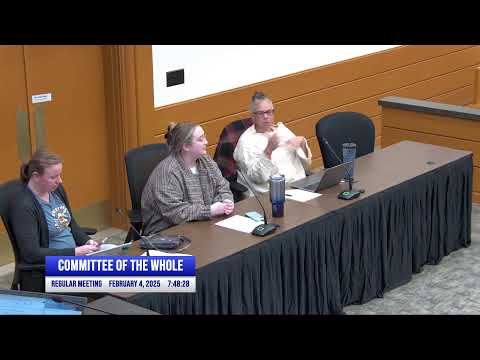
Council members question sharp increase in mobile food truck permit fee; request legal and process review
Summary
Committee members raised concerns after the Board of Health increased the mobile food truck permit fee to $300—council members requested the fee-analysis spreadsheet and asked staff and law department to clarify which fees fall under council authority vs. the health board's state-approved process.
Members of the Committee of the Whole raised concerns about a recent Board of Health change that increased the fee for a mobile food truck permit to $300. Committee members said, based on their preliminary research, that $300 would be among the highest mobile-food permit fees in the state and is substantially higher than recent charges in neighboring jurisdictions.
Committee members explained they view the increase as significant for food-service operators, whose profit margins are typically narrow. Members requested clarification of the Board of Health’s process: an email shared in the meeting said the health board is required to complete a state-provided cost-analysis spreadsheet, submit it to the state for approval, and notify licensees of proposed fees with an opportunity for a public hearing; the email said no licensees attended the public hearing in this instance and the board adopted the calculated fees after the third reading.
Council members said they would seek the underlying cost-analysis spreadsheet and asked the law department and the health board to confirm whether the notices were sent in languages other than English. Several members proposed inviting a health-board representative and food-truck vendors to a future small-business committee meeting to review the spreadsheet, explain the calculation, and discuss whether the city should pursue any legislative or budgetary responses.
Committee members discussed enforcement and oversight distinctions: the council has previously set fees by ordinance in other areas (for example, a chicken-keeping ordinance was noted as an instance where council wrote a controlling ordinance and set fees), but members said the Board of Health operates within state regulatory rules that can include a state review of fee calculations. Members asked staff to check with the law department (named in the meeting as Keith) about the legal limits of council oversight and to prepare options for the small-business committee. No formal vote or ordinance was introduced during the committee discussion.
Clarifying details and next steps recorded during the meeting include a request from council for the Board of Health cost-analysis spreadsheet, outreach to food-truck vendors and the Food Truck Association for input, and a plan to schedule a small-business committee discussion that would include health-board representatives and vendors. Council members emphasized the need to confirm whether notices were delivered in Spanish or other languages to affected licensees.
The committee also discussed policy options that would be within council control if legal review shows authority to act—for example, targeted fee relief or offsets for small businesses—while noting council should avoid actions that cannot be enforced or that would conflict with statutory requirements.