Get Full Government Meeting Transcripts, Videos, & Alerts Forever!
Get email alerts on the County Finance Tax Revenue topic
No spam. Unsubscribe anytime.
Will County finance staff review sales, motor-fuel and cannabis tax receipts; PPRT decline noted
Summary
At a Will County Finance Committee meeting staff explained recent sales-tax receipts, county-option motor-fuel tax rates, declines in personal property replacement tax (PPRT) receipts and the county's cannabis-tax collections and restrictions.
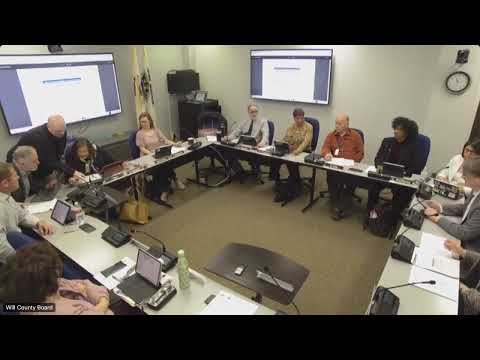
At a Finance Committee meeting of the Will County Board, finance staff summarized several tax and revenue streams and answered members' questions about timing and account treatment.
Finance staff member Karen (treasury/finance staff) described the packet of tax reports and explained that the document compares collections for selected sales taxes through Nov. 30 against budget. Karen said the corporate fund is the statutory fund that covers elected-official operations and that other tax receipts are recorded in special-revenue funds because their revenues are restricted to specific uses. "The other funds that we have are considered special revenue funds. They're segregated because their revenue is restricted," Karen said.
The report noted a drop in the county's personal property replacement tax (PPRT). Karen said the budget had assumed 8.9 million but the county received about $8.2 million the prior fiscal year and that this year the county saw a substantial cut. She explained how PPRT revenue is first used to cover FICA and IMRF special-revenue obligations; after those needs are met, the remainder is swept into the corporate fund.
On motor-fuel tax, Karen explained that Will County has a county-option motor-fuel tax (MFT) that increases annually with the Consumer Price Index. "July 1 every year, the county option MFT increases with the CPI. And so right now, we are sitting at 4.9' a gallon. It was 4.7' a gallon July 1 of '23," she said, and compared Will County's rate with neighboring counties: DuPage 9.4', Kane 4.9', Lake 4.7', and McHenry 8.3' per gallon.
Karen also explained the cannabis-tax collections. She said the county receives two types of cannabis sales tax: a state distribution and a county-option tax. Through November the committee packet showed roughly $1,300,000 collected to date that fiscal year: about $164,000 came via the state distribution and roughly $1,200,000 was the county option. Since enactment (one collection enacted in January 2020 and the other in July 2020), Will County had collected nearly $5.9 million in cannabis sales taxes and distributed about $2.7 million of that total. Karen said those receipts are held in a special-revenue account because the revenue is restricted to specific purposes. "Is that an interest bearing account? Yes," Karen said when asked.
Karen clarified timing mechanics for sales taxes: sales-tax liabilities are reported, then payments are remitted on a multimonth schedule; she noted approximately a four-month lag between when liability occurs and when the county receives payment from the state. She also noted the county does not collect sales taxes at the retail level: retailers remit to the state, which then distributes to counties and municipalities.
Why this matters: the status of these restricted funds and timing of receipts affect the county's ability to close fiscal-year accounts and budget for programs paid from special revenues.
Ending: Committee members asked for additional documentation on investments and a refresher presentation on how the county treasurer manages pooled funds; staff agreed to pursue a meeting with the treasurer's office or the county's investment manager if members request it.