Get Full Government Meeting Transcripts, Videos, & Alerts Forever!
Get email alerts on the Committee Procedures topic
No spam. Unsubscribe anytime.
City, County & Local Affairs Committee sets meeting rules, emphasizes public testimony
Summary
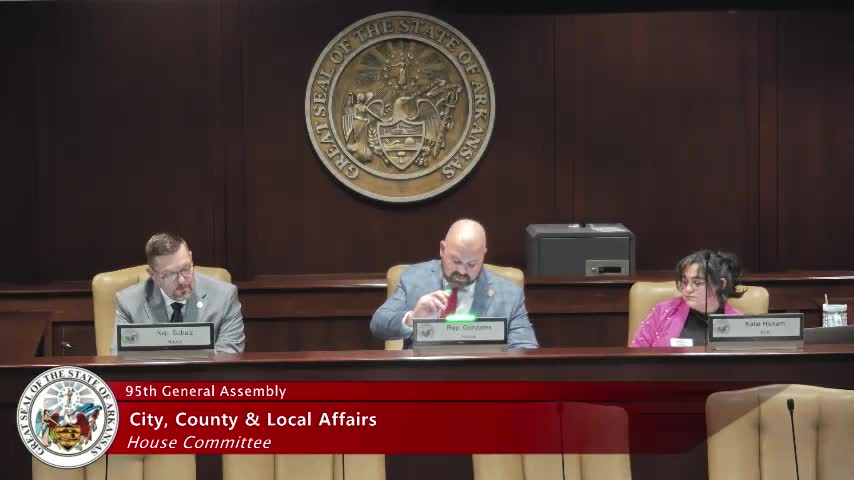
At an organizational session of the Arkansas House City, County & Local Affairs Committee, members and staff reviewed meeting logistics, quorum and agenda rules, procedures for amendments and deferred items, and emphasized preserving public testimony.
The City, County & Local Affairs Committee of the Arkansas House reviewed meeting procedures and introduced staff and outside stakeholders at its organizational session.
Committee leadership and staff outlined how agendas will be handled, how members register to speak and vote, and how contested or out-of-state testimony will be scheduled. The committee also stressed that public testimony during committee hearings is the primary opportunity for the public to speak on bills before they reach the House floor.
Committee organizers said meetings will generally be held on Wednesdays at 10:00 a.m., that a quorum of 11 committee members is required to begin business, and that committee agendas will be prepared in accordance with house rules and posted at least two days in advance. The chair said, “I really want the public to have input, be able to freely set at the table and testify,” and added that limiting debate will be rare except when discussion yields no new information (attributed to Chair). The chair also told members they should be in their seats on time to make quorum checks easier.
Staff and procedural details covered how items are handled if a sponsor is absent: when an item that has been called up is without its sponsor, it will be placed at the bottom of the active agenda; if a bill or resolution is called and the sponsor fails to appear three times, it will go to the deferred list unless staff are notified otherwise. Committee staff said it takes two days’ notice to return an item from the deferred list to the active agenda to allow public notice and potential testimony.
Members were told that amendments must be submitted in writing with copies for distribution; the chair said five signed copies are required for an amendment though members were reminded to coordinate with staff. The chair instructed members to notify staff in advance if they anticipate controversial bills or out-of-state witnesses so the committee can set a special order of business and organize testimony.
Committee staff and external organizations introduced themselves. Staff named included Katie Hickam (committee staff; “I’m Katie Hickam and this is my first session here. I’m super excited.”), Yesenia Alvarado (committee assistant) and committee counsel Sydney Sims (not present). Agency and stakeholder representatives introduced themselves or were represented, including Charlie Camp (Legislative Audit), Josh Stewart (Governor’s Office), Will Hopkins (Arkansas Farm Bureau), representatives of the Arkansas Association of Counties, the Arkansas Municipal League, the Arkansas Sheriffs Association and the Attorney General’s Office. Representative Bart Schultz, identified as vice chair, introduced himself and offered members a direct contact, saying, “Don’t ever hesitate to holler at me if you need me.”
Members were shown the sign-in/microphone activation procedure and told to sign in to the committee system before activating their microphones (staff explained the format is to enter 10 and then the member’s district number). The chair said members could pursue follow-up questions in committee without pausing for formal follow-up requests unless debate became repetitive, in which case the chair would step in to redirect.
The meeting concluded with brief additional introductions and adjournment.