Get Full Government Meeting Transcripts, Videos, & Alerts Forever!
Get email alerts on the Pavement Infrastructure topic
No spam. Unsubscribe anytime.
Green River consultant: road network ‘satisfactory’; $2.05M a year needed to maintain condition
Summary
MDS Technologies presented a pavement condition survey showing the citywide Pavement Condition Index (PCI) at 72.2 (satisfactory), an improvement from 2019, and recommended an annual pavement budget of about $2,050,000 to maintain the network; the city plans to use a 6P tax to fund reconstruction projects over the next 3–4 years.
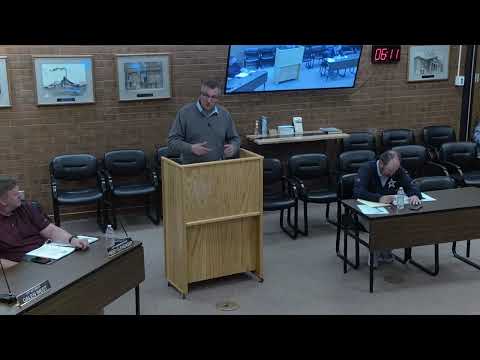
At the Green River City Council meeting, MDS Technologies consultant Trevor presented the firm’s 2024 pavement condition survey and said the city’s paved road network has an average Pavement Condition Index (PCI) of 72.2 — in the “satisfactory” range — and that maintaining the network at its current level will require roughly $2,050,000 per year.
Trevor said the city’s PCI rose from 70.3 in 2019 to 72.2 in 2024 and that the share of streets in the poorest categories has dropped: very poor or lower fell from 10.5% in 2019 to 6.5% in 2024. “It takes a lot of money and effort to kind of move things up,” Trevor said, noting the modest two-point increase is meaningful for pavement engineers.
The PCI is a 0–100 index that classifies pavement condition into bands (good/satisfactory/fair/poor/very poor/serious/failed). Trevor and his team used high-resolution, GPS-referenced photography of every city-maintained block to quantify pavement distresses and calculate PCI scores. Examples cited in the presentation included Bridger (between Essex and Butte Street) at or near 100, Shoshone (between Hitchin Post Drive and Honor Way) at about 77, and segments such as Riverview and Indian Hills with PCI scores indicating reconstruction candidates.
Why this matters: The consultant walked council through a pavement-management concept that stresses timely, lower-cost surface treatments (slurry seals or cape seals) when a street is still in good-to-fair condition to avoid much larger reconstruction costs later. The firm’s budget modeling showed multiple scenarios: doing nothing would drop the overall PCI below 40 in about 10 years; spending $500,000–$1.5 million per year slows deterioration but does not stabilize the network; about $2,050,000 per year would maintain current conditions. With the city’s expected 6P tax revenue in the short term (Trevor and staff estimated $2.4–$2.6 million annually over the next three years), the network could improve above the current average.
Treatment options discussed included: - Slurry seal and cape seal: surface treatments intended to seal the pavement and extend life at relatively low cost. Mark Wethlissel, Green River public works director, described the difference: “A Cape Seal applies a chip first and then a slurry on top — a double layer — while a slurry seal adds fine aggregate and a layer of binder.” - Mill and overlay: removing the top inch or two of pavement and placing new asphalt — a mid-range rehabilitation. - Reconstruction: full structural rebuild when subgrade and structural distresses are present.
Council questions and staff responses: Council members asked about subgrade and core information. Councilwoman Jessica Mazur asked whether the report addresses subconditions beneath the pavement. Mark said surface imagery and distress types can indicate deeper problems and that the city obtains geotechnical borings when planning full reconstruction projects; he gave Bridger as an example where borings were taken and storm drainage will be added as part of the rebuild. Councilman Williams and other members expressed concern about ratepayer affordability and the pace of planned increases tied to water/wastewater needs; staff acknowledged those concerns and said the pavement recommendation is a planning tool for long-term budgeting.
The presentation also showed maps comparing 2019 and 2024: the city has reduced the total mileage in the worst condition, and the city is already using the 2019 data to target a list of six major streets for 6P-funded reconstruction in the next 3–4 years (segments of Riverview, Wilkes, Bridal, Indian Hills and others were highlighted). Staff said slurry/cape programs and reconstruction funded by the 6P tax together are the recommended three-pronged approach to raise and then preserve the network PCI.
Ending: Staff and the consultant recommended the city continue its proactive low-cost surface treatment program (slurry and cape seals), proceed with funded reconstruction under the 6P program, and expand mill-and-overlay work as reconstruction needs shrink — with the stated annual maintenance target of about $2,050,000 to sustain the current PCI. Councilmembers pressed for more subgrade data for specific segments before choosing surface vs. structural fixes; staff replied the city collects geotechnical information where reconstruction is planned.