
Pilot of virtual GPS collars shows promise for grazing and vegetation work, but cell service and cost remain barriers
Get AI-powered insights, summaries, and transcripts
Sign Up Free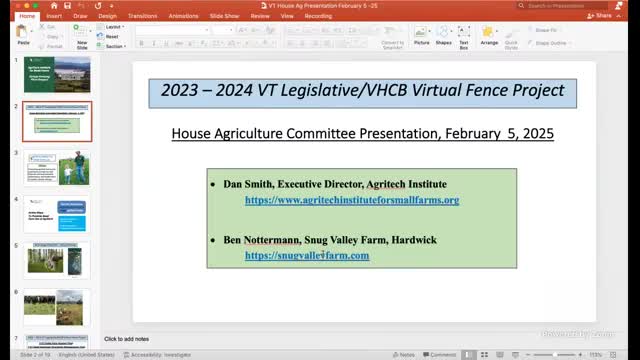
Summary
Presenters told the Agriculture, Food Resiliency, & Forestry Committee that a one‑year pilot of cellular-based virtual fencing on Vermont farms and other sites produced labor savings, finer exclusion zones and data on animal behavior, but rollout is constrained by spotty cell coverage, predator risk for small ruminants and upfront equipment cost.
At a meeting of the Agriculture, Food Resiliency, & Forestry Committee, presenters reviewed results from a pilot of cellular-based virtual fencing used on cattle, goats and other trial sites and described operational benefits alongside limitations.
The pilot — funded in part through legislative support and grants from the Dairy Business Innovation Center and the Linelac Foundation — evaluated the No Fence branded GPS collars on 11 projects across five operators and multiple site types, including pasture, ski‑area vegetation management and solar arrays. Presenters said the collars allowed crews to create virtual perimeter and exclusion zones from a smartphone, track animals’ locations and generate heat maps of grazing patterns.
“I'm not overstating it to say that it proved out better than our expectations,” said Dan (presenter), who described setting up the pilot and coordinating trials. Ben Nauterman, a farmer who participated in the project, said the units cost “roughly about $300” per collar to purchase and that a small annual software subscription was charged per collar.
The committee heard several operational benefits documented by the pilot. Presenters said virtual fencing reduced daily labor for moving animals compared with setting temporary polywire and reels, allowed fine exclusion of wetlands or poles without installing physical fencing, and produced GPS heat‑map data that operators could use to gauge where animals spent time and which plants they preferred. Trials on a goat dairy showed improved browse management and, according to operators, an increase in milk production linked to better access to targeted browse.
At the same time, presenters identified three main barriers to broader adoption: inconsistent cellular coverage in parts of Vermont, predator pressure on smaller ruminants at some sites, and the upfront cost of purchasing multiple collars. Dan told the committee that one vendor’s equipment failed during a network transition from older to newer cellular standards, compressing what had been intended as a two‑year pilot into essentially one year and complicating some trials.
Presenters also discussed technical details and operator experience. Collars ping the satellite at selectable intervals (reported choices: 5, 10 or 15 minutes) and can be updated by cellular connection in the field or via Bluetooth at short range. Operators reported that most animals learn the audio warning and boundary in two to three days, and that collars include rechargeable batteries and small solar panels; battery life and the need to retrieve collars for charging were raised as practical considerations.
Committee members asked about specific uses beyond grazing. Presenters said the system showed promise for vegetation control — for example, grazing knotweed on riverbanks and managing growth under transmission rights‑of‑way or around ski‑area slopes — but noted that utility right‑of‑way widths and equipment signaling in narrow corridors could present technical limits. Shelburne Farms ended its trial early because coyotes predated lambs during the pilot, illustrating predator risk for small ruminant applications.
No formal action was taken. Presenters said they are finishing a combined pilot report and plan to return with a proposal for follow‑up testing and potential finance mechanisms to offset upfront cost. Dan said he is exploring a revolving loan or lease program and potential collaboration with a state effort to improve cellular coverage.
The presentation prompted committee members to request further results and a formal recommendation if presenters pursue expanded trials or funding requests to address coverage and cost issues.