Get Full Government Meeting Transcripts, Videos, & Alerts Forever!
Get email alerts on the Legislation topic
No spam. Unsubscribe anytime.
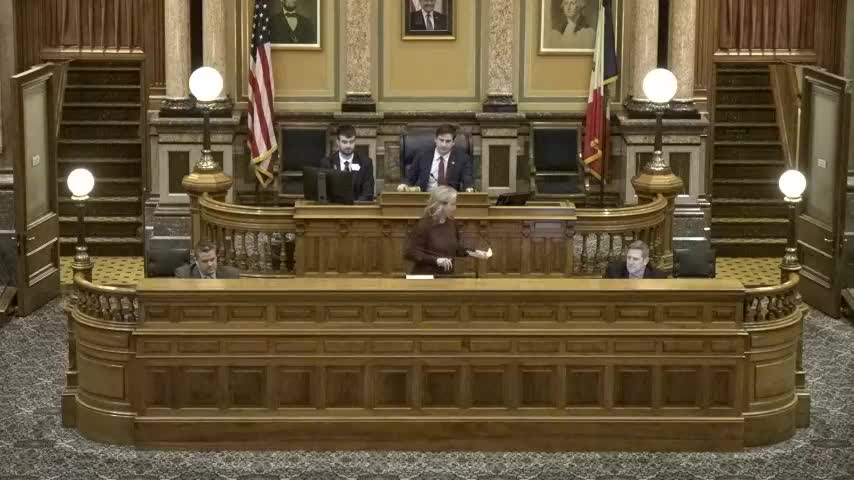
Iowa House conducts first readings of 10 bills, refers measures to committees; adjourns until Jan. 28
Summary
The Iowa House of Representatives read 10 House files for the first time and sent each to a standing committee. No bills received floor debate or roll-call votes in the session; the House approved a motion to adjourn until Tuesday, Jan. 28 at 8:30 a.m.
The Iowa House of Representatives conducted first readings for 10 House files and referred each measure to a standing committee, then approved a motion to adjourn until Tuesday, Jan. 28, at 8:30 a.m., Representative Seacrest moved.
Most measures were read without floor debate and sent to committees that will consider them in more detail. The bills introduced covered education policy, criminal procedure, higher-education residency requirements, involuntary commitment procedures, direct shipment of alcohol, a proposed sales-tax change, property-tax adjustments, rural veterinary support, and changes to gambling licensing and fees.
House File 135, introduced by Representative Jones and others, was described as “a bill for an act providing for a waiver of institution and mandatory fees at region institutions and community colleges for certain sanctionary sanitary workers and their children.” The measure was given a first reading and referred to the Committee on Education.
House File 136, by Representative Wood, was read for the first time and referred to the Committee on Education. The bill concerns Iowa school performance profiles established by the Department of Education and how dropout students affect school performance grades contained in those profiles.
House File 137, by Representative A. Mayer and Representative Collins, proposes requirements related to residency for applicants admitted to the State University of Iowa’s colleges of medicine, nursing and dentistry and would require an annual report; it was referred to the Committee on Health and Human Services.
House File 138, by Representative Rinker, concerns the Iowa Rules of Criminal Procedure, including provisions related to the right to a speedy trial; it was referred to the Committee on Judiciary.
House File 139, by Representative Latham, addresses filing applications in custody of respondents in involuntary commitment proceedings and was referred to the Committee on Judiciary.
House File 140, by Representative Jones and others, would provide for the direct shipment of alcoholic liquor, outline fees and include effective-date provisions; the measure was referred to the Committee on State Government.
House File 141, by Representative Jones, was described as a bill imposing a sales tax on the sales price of an item containing traceable amounts of “Piper Methodism” (description in the bill text); it was referred to the Committee on Ways and Means.
House File 142, by Representative Wills, would create a conservation area designation subject to modified property tax levy rates and would eliminate the forest and fruit trees reservations property-tax exemption program; it was referred to the Committee on Ways and Means.
House File 143, by Representative Wood, would establish a Rural Veterinary Practice Innovation and Revitalization Fund and related assistance for veterinary practices in certain counties and make appropriations; it was referred to the Committee on Appropriations.
House File 144, introduced by the Committee on Ways and Means, concerns licensing and regulation of gambling games, proposes a moratorium on the issuance of new licenses, and would set fees and effective/retroactive bookkeeping provisions; the bill was placed on the Ways and Means calendar for further consideration.
Representative Seacrest moved, “Mister Speaker, I move the House adjourn until Tuesday, January 28 at 8:30 a.m.” The presiding officer put the motion, members responded in the affirmative by voice vote, and the speaker declared the motion adopted. No roll-call vote on the adjournment or on any of the bills was recorded in the portion of the session covered by the transcript.
Next steps: each bill will proceed to the committee to which it was referred for hearings, possible amendment and any committee votes required before returning to the floor.