Get Full Government Meeting Transcripts, Videos, & Alerts Forever!
Get email alerts on the Venue Electronic Crimes topic
No spam. Unsubscribe anytime.
Committee backs bill clarifying venue rules for electronic crimes
Summary
Senate Study Bill 1001 would set clearer rules for where electronic-crime trials are held if the proper county is unclear, prioritizing the victim's residence, the defendant's residence, or counties where a non‑natural-person victim has physical presence.
A Senate committee voted to advance Senate Study Bill 1001 (SSB 1001), a measure submitted by the Iowa County Attorneys Association that clarifies venue for prosecution of electronic crimes when the appropriate county cannot be readily determined.
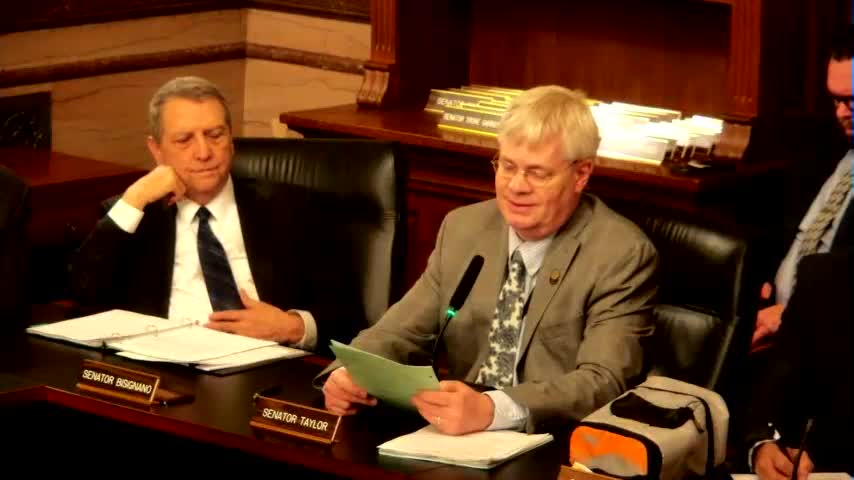
Senator Taylor, who presented the bill, described four venue rules the measure would add to code: (1) when the county where the offense occurred cannot be readily determined, trial shall be held in the county of the victim's residence; (2) if there is no victim or the victim is not an Iowa resident and residence cannot be established, trial should be held in the county of the defendant's residence; (3) when the victim is not a natural person, venue is proper in any county where the victim has a physical presence; and (4) when there are multiple victims, venue may be in any county where a victim resides, with a natural-person victim's county taking priority over others.
Taylor said the bill was brought by the Iowa County Attorneys Association to address difficulties in determining venue for electronic crimes. The subcommittee—Senator Taylor, Senator Rowley and Senator Kornbach—signed off and the committee moved SSB 1001 to the calendar as a committee bill by voice vote; no roll-call tally or fiscal note appears in the transcript.
The transcript does not specify how the changes would interact with existing venue statutes or with multi-jurisdictional investigations; it records only the committee explanation and subsequent motion to advance the bill.