Get Full Government Meeting Transcripts, Videos, & Alerts Forever!
Get email alerts on the Income Tax Revenue topic
No spam. Unsubscribe anytime.
Committee advances bill to sequester unanticipated federal-driven income-tax revenue
Summary
House Bill 216 would require material, federally driven increases in state income-tax revenue to be held in a restricted account and require explicit legislative action before the funds are spent, a change proponents say would increase transparency and force lawmakers to decide how to use such revenue.
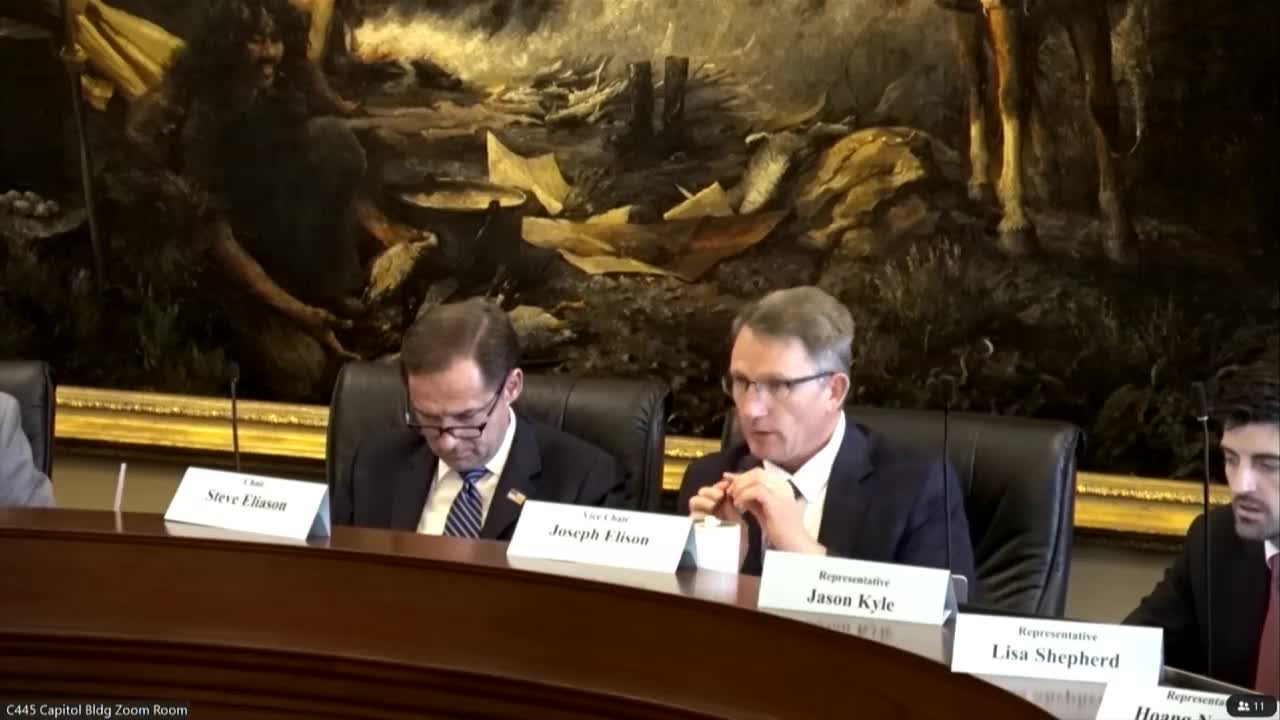
The Utah House Revenue and Taxation Standing Committee voted unanimously to pass favorably House Bill 216, income tax revenue amendments, a bill that would automatically place materially increased state income-tax revenues—when the increase stems from federal changes—into a restricted account until the Legislature decides how to allocate the funds.
Representative Thurston, the bill sponsor, said the measure is meant to address what he described as a "passive tax increase" that occurred after prior federal tax changes. "When you do it the way they did it, they change the definition of what's taxable income," Thurston said, describing how Utah’s reference to the federal taxable income definition unintentionally raised state collections for some taxpayers. "It puts it into a restricted fund until we decide as a legislature to give it back or to spend it," he said, adding the aim is to force a legislative decision rather than allowing automatic appropriation.
The nut graf: supporters said the bill creates transparency by requiring the Governor’s Office of Planning and Budget (GOPB), the Tax Commission, and the Legislative Fiscal Analyst (LFA) to identify material federal-driven revenue increases, notify the Legislature, and place the funds in a restricted, interest-bearing account pending legislative action. Representative Thurston and staff said the bill was drafted with input from the Tax Commission, GOPB and LFA.
Committee members asked for detail on the materiality threshold and likely fund size. The bill sets materiality at a 0.5 percent increase over expected revenue (sponsor described this as the figure chosen to avoid frequent small changes while capturing larger, consequential shifts). Committee discussion included an estimate example that a 0.5 percent increase on an $8 billion education fund would be roughly $40 million; Thurston also said the prior federal change had produced an ongoing increase he recalled as "about a 2 and a half percent" increase in revenues.
The bill requires the restricted account’s interest-bearing treatment; committee members discussed how interest is treated for restricted accounts (one representative noted interest earnings often flow back to the general fund). The committee approved the bill with a favorable recommendation by voice vote; the transcript records a unanimous voice vote but no roll-call tally.
Ending: The committee passed HB 216 out favorably. Sponsors and fiscal staff said further clarifications on accounting and mechanics (investment treatment and how interest is handled) may be needed as the bill advances.