Get Full Government Meeting Transcripts, Videos, & Alerts Forever!
Get email alerts on the Integrated Resource Planning topic
No spam. Unsubscribe anytime.
Committee advances HB 201 to tighten how integrated resource plans account for capacity, firming and demand management
Summary
The committee passed the first substitute to HB 201 on a 9‑1 vote. The bill would require utilities and the Public Service Commission to distinguish between load reductions and firm capacity when evaluating integrated resource plans, and to ensure firming costs for variable resources are fully attributed.
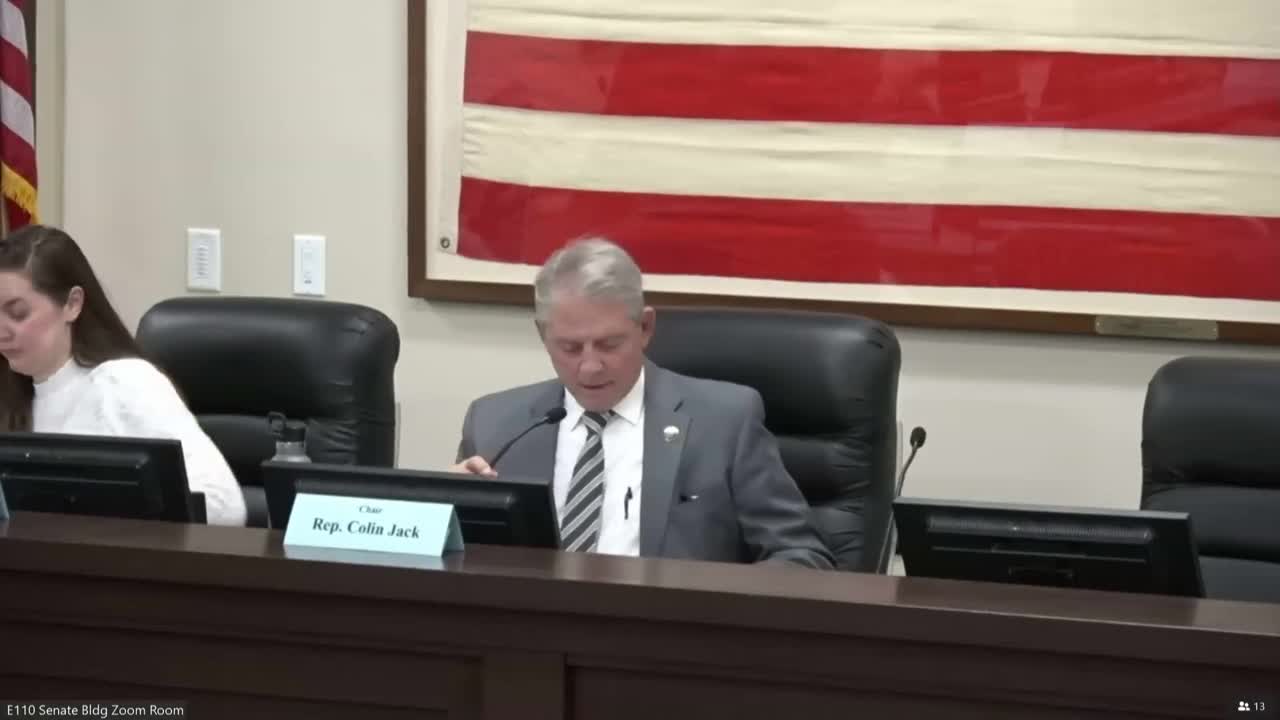
The House Public Utilities and Energy Standing Committee on Oct. 12 voted 9‑1 to pass the first substitute to House Bill 201, a measure that would change how utilities and regulators evaluate integrated resource plans (IRPs) by clarifying how capacity, energy and demand‑management programs are counted.
Representative Colin Jack, chair of the committee and sponsor of the bill, said the bill is designed to ensure that utilities properly attribute the full cost of backup or firming resources to variable energy supplies such as wind and solar and to keep demand‑management programs voluntary and accounted for on the load side rather than treated as firm capacity.
"You can do all of these programs to improve load factor, but you still have to meet the demand," Representative Jack said, summarizing the bill’s core principle that utilities must plan adequate capacity to serve customers when they need it.
The first substitute makes three main changes, the sponsor told the committee: it requires full cost attribution for supplemental (firming) resources used to back intermittent generators; it requires accurate accounting of generation capacity so utilities cannot double‑count nameplate ratings (for example, counting both solar and the battery it charges as full, additive capacity); and it states that demand‑management and energy‑efficiency programs must be voluntary and correctly reflected as load reductions rather than as firm generation capacity.
Committee members and members of the public debated the bill’s potential effects on renewable energy deployment and on energy‑efficiency programs. Representative Peck and others asked whether the proposal would disadvantage programs such as Rocky Mountain Power’s consumer programs; the sponsor said the measure does not forbid demand‑management programs and that energy efficiency remains an important and cost‑effective resource. Multiple public witnesses urged caution or opposition.
Public testimony included Maria Archibald of the Utah chapter of the Sierra Club, who said HB 201 "arbitrarily singles out renewable energy resources" and would disadvantage wind and solar by assigning storage costs to them; Kevin Emerson of Utah Clean Energy and Glenn Anderson, an independent consultant, both urged attention to unintended consequences and to rapidly evolving storage technologies; Nathaniel Johnson, executive director of the Utah Rural Electric Cooperative Association, described co‑ops’ emphasis on reliability and customer service; and Lynn Carroll and other residents urged prioritizing clean energy and affordability.
Kevin Emerson, citing program results, told the committee that since 2014 Utah demand‑management programs have saved roughly 2,800,000,000 kilowatt‑hours of electricity — "enough to power 320,000 homes for about a year" — and that Rocky Mountain Power’s programs have generated about $1.2 billion in net economic benefits over the past decade. He warned the committee the substitute’s language could unintentionally constrain investment in demand‑management or energy‑efficiency programs.
Sponsor Representative Jack used a simple example to explain the accounting issue: "Let's say I have 100 megawatts of solar and I'm charging 100 megawatts of battery ... that's not 200 megawatts of resource. It's only 100," he said, explaining the bill’s anti‑double‑counting provision.
Committee action: the committee adopted the first substitute (voice vote) and then voted 9‑1 to pass the first substitute favorably; Representative Dominguez cast the lone no vote.
Why it matters: supporters say the bill protects ratepayers by ensuring IRPs account for the cost of firming intermittent resources and prevent utilities from obscuring true costs; opponents say the language could make renewables and storage look more expensive and could discourage deployment or investment in demand‑management programs. The Public Service Commission and utilities will continue to play central roles under the bill's framework.