Get Full Government Meeting Transcripts, Videos, & Alerts Forever!
Get email alerts on the Long Term Care topic
No spam. Unsubscribe anytime.
Nursing homes, home health and private-duty nursing seek rate increases to avoid closures and institutionalization
Summary
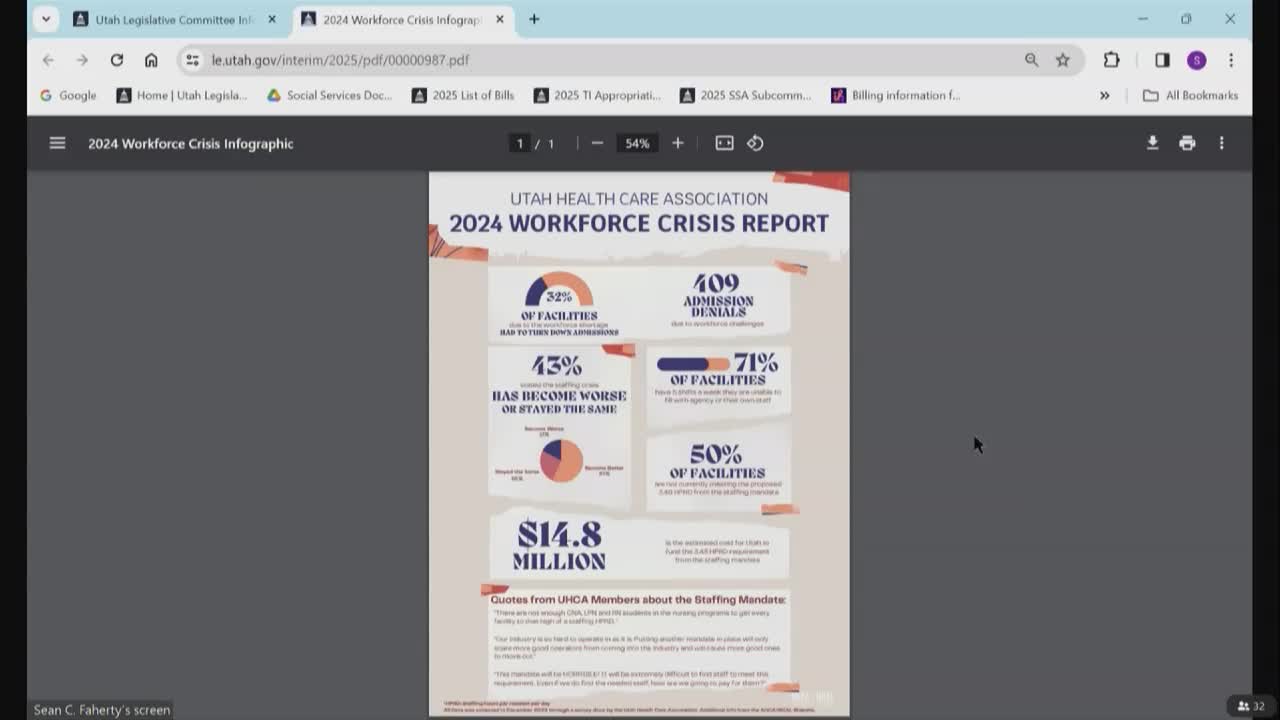
Industry groups and legislators told the Social Services Appropriations Subcommittee that Medicaid reimbursement rates for nursing homes, ICF/ID facilities, home health and private-duty nursing are substantially below cost and need increases to retain workers and prevent more hospital or institutional placements.
Senators and provider representatives told the Social Services Appropriations Subcommittee that Utah's Medicaid rates for long-term care and home-based supports lag costs and are driving access problems.
Lisonbee Spangler of the Utah Health Care Association and Senator Escamilla combined two related requests and asked for $5 million for nursing-home rate increases and about $292,000 for intermediate care facilities for individuals with intellectual disabilities (ICF/ID). They said Medicaid rates leave nursing homes operating with about a $100-per-day shortfall and that closures are possible without relief.
"Now really is the time to invest in long term care," Spangler said, citing an 18% projected growth in Utah's older population over two years.
Representative Ward and industry witnesses described private duty nursing (PDN) and home health reimbursement shortfalls. Matt Hanson, executive director of the Home and Hospice Association, said PDN reimbursements cover only about 56% of provider costs and are 46% lower than neighboring-state averages for RN PDN rates; LPN rates are about 31% lower. The association requested $1.926 million ongoing from general funds for PDN.
Ward presented home health and personal-care rate increases that would be matched by federal funds and said these services prevent more expensive institutional care. Witnesses described exodus of waiver providers (aging waiver and New Choices waiver) and noted the state has lost over 60% of some provider capacity in three years for those waivers.
Home and hospice testimony emphasized that PDN averts hospital stays and institution placement for medically complex children and adults; the average PDN cost cited was $424 per day versus a hospital cost of roughly $3,500 per day if nursing care is not available.
Separately, Senator Owens and staff proposed a broader provider cost-of-living adjustment (COLA) approach that would standardize a 2% COLA across multiple rate categories and reduce the need for repeated individual requests. Owens's plan estimated $8 million state funds would bring $60 million in federal match and cover many provider requests aggregated in the committee packet.
The committee did not take a final vote on any of these funding requests at the hearing. Sponsors asked members to take questions offline and to consider the items in prioritization as the subcommittee develops its final budget recommendations.
Ending: Providers emphasized workforce and access risks if rates remain unchanged and asked for ongoing funding that would leverage federal matches to sustain home- and community-based services.