Get Full Government Meeting Transcripts, Videos, & Alerts Forever!
Get email alerts on the Behavioral Health topic
No spam. Unsubscribe anytime.
Behavioral Health Commission asks Legislature for range of funding to shore up crisis care, hospital capacity and peer supports
Summary
Representative Brady Eliason, a legislative oversight member of the Behavioral Health Commission, presented the panel's funding recommendations to the Social Services Appropriations Subcommittee aimed at expanding crisis response, sustaining peer supports and preventing further bed closures at the Utah State Hospital.
Representative Brady Eliason, a member of the legislative oversight board for the Behavioral Health Commission, told the Social Services Appropriations Subcommittee that the commission submitted a set of funding recommendations aimed at gaps in Utah's behavioral health system.
The commission recommended increases and one-time investments across crisis services, peer supports and state hospital capacity to reduce pressure on emergency departments and jails and to improve continuity of care, Eliason said.
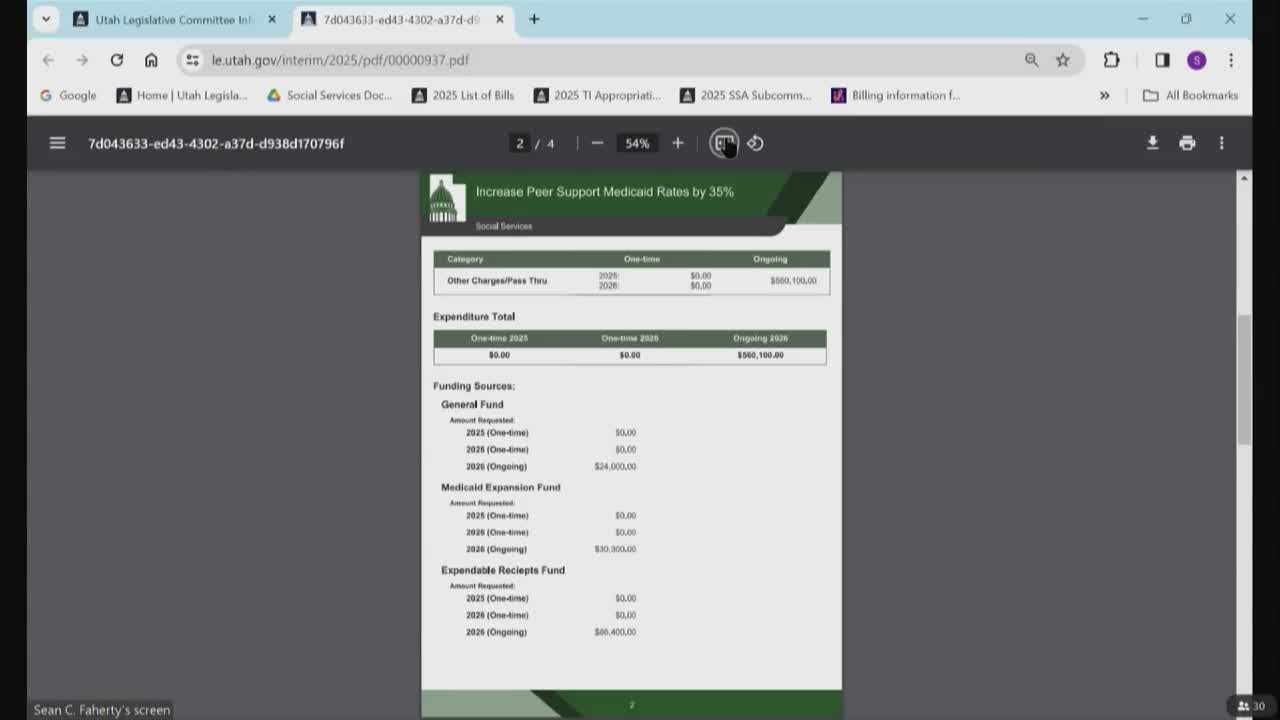
The package calls for a small ongoing boost to peer support Medicaid rates (just under $24,000 in the commission's request) to reduce churn among workers who provide lived-experience supports; continuation of a 5% pandemic-era Medicaid increase for behavioral providers that expires June 30, 2025; a 26% raise for Mobile Crisis Outreach Team (MCOT) reimbursement; funding for one additional MCOT; a $600,000 one-time pilot to test humane, non-law-enforcement transports in rural areas; and money for one additional rural behavioral health receiving center in the Uinta Basin.
"Peers are a critical extender in our workforce," Eliason said, describing peer staff who work on MCOTs and at receiving centers. "Peer support reduces rehospitalization, emergency-department visits and increases treatment adherence." Mia Nafsiger, staff for the Behavioral Health Commission, joined Eliason for the presentation.
Committee members heard that MCOT usage is rising (Salt Lake County visits doubled in the previous 12 months), but reimbursement rates have not been adjusted in nearly eight years. Eliason said the increase would be a relatively small budget item with a large operational effect, helping sustain 24/7 coverage that has been recently achieved.
The commission also asked for $89 million one-time to add roughly 60 lower-acuity beds at the Utah State Hospital to relieve pressure created by rising forensic (court-ordered) admissions and to free higher-acuity beds for short-term treatment. The request included $1.2 million ongoing for operational costs. "We are 30 beds below 2008 levels," Eliason said, describing long-term capacity shortfalls that have worsened as forensic admissions have grown.
On correctional health, Eliason repeated a prior interim recommendation: the department and Utah Department of Corrections must replace a non-billing electronic medical record (Fusion) with a system that supports Medicaid billing and discharge planning tied to the federal Justice-Involved Medicaid waiver. The commission requested $10 million one-time from a Medicaid restricted account for an RFP and implementation; the intent is that county jails and state corrections can bill Medicaid for eligible inmates up to 90 days before release and support reentry.
Separately, the commission proposed maintaining state hospital operations with $3.8 million ongoing and $1 million supplemental to avoid future bed closures, citing higher staffing and operating costs since the pandemic.
The committee did not take on any of the commission's line-item funding decisions at the hearing; speakers were given three minutes each and members were asked to take questions offline. The commission's requests will be part of the subcommittee's budget prioritization in subsequent meetings.
Ending: If the subcommittee supports any of the commission's items, staff and sponsors said they will bring specific intent language and statutory changes back to the committee for implementation and fiscal detail.