Get Full Government Meeting Transcripts, Videos, & Alerts Forever!
Get email alerts on the Community Health Aid Program Chap topic
No spam. Unsubscribe anytime.
Senate hears bill to make Community Health Aide Program permanent for Montana tribes
Summary
Senate Bill 170 would remove the termination date for Montana’s Community Health Aide Program (CHAP), allowing tribes to continue training and certifying community, dental and behavioral health aides and seeking Medicaid state‑plan inclusion and 100% FMAP reimbursement for IHS/tribal facilities.
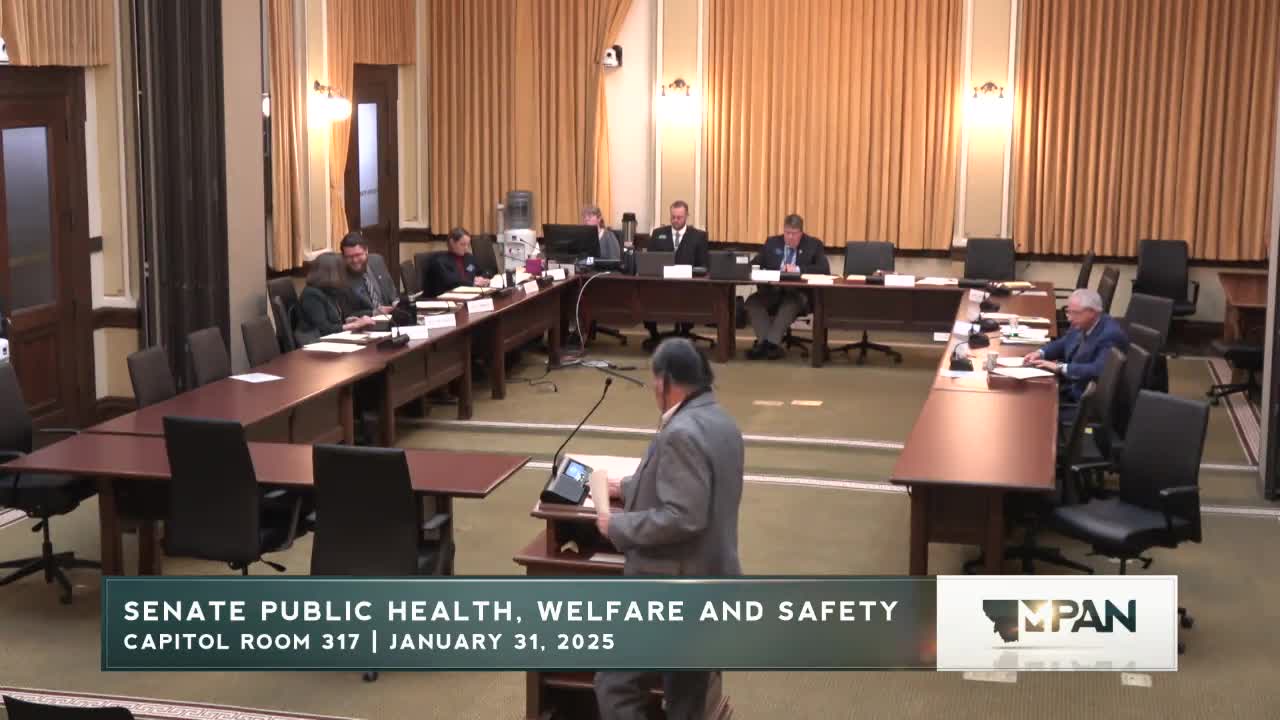
Senator Jonathan Windy Boy introduced Senate Bill 170 on Jan. 31, 2025, asking the Senate Public Health, Welfare and Safety Committee to eliminate the program’s sunset date and authorize the state to seek a Medicaid state plan amendment to include CHAP providers.
Windy Boy said CHAP—comprising community health aides, dental health aides and behavioral health aides—is a ‘‘grow‑your‑own’’ model that enables tribes to recruit and train local providers who work under the supervision of licensed clinicians. Proponents representing multiple tribal governments, tribal health centers and tribal organizations told the committee CHAP expands access to primary and emergency care in remote reservation communities and helps stabilize local health workforces.
Lance Forster of the Montana American Indian Caucus and letters provided by tribal chairs noted CHAP’s track record in Alaska and adoption in other Western states. Fort Peck and Rocky Boy tribal representatives and Alyssa Snow (representing several Montana tribes) emphasized the program’s cultural fit and argued that including CHAP in the state Medicaid plan would enable 100% Federal Medical Assistance Percentage (FMAP) reimbursement for Medicaid payments made to Indian Health Service and 638 tribal facilities for CHAP services.
Dorothy Dupree, a former federal IHS area director and CMS advisor, told the committee the bill would stabilize CHAP implementation by eliminating periodic waivers and allowing a state plan amendment (SPA) so tribes can be reimbursed sustainably under existing federal law. Proponents said the state would not bear net costs because Medicaid payments to IHS and 638 tribal facilities would remain federally reimbursed at 100% under current law.
Several tribal health centers and organizations submitted letters and testified in support, and mental‑health advocacy group NAMI Montana also endorsed the bill. DPHHS Health Resources administrator Mary Lemieux was on hand as an informational witness.
Committee members asked whether CHAP would include traditional healing practices and about next steps for training and education programs. Windy Boy said the bill focuses on removing the sunset and directing DPHHS to apply for a SPA; he indicated separate legislation will address educational program expansion and cultural practices. No opponents appeared at the hearing and the committee took no formal action during the Jan. 31 session.