Get Full Government Meeting Transcripts, Videos, & Alerts Forever!
Get email alerts on the Food Safety Panel Toxic Additives topic
No spam. Unsubscribe anytime.
Bill to create state food‑safety panel on cumulative additives draws industry opposition
Summary
Senate Bill 155 would create a panel to study cumulative exposure to toxic food additives and authorize the Department of Agriculture to restrict ingredients on panel recommendation; agricultural and consumer groups warned the measure duplicates federal oversight and could cost about $1 million annually to enforce.
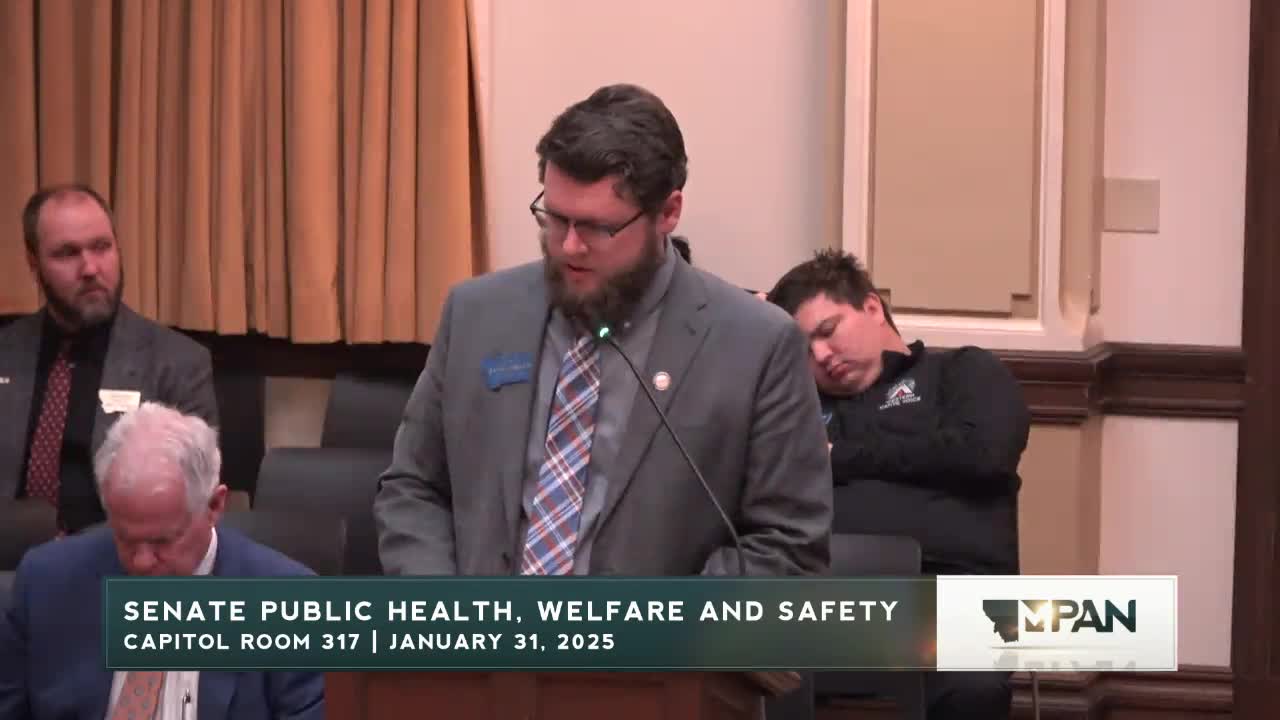
Senator Daniel Emmerich opened the Jan. 31 hearing on Senate Bill 155, a proposal to create a state food‑safety panel to study the cumulative effect of toxic food additives and to authorize the Montana Department of Agriculture to adopt rules limiting ingredients based on the panel’s recommendations.
Emmerich said the intent is to assess how multiple products containing the same additive could combine to expose consumers to higher levels than a single‑product evaluation would show. ‘‘The issue arises when you have a certain number of those products that are unrelated products, but they have the same toxic additive in them,’’ Emmerich said.
Proponents included tribal food sovereignty advocates who described disproportionate access to processed foods on reservations and asked the panel to study the health impacts of commonly donated, highly processed items. Patrick Iowaki, an executive director of a nonprofit food sovereignty program, urged senators to ‘‘support Senate Bill 155 with the due pass’’ to address those community concerns.
Opponents from industry and trade groups said the proposal duplicates federal regulation and existing state programs. Brad Griffin, representing the Montana Retail Association and Montana Restaurant Association, listed federal agencies that already regulate food safety and highlighted HACCP and ServSafe training programs used by retailers and restaurants. Chris Averill of the Montana Agricultural Business Association cited the fiscal‑note estimate of roughly $1 million per year and nine full‑time positions for the Department of Agriculture to enforce the proposal and said the bill would amend Montana law (transcribed as "50 31 108") that already allows ingredient regulation.
Erin Raden, representing the Consumer Brands Association, said the bill risks creating a patchwork of state regulations that would undermine a national, FDA‑led risk‑based system and increase costs for families and the state. Informational testimony from Ian Foley, the Department of Agriculture’s Ag Sciences Division administrator, said the department could model enforcement after the state animal‑feed program: label review, inspections, lab testing in the department’s Bozeman laboratory and stop‑sale and mandatory recall authority if prohibited ingredients are detected.
Committee members asked about implementation and scope. Senator Newman asked whether the department could realistically coordinate enforcement with the FDA and whether the department’s existing activities for animal feed made the proposal feasible. Foley said the department has experience working with FDA and conducting inspections and laboratory testing for animal feed and that the bill’s fiscal note was based on analogous animal‑feed work.
The fiscal note and multiple industry witnesses were the most prominent points of opposition, with trade groups urging a do‑not‑pass recommendation citing duplication, enforcement costs and the value of a national food‑safety system.
No committee vote occurred during the Jan. 31 hearing.