Get Full Government Meeting Transcripts, Videos, & Alerts Forever!
Get email alerts on the Air Quality Standards topic
No spam. Unsubscribe anytime.
Bill would bar DEQ, local programs from adopting air standards stricter than federal law; proponents cite regulatory certainty, opponents warn of public‑health,
Summary
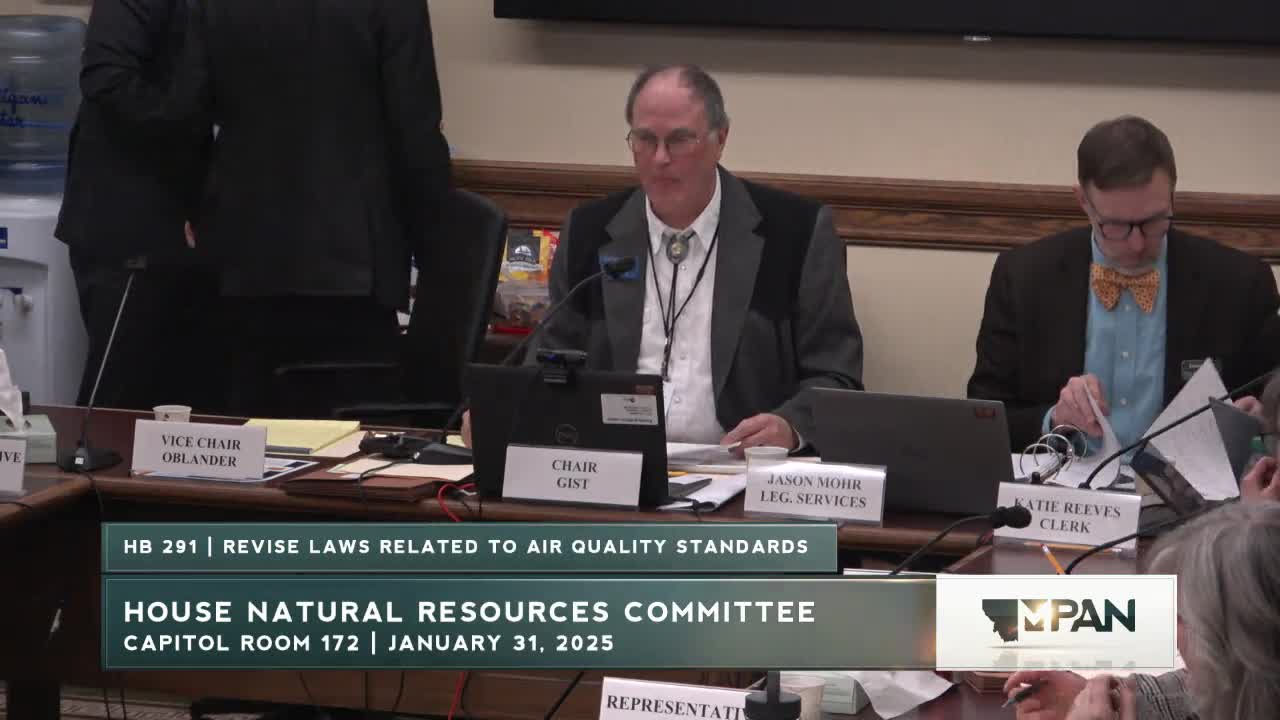
Vice Chair Oblender introduced House Bill 291 to bar the Montana Department of Environmental Quality and approved local pollution control programs from adopting air-quality standards more stringent than the Federal Clean Air Act.
Vice Chair Oblender introduced House Bill 291, which would remove the authority of the Department of Environmental Quality and local pollution control programs to adopt air-quality standards that are more stringent than limits under the Federal Clean Air Act. "House bill 2 91 removes the authority from the DEQ and the local pollution control programs to set standards or limits that are more stringent than the federal clean air act," the sponsor said in opening remarks, adding that the measure "restores legislative authority to the legislature to determine when something stricter needs to be done."
Why it matters: Supporters framed the bill as a measure to ensure consistency and predictability so businesses can rely on a single set of standards. Opponents warned that the change would impede Montana's ability to protect local air quality — particularly fine particulate matter (PM 2.5) from wood-stove smoke and other local sources — and could prevent the state, if needed, from adopting stronger protections to address greenhouse gases or emerging pollutants. Multiple witnesses referenced Montana's constitutional provision (and the recent Held v. Montana litigation) as the basis for state authority to protect a "clean and healthful environment."
Supporters' case: Representatives of industry and business associations supported the bill as a way to avoid a patchwork of local standards. John Iverson of the Treasure State Resources Association said the measure prevents the state from repeating the experience on nutrient standards and avoids "a patchwork of regulatory enforcement." The Montana Chamber of Commerce and Montana Petroleum Association described the bill as providing regulatory certainty; Melissa Lewis of the Petroleum Association said cooperation between DEQ and stakeholders on federal rules (for example, methane monitoring and reporting) can continue under the bill.
Opponents' case and public-health concerns: The Montana Environmental Information Center, Missoula Public Health and public-health professionals cautioned that the bill would limit local and state capacity to address locally specific problems. Missoula Public Health's Shannon Theriault said local programs were often the first line against wood-stove smoke and other particulate problems and that waiting for federal nonattainment designations can be slower and impose more rigid paperwork on communities. Public-health professionals, physicians and environmental groups argued that limiting state/local authority would constrain Montana's ability to act on climate-related and other health risks; several witnesses referenced the Montana Supreme Court's Held v. Montana ruling.
Technical points and scope: The sponsor and DEQ staff clarified that the bill preserves the legislature's authority to adopt stricter standards and that the statute includes a grandfathering clause for preexisting requirements and an exception for areas that are in nonattainment or maintenance for national ambient air quality standards. DNRC/DEQ staff noted the state currently has no active standards that are stricter than the federal Clean Air Act in the counties with local air programs. The bill as written would affect DEQ's discretion to initiate rulemaking that would exceed federal standards; DEQ Director Sonya Nowakowski testified as an informational witness and said DEQ does not intend to regulate greenhouse gases at this time.
Stakeholder geography and specifics: Testimony named eight counties with local air pollution control programs — Missoula, Lincoln, Lewis and Clark, Butte-Silver Bow, Ravalli, Yellowstone, Cascade and Flathead — and local health officials described wood-stove smoke episodes and inversion-prone valleys where smaller-scale regulations have been used to limit particulate exposure.
Committee questions and next steps: Committee members asked whether the state or county programs had historically used the authority to adopt stricter standards (witnesses said it is rare and requires a rigorous justification process) and whether DEQ intended to regulate greenhouse gases (DEQ said it did not intend to do so). The hearing record shows extensive proponent and opponent testimony; the transcript does not record a committee vote on HB 291 in this session.