Get Full Government Meeting Transcripts, Videos, & Alerts Forever!
Get email alerts on the Education topic
No spam. Unsubscribe anytime.
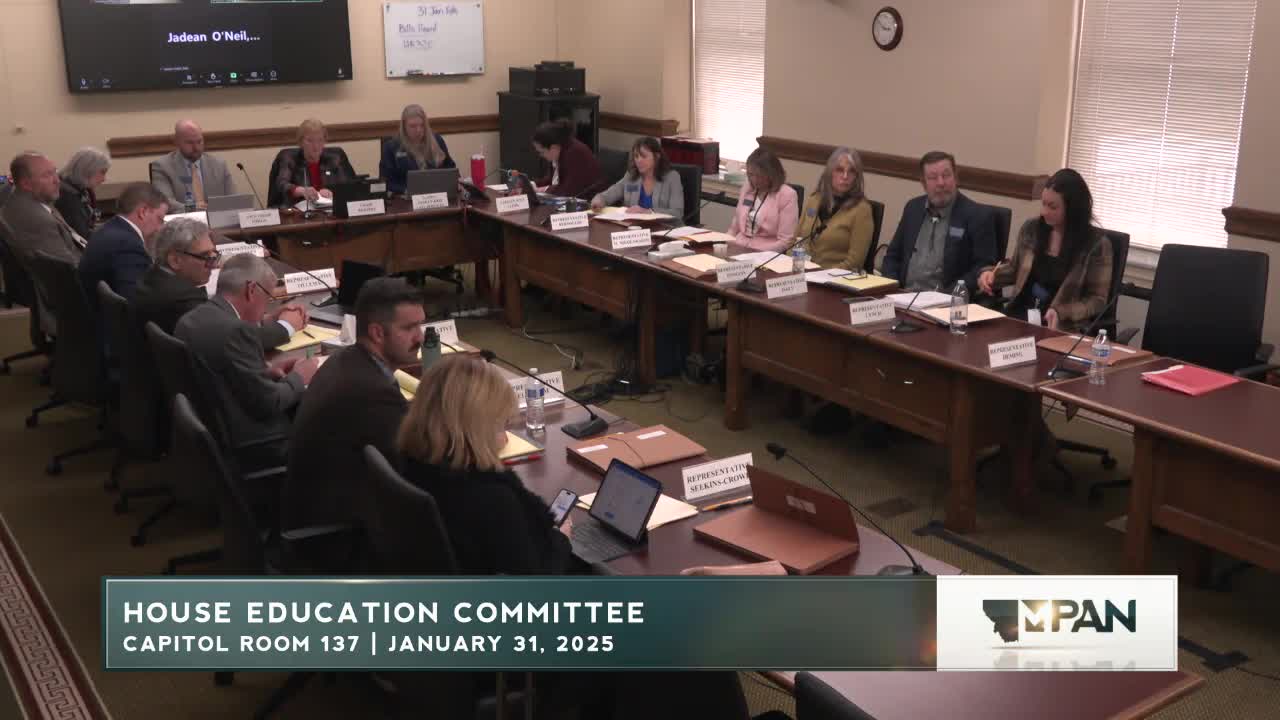
House Education Committee Hears Hours of Testimony on MAPS school‑choice tax‑credit proposal
Summary
Lawmakers heard hours of testimony for and against HB 320, the Montana Academic Prosperity Program (MAPS), a tax‑credit and privately funded assistance plan that would make up to about $7,000 per student available through two entry paths; committee requested a fiscal note and amendments and took no vote.
HELENA — The Montana House Education Committee on Wednesday heard more than three hours of testimony on House Bill 320, a school‑choice proposal sponsored by Representative Lee Deming that would create the Montana Academic Prosperity Program, or MAPS. The bill would allow families to access education tax credits or privately managed education assistance accounts capped at about $7,000 per student and would be administered through a nonprofit program manager and a volunteer MAPS council.
Representative Lee Deming, R‑Laurel, introduced the bill and told the committee, “MAPS is a privately funded tax credit program that every K‑12 student can access to pay for education options that will best fit their needs.” He described the education assistance amount as “up to about $7,000 annually.”
The bill’s proponents — a mix of parents, private‑school leaders and school‑choice advocacy groups — framed MAPS as a way to expand options for families who want alternatives to local public schools. Trish Schreiber, senior education fellow at the Frontier Institute, said MAPS “is a single program administered by a nonprofit program manager with two points of entry” and described built‑in transparency and a lottery for oversubscription. Sue Vinton, a State Senator speaking as a private citizen, said MAPS “is a universal program that offers all children all the educational options available in our state.” Leslie Heiner, an attorney with EdChoice, told the committee she had been “intimately involved in the Espinosa case” and said the bill had been drafted with constitutional concerns in mind.
Opponents, including local school administrators, education associations and public‑school advocates, warned the committee that the bill could divert tax revenue and undermine public schools. Lance Melton of the Montana School Boards Association testified that “Problems with House Bill 320 violates Espinosa itself” and said he was concerned MAPS would create unequal treatment between public and nonpublic students. Doug Reisig of the Montana Quality Education Coalition argued the bill “delegates to the MAPS council the power to define qualified educational expenses with no guiding principles or guardrails.”
Key features described in testimony
- Amounts and caps: Sponsor testimony described a program that provides up to about $7,000 per participating student annually. Testimony said the bill sets a $200,000 per‑donor donation incentive cap, a $4,000,000 cap per point of entry (two points of entry were described), and an $8,000,000 aggregate cap in the initial year. Trish Schreiber said the program manager would receive a 10% administrative set‑aside from donations.
- Two entry paths: Witnesses described two ways families could access benefits: (1) a donation pathway in which private donors contribute to a nonprofit program manager that pays educational assistance, and (2) a tax‑credit pathway in which families apply state tax credits against their state income tax liability for qualified education expenses.
- Eligibility and limits: Sponsor testimony said families would be eligible for assistance if household income does not exceed 500% of the federal poverty level. The bill as explained would allow parents to claim credits up to their state tax liability and to request less than the $7,000 cap if needed.
- Oversight and reporting: Proponents described a five‑member MAPS council appointed by the governor to select a program manager, refine the list of qualified educational expenses, and provide annual reporting to the Legislature on usage, dollar totals and anonymized demographics. Trish Schreiber said the council and program manager would report each year on the total number and dollar value of education tax credits and educational assistance accounts and provide a categorization of qualified‑expense use.
Issues raised by committee members and witnesses
- Fiscal uncertainty: Multiple legislators and the committee asked for a fiscal note. Department of Revenue staff and others said the agency had not completed fiscal analysis at the time of the hearing. Opponents warned that tax‑credit programs in other states had grown rapidly and stressed long‑term fiscal risk.
- Accountability and access: Opponents including public‑school leaders sought clear accountability standards for participating providers. Witnesses asked whether private providers would be required to meet teacher‑certification, safety, testing or special‑education standards comparable to public schools; proponents pointed to parental choice and the council’s role in setting qualifying expenses.
- Distinction from homeschooling and constitutional concerns: Sponsor and proponents said MAPS is not a voucher program and is privately funded. The bill would create a legal distinction between MAPS students and homeschool students and proponents said they had consulted with homeschooling advocates to avoid unintended impacts on homeschooling statute. Opponents argued the bill delegates too much discretion to a quasi‑private council and raised equal‑protection and nondelegation concerns.
What the committee did
The committee did not take a vote. Members asked for a fiscal note, clarification of amendments the sponsors said were forthcoming to clarify the MAPS‑vs‑homeschool distinction, and additional detail about definitions of qualifying educational expenses. Representative Deming said he had not yet seen the technical amendment and that fiscal analysis was pending. The hearing ended without action and the committee adjourned.
Why it matters
Proponents argue MAPS would increase educational choice and help families — especially those in rural areas or with children who struggle in traditional settings — access alternatives. Opponents say a tax‑credit program of this type risks siphoning revenue away from public schools that serve the majority of Montana students and that the bill as drafted lacks clear statutory guardrails on eligibility, auditing and provider accountability.
What to watch next
The committee requested a fiscal note and said it expects technical amendments to the bill clarifying the MAPS‑homeschool distinction and the council’s authorities. Lawmakers and stakeholders will likely reconvene once fiscal analysis and proposed amendments are available; no vote was taken at this hearing.