Get Full Government Meeting Transcripts, Videos, & Alerts Forever!
Get email alerts on the State Library Restructuring topic
No spam. Unsubscribe anytime.
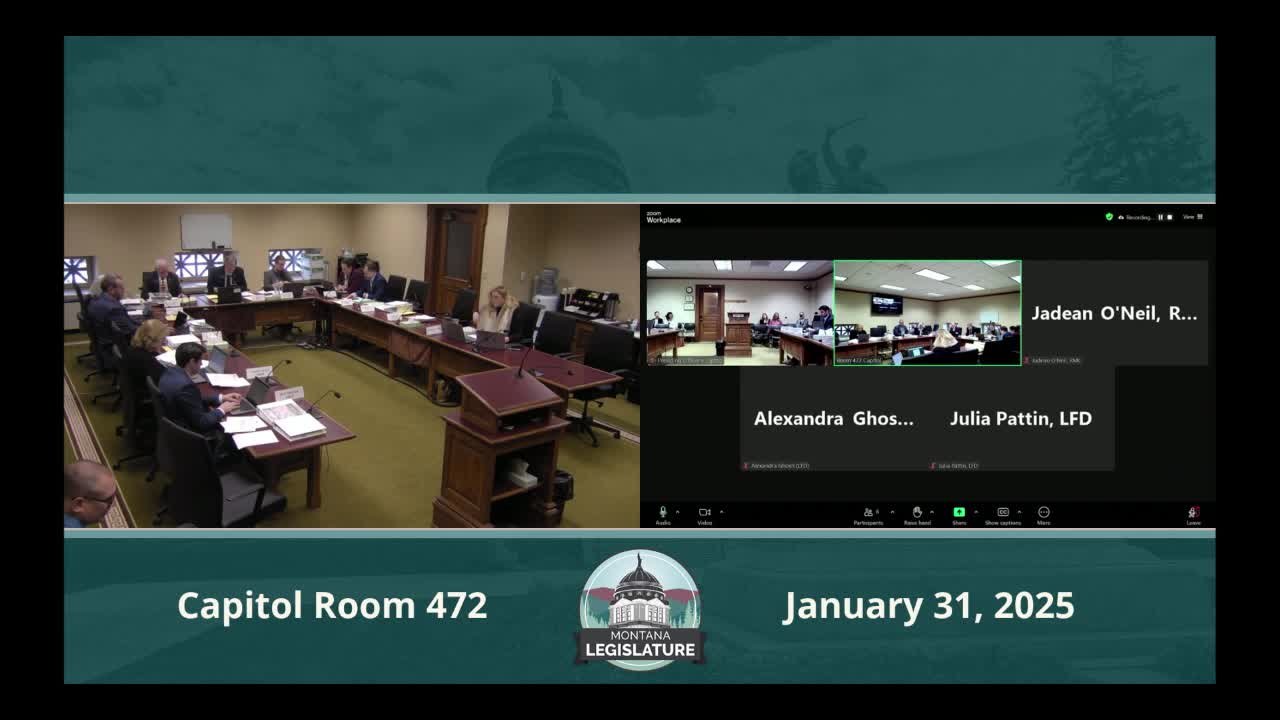
Appropriations subcommittee approves splitting Montana State Library into three programs
Summary
The committee voted to establish three programs—Central Services; Patron and Local Library Development Services; and GIS Data and Information Services—for the Montana State Library and discussed funding sources, declining balances in the Montana Land Information and 9‑1‑1 accounts, and next steps on fiscal analysis and decision packages.
The Joint Appropriations Subcommittee on Education voted unanimously to establish three programs for the Montana State Library (MSL): Central Services; Patron and Local Library Development Services; and GIS Data and Information Services. The committee’s vote followed a budget hearing and an extended discussion of funding streams, program responsibilities and projected fund balances.
Alexandra Ghosh, a legislative fiscal analyst with the Legislative Fiscal Division, presented a potential program breakout and accompanying fiscal addendum that split the previously single MSL program into three functional areas. The analysis showed the proposed central services budget would include about $979,000 in personal services and a reclassification of $165,000 from operating to debt service tied to a new building lease. Overall, the executive request for the library breakout was roughly $371,000 (5.2%) higher than the FY25 base for the central services portion, driven mostly by statewide present law adjustments.
The committee and library staff focused heavily on two state special revenue streams: the Montana Land Information Account (MLIA) and the Coal Severance Tax Library Account. Analysts showed MLIA revenues peaked in 2022 and were projected to decline, producing negative ending balances in some forecasts for FY26–FY27; the committee discussed options including reducing appropriations from MLIA, shifting costs to other sources, or adopting the executive request unchanged.
Committee members also raised concerns about a projected deficit in the 9‑1‑1 GIS mapping account used to support next‑generation 9‑1‑1 mapping services. Melissa Briggs, central services administrator for the State Library, told the committee that statewide present law pay and fixed‑cost increases raise appropriation obligations even where statutory cash amounts remain unchanged—creating “unfunded mandates” in state special revenue funds that the agency addresses by cutting other expenditures rather than overdrawing accounts.
State Librarian Jenny Stapp and other library staff explained that some positions and supervisory time cross program areas (for example, staff who supervise both GIS work and patron services), which produced “wonky” line‑item movement when the single program was reallocated into three. Stapp said the agency would work with fiscal staff to refine the breakout and align decision packages and position funding if the subcommittee’s program division is finalized.
Vice Chair Fuller moved to establish the three programs; the committee adopted the motion by voice vote with no recorded opposition. Committee members asked staff to produce a revised, fully flushed fiscal analysis and decision packages to accompany the three‑program structure before the committee’s executive action deadline.
The subcommittee set follow‑up work for the next two weeks to refine the library’s program budget lines and reconcile MLIA, coal severance and 9‑1‑1 fund balances with the proposed program breakout.