Get Full Government Meeting Transcripts, Videos, & Alerts Forever!
Get email alerts on the Transgender Sports And Privacy topic
No spam. Unsubscribe anytime.
Montana committee hears sharply divided testimony on HB300, a bill that would define discrimination in education and limit male participation in female sports
Summary
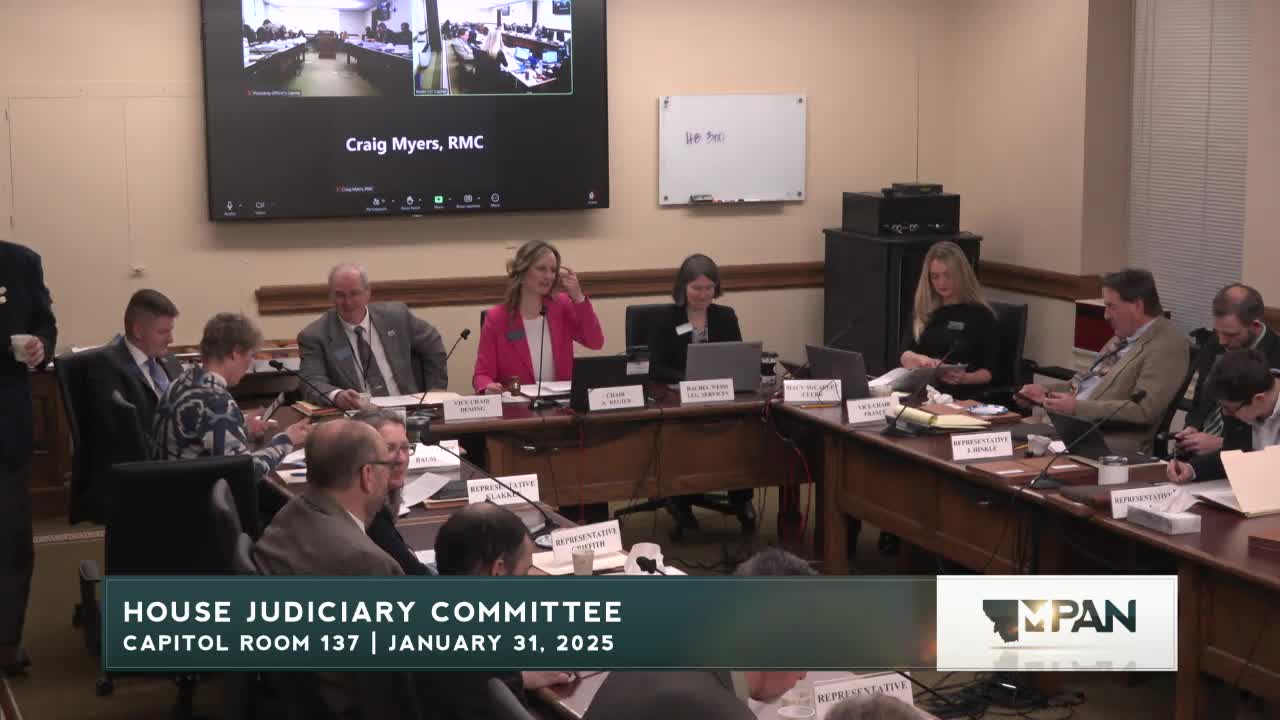
Representative Carrie Seekins Crowe, the bill sponsor, opened the House Judiciary Committee hearing on House Bill 300 and urged members to give the measure a "do pass" recommendation, saying the text would "provide additional clarity to our discrimination in education laws" and protect women's athletic opportunities and private spaces.
Representative Carrie Seekins Crowe, the bill sponsor, opened the House Judiciary Committee hearing on House Bill 300 and urged members to give the measure a "do pass" recommendation, saying the text would "provide additional clarity to our discrimination in education laws" and protect women's athletic opportunities and private spaces.
The bill would amend Montana's discrimination-in-education provisions to specify that denying females access to single-sex facilities or to athletic opportunities designated for women would be unlawful discrimination. Supporters framed the measure as a restoration of Title IX's protections for female athletes and a way to give women a legal path to file complaints under the state's human-rights code. "I urge my colleagues to support this critical piece of legislation and please vote for a due pass," Seekins Crowe told the committee.
Proponents included representatives of the governor's office, conservative advocacy groups and women's sports advocates. Dylan Klapmeier, Gov. Greg Gianforte's education policy adviser, said the governor supports HB300 and described the bill as a way to strengthen the 2021 Save Women's Sports Act; Klapmeier quoted the governor's characterization that "men do not belong in women's sports, in women's bathrooms, or in women's shower rooms." Advocates such as the Montana Family Foundation and Independent Women testified that the bill would protect female athletes' scholarships and privacy.
Opponents included health providers, civil-rights groups and transgender-rights organizations, who warned the bill would stigmatize and exclude transgender students and could have broad consequences for schools and campuses. Sean Reagor of BridgerCare said, "BridgerCare strongly opposes House Bill 300," adding that measures that exclude and stigmatize transgender people harm mental and physical well-being and could create barriers to school participation. Khadija Davis of the ACLU of Montana told the committee that "trans athletes make up a minuscule percentage of student athletes" and urged members to vote no.
Officials from higher education cautioned about compliance risks. Galen Hollenbaugh, deputy commissioner for government relations and communications at the Office of the Commissioner of Higher Education, told the committee that, if enacted as written, "Section 3 ' would place the Montana University System out of compliance with NCAA policy regarding transgender athletes," and that Section 4's language about access to sleeping quarters could expose residence halls to litigation.
Witnesses and committee members debated legal precedent. Counsel for Alliance Defending Freedom and other proponents cited federal and state law and urged that the bill would clarify the meaning of discrimination under the Montana Human Rights Act and Title IX. Opponents pointed to recent Montana and federal court decisions: committee members and witnesses discussed the Barrett decision (a Montana court ruling that struck down earlier university-directed legislation) and the Ninth Circuit and U.S. Supreme Court filings in challenges such as Hecox v. Little in Idaho.
Several witnesses and agency representatives told the committee that precise data were not available in the hearing record. Office of Public Instruction Superintendent Susie Hedlund said she had been in the job "three weeks" and did not have numbers on how many transgender students are participating in Montana sports. Witnesses on both sides cited national estimates in testimony: proponents invoked legal and anecdotal examples of what they described as harms to women's sports; opponents cited analyses and NCAA statements that transgender athletes represent a very small share of participants.
Committee members pressed witnesses on practical enforcement questions: how schools would determine eligibility or privacy protections, how the bill would affect intercollegiate membership and postseason play under NCAA rules, and what fiscal and legal costs might follow if litigation results. The committee did not take a final vote on HB300 at the hearing; the sponsor asked for a "do pass" recommendation and the chair scheduled executive action for a later date. The hearing record includes multiple requests from legislators for additional information, including the cost to the state of prior litigation over similar measures and counts of transgender athletes in Montana, which were not provided at the hearing.