Get Full Government Meeting Transcripts, Videos, & Alerts Forever!
Get email alerts on the Operations And Analytics topic
No spam. Unsubscribe anytime.
DPHHS reorganizes operations, centralizes compliance and health data analytics
Summary
The Department of Public Health and Human Services outlined a reorganization that moved compliance and the Office of Health Data and Analytics into Operations Services Division, highlighting steps to reduce repeat audit findings and build analytics capacity tied to Medicaid forecasting.
The Department of Public Health and Human Services on Friday told a legislative subcommittee that it has centralized compliance and data-analytics functions into its Operations Services Division to reduce repeat audit findings and improve financial and data oversight.
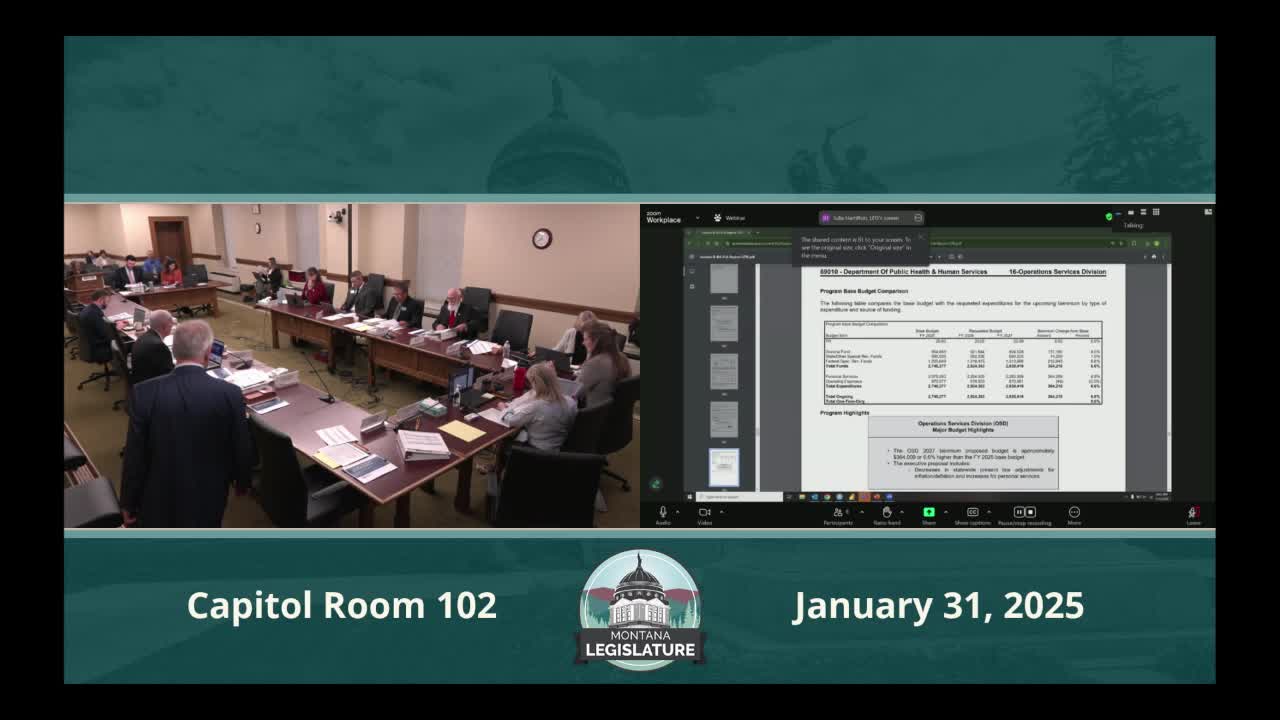
The reorganization moved the Office of Health and Data Analytics and several compliance and internal-control positions into Operations Services Division. Kim Aiken, Chief of Finance and Operations for DPHHS, told the committee the division now has just over 20 full-time-equivalent positions and that the division’s base budget is about $2.7 million, with the executive request at roughly $2.9 million per year of the upcoming biennium.
The change matters because the department said repeat audit findings from the Legislative Audit Division prompted a centralized approach to monitoring subrecipients, clarifying “what it is to have a vendor relationship or a subgrantee relationship,” and better tracking corrective actions. The department also emphasized that moving the analytics and compliance work into one division should improve consistency in controls and program support.
Aiken described the compliance goal as reducing repeat audit findings and providing technical assistance and common processes across programs. “Subrecipients generally are entities, providers essentially that take on the functions of a grant award that are essentially granted to the department,” Aiken said. She contrasted that with vendors or contractors: “In a vendor relationship, we’re procuring goods or services, and that would be a contractor. And those relationships do not have the same reporting requirements. The state retains those.”
On analytics, Aiken said the Office of Research and Data Analytics — which includes the Office of Health Data and Analytics and staff who produce Medicaid projections — was moved back into Operations Services after earlier shifts between technology and operations. Paul Bellotti, who leads the office, has begun outreach to Montana universities and has statements of work to hire analytics partners. Aiken told the committee two positions for analytics are currently advertised and she reported substantial applicant interest.
Committee members pressed whether the department planned to use artificial intelligence tools. Aiken said some recently funded system replacements would allow future AI use but “we’re nowhere close to that today,” and added that the executive branch coordinates AI pilots with the state’s SITSD (State Information Technology Services Division).
The department described several personnel and accounting consequences of the reorganization: 12 position base (PB) units moved into the division in the interim, and an amount transferred for those PBs exceeded the actual need, producing a small negative adjustment in the fiscal detail. The division’s budget changes were driven largely by personal-services increases for pay adjustments and by statewide present-law adjustments.
The department said compliance centralization includes work to improve subrecipient monitoring and risk assessments, to avoid excessive monitoring of low-risk subrecipients and to strengthen scrutiny of higher-risk ones. Aiken and staff said the changes respond in part to audit findings that grew more frequent after new federal funding streams such as ARPA increased the number of subrecipient relationships.
Lawmakers asked for more collaboration with MARA (Montana’s data advisory group) and with the Department of Administration’s chief data officer; Aiken and Bellotti said informal contacts already exist and that the department could expand coordination.
The presentation included performance data: the division’s fiscal 2024 appropriation was about 72.8% expended overall, with general-fund spending at roughly 96.8% expended. Aiken said the division’s work is primarily personal services and operating expenses; it was “administrative” rather than grantmaking or benefits-focused.
The department said it will continue to report back to the committee with details on subrecipient monitoring and analytics staffing as hires proceed.
Ending — The subcommittee did not take formal action during the presentation; members asked the department to provide additional documentation about analytics collaborations and to return with more detail on the subrecipient-monitoring tools and timelines.