Get Full Government Meeting Transcripts, Videos, & Alerts Forever!
Get email alerts on the Jury Excusal 75 topic
No spam. Unsubscribe anytime.
Committee Hears Bill Letting Montanans 75 and Older Opt Out of Jury Service on Request
Summary
Senate Bill 137 would allow prospective jurors aged 75 or older to be excused from jury service upon request. Proponents cited rural travel distances and mobility issues; clerks of court asked for procedural simplicity rather than a physician's note.
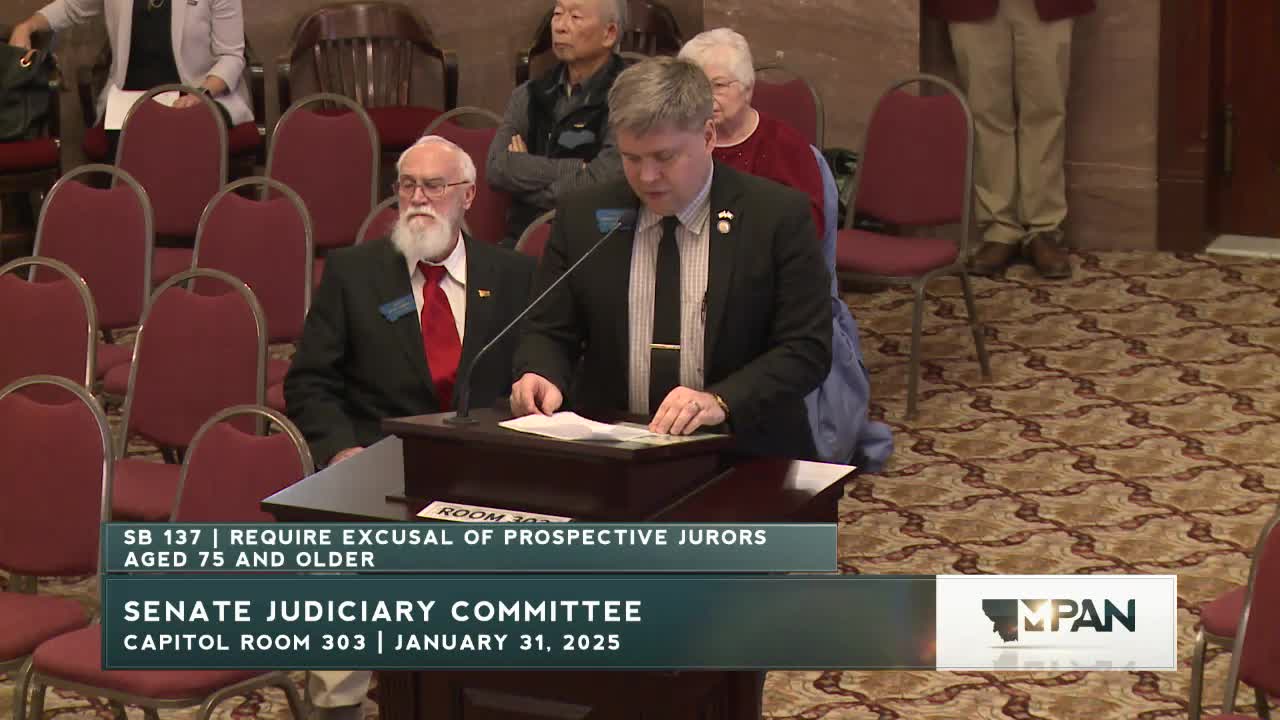
Senate Bill 137, which would permit Montanans age 75 or older to be excused from jury service upon request, drew supportive testimony at a Jan. 14 hearing before the Senate Judiciary Committee.
Sponsor Sen. Jeremy Trevis described the measure as an "opt‑out" accommodation for older citizens who may face long drives to courthouses and physical limitations that make full‑day service difficult in rural districts. "On the request of a person who is 75 years of age or older, the court or jury commissioner shall excuse the person from jury service," Trevis explained during his opening remarks.
Supportive testimony included a range of local officials and county clerks. Russ Temple, a senator from District 14, and Pamela Harada, a Helena resident and 79-year-old supporter, described travel distances, mobility concerns and the prevalence of similar rules in other states. Elizabeth Ball, Roosevelt County clerk of district court and president of the Montana Association of Clerks of District Court, testified the bill would ease the administrative process for older residents and said clerks often receive requests for relief that are sensitive for seniors. Ball asked the committee to allow a simpler affidavit process rather than requiring medical certification for age‑based excusal.
No opponents registered at the hearing. Committee members asked procedural questions about whether the excusal is automatic or opt‑in; sponsor and clerks clarified that the bill creates an option for eligible jurors to be excused on request, not a mandatory removal from the pool.
Why it matters: The bill addresses a practical issue in jury administration for an aging population, especially in rural counties where travel to court facilities can be burdensome. It is a narrow procedural change with limited fiscal impact.
What’s next: The committee closed the hearing and did not take immediate action. If advanced, the bill would change jury‑selection procedures statewide and require clerks and jury commissioners to track age‑based excusal requests.