Get Full Government Meeting Transcripts, Videos, & Alerts Forever!
Get email alerts on the Paid Sick Leave topic
No spam. Unsubscribe anytime.
Montana sponsor outlines paid‑sick‑leave proposal as business groups urge caution
Summary
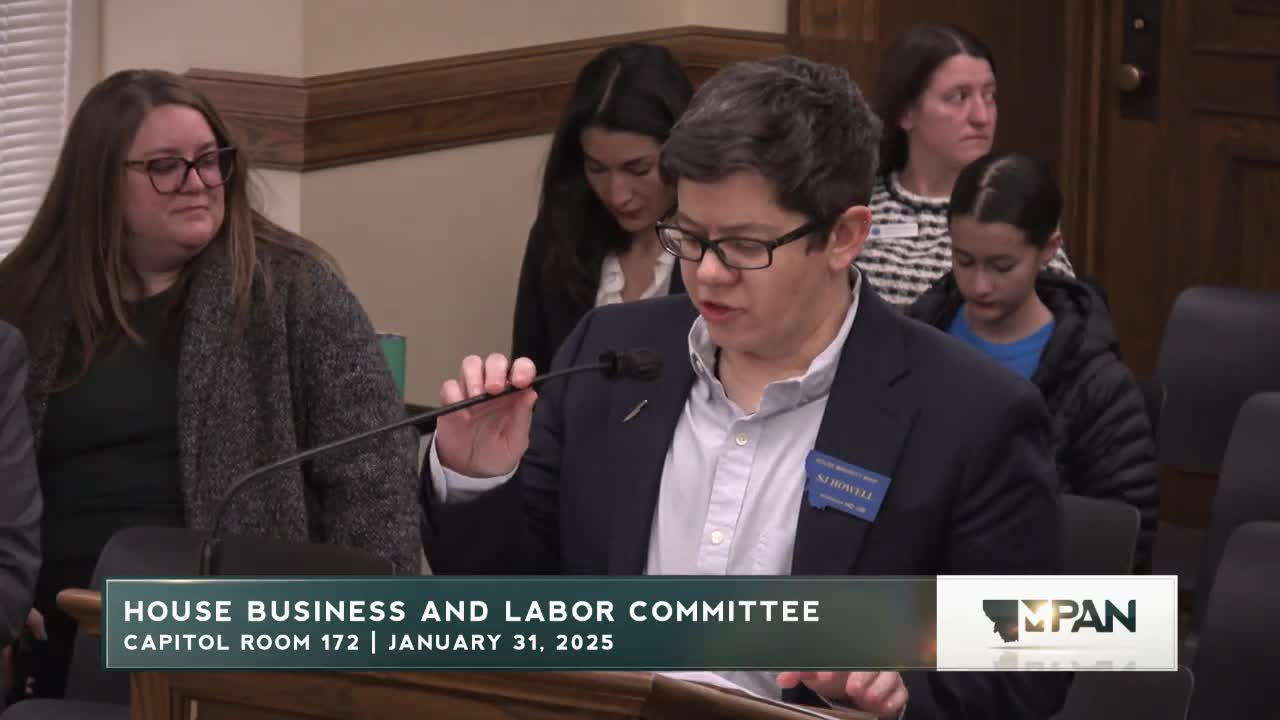
Representative Howell told the House Business and Labor Committee that House Bill 297 “is designed to ensure that all Montana workers have access to 1 of the most basic of workers' rights, paid sick days.”
Representative Howell told the House Business and Labor Committee that House Bill 297 “is designed to ensure that all Montana workers have access to 1 of the most basic of workers' rights, paid sick days.”
Her bill would let employees earn one hour of paid sick leave for every 40 hours worked, up to 40 hours (five days) a year; employees could accrue or carry over time but could not use or accrue more than 80 hours (10 days) in a year. The bill exempts businesses with fewer than 10 employees and exempts employees covered by a collective‑bargaining agreement. The measure also permits use of paid sick time for domestic violence, sexual assault or stalking‑related needs and bars retaliation for using leave.
Why the bill matters
Howell and proponents said the law would reduce disease transmission, increase access to preventive care and reduce emergency‑room visits. “Paid sick days give workers the time they need to recover, to see a doctor, or to take care of a sick kid or a sick family member,” Howell said.
Support and opposition
Supporters at the hearing included public‑policy and health advocates and unions. Heather O'Loughlin of the Montana Budget and Policy Center said the policy addresses workers who “do not have access to paid sick days” and argued leave supports preventive care and reduces ER visits. Kelsen Young of the Montana Coalition Against Domestic and Sexual Violence urged the committee to note the bill’s domestic‑violence provisions, saying they help survivors retain employment while seeking safety.
Opponents included the National Federation of Independent Business (NFIB) and the Montana Chamber of Commerce. NFIB's Rhonda Wiggers told the committee she is not opposed to sick leave per se but warned against adding regulations that limit small businesses' ability to tailor benefits: “We would ask for a do not pass,” she said. Kerry Hegreberg of the Chamber warned the bill could upend employer PTO policies and flagged definitions and record‑keeping as areas of concern.
Technical issues and enforcement
Quinlan O'Connor, chief legal counsel at the Department of Labor and Industry (DLI), described enforcement as a wage‑claim style process and said the agency estimated added workload for wage and hour investigators. The fiscal note included estimated investigator FTE and rulemaking costs; Commissioner Sarah Swanson told the committee that DLI processes wage claims regularly and that the department's estimated enforcement workload was conservative.
Key clarifications from testimony
- Accrual: Employees accrue one hour of sick time per 40 hours worked, prorated for part‑time workers. - Cap and carryover: Employees cannot use or accrue more than 80 hours (10 days) per year. - Small‑business exemption: Employers with fewer than 10 employees are exempt. - Collective bargaining: Employees covered by collective‑bargaining agreements are exempt. - Allowable uses: Personal or family illness, medical care, and needs related to domestic violence, sexual assault or stalking.
Outcome
The committee heard lengthy testimony from proponents and opponents and questioned DLI and the sponsor on implementation and fiscal effects. The transcript does not record a committee vote on HB 297 during the same meeting.
Ending note
Supporters framed HB 297 as modest and aimed at protecting public health and worker stability; opponents cautioned about compliance and administrative costs for small employers. The committee requested additional information on some technical points.