
Board weighs budgeting models, staffing formulas and class-size tradeoffs as treasurer models costs
Get AI-powered insights, summaries, and transcripts
Subscribe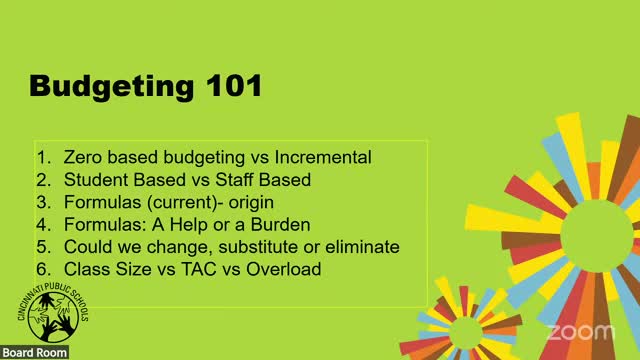
Summary
Treasurer Jen Wagner reviewed 0-based vs incremental budgeting, student-based vs staff-based allocation, and staffing formulas; a scenario with smaller class sizes was estimated to cost roughly $4.9–5.0 million in additional staffing.
Treasurer Jen Wagner and Superintendent Keisha Murphy led a discussion of budgeting models, staffing formulas and the tradeoffs of smaller class sizes on Feb. 1, laying out options for the board as it prepares next year's budget.
Wagner explained the difference between incremental budgeting (adjust the prior year's budget upward) and 0-based budgeting (start from zero and justify every line item). "Incremental budgeting, the budget grows so fast because you never stopped doing anything you did," Wagner said, arguing that 0-based budgeting is labor-intensive but could improve prioritization.
The treasurer also described the district's current "student-based staffing" approach, where projected enrollment and student condition weightings generate staffing formulas (for example, class size loadings and specialist allocations), and contrasted that with more strictly student-based school budgets used elsewhere. Wagner said some school staffing increments (class-size minimums, certain special education formulas) are shaped by collective bargaining agreement provisions, while other formulas (for example, assistant-principal allocations) are district practice rather than contractual mandates.
Wagner presented a staffing simulation: using a model with smaller class sizes (K–3 at 20:1, grades 4–6 at 28:1, grades 7–12 at 30:1) would increase staffing costs by about $4.9 million compared with the January staffing run. She noted that smaller classes increase the number of certified teachers needed while reducing some paraprofessional (para) overload costs; the district currently budgets roughly $4.7 million for overload paras and about $2.1 million for overload pay. "Smaller class sizes means more people," Wagner said.
Board members probed operational impacts: fewer paras can affect lunch and recess coverage, bus supervision, and other non-instructional duties often handled by paras; members noted that Montessori classrooms commonly require dedicated paras, which could affect cost offsets. Several members also cautioned that recruitment realities limit the district's ability to fill new certified positions immediately; the board and administration agreed that filling current vacancies and labor-market constraints are a practical limit on how quickly class-size reductions could be implemented.
Members asked for more granular data: current para vacancy rates, the distribution of paras across buildings, specific recruitment strategies and the operational consequences of shifting funding from paras to certified teachers. Administration and the treasurer agreed to return with more detailed vacancy and cost analyses to inform the board's budgeting choices.