
Board seeks clarity after Taft Elementary Montessori decision; questions about student displacement and transportation
Get AI-powered insights, summaries, and transcripts
Subscribe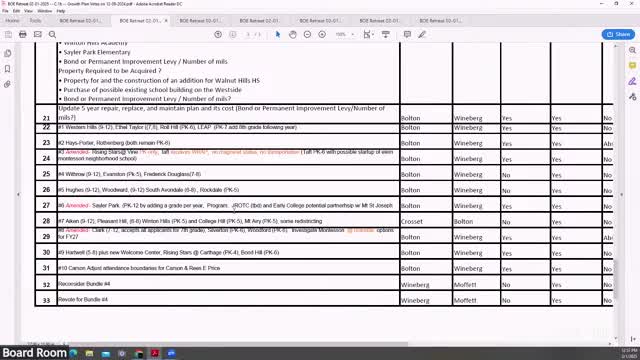
Summary
Board members pressed for clearer information about where Taft students would be assigned after the district approved a Montessori start-up and removed magnet status; superintendent said current pre-K–5 students can remain but transportation will change.
Board members at the Feb. 1 Cincinnati Public Schools meeting pressed administrators for clarity on how a proposed Montessori start at Taft Elementary would affect current students and transportation after the board's December actions.
The discussion began when a board member said she did not recall a definitive decision to convert Taft into a Montessori K–6 school and asked where the roughly 200 students at the school would be assigned. Several members said the December bundle left details unresolved.
Board member Weinberg said she did not believe the board had settled how students would be reassigned, arguing that simply telling families they could go "wherever they wanted to go" was insufficient. "So where are those students going to go? We've never really finished that conversation definitively that I heard," Weinberg said.
Superintendent Keisha Murphy replied that, following the December meeting, the board's action did not force current students to leave. "All of the students who are at Taft right now, pre k through 5, will be able to remain at Taft pre k to 5," Murphy said, adding that the Montessori startup would begin with preschool rather than converting all grades at once. She described a multi-year transition that could span roughly six to seven years to fully matriculate new Montessori cohorts while grandfathering existing students.
Murphy and board members also clarified other elements tied to the December bundle: the school's magnet status would be removed (which removes the district-funded transportation entitlement), preschool from Vine would move to Taft to preserve programmatic capacity, and the district had discussed grandfathering arrangements and limited transitional transportation in the short term.
Board members raised concerns about where students who currently ride district transportation to Taft would be assigned if they did not choose to stay, and whether neighborhoods that would receive those students would be able to absorb enrollment changes. Murphy said the district can determine neighborhood assignments by address and provide that information, but she also acknowledged additional family engagement and detailed transition planning would be required.
Members requested more specific data and family outreach results, including enrollment by feeder area, how many families indicated they would remain or need transportation, and the timeline and costs for any transitional transportation supports. Treasurer Wagner and administration were asked to provide a detailed Phase 1 accomplishments/data sheet covering enrollment, capacity and costs for the repurposing work as a board assignment.