Get Full Government Meeting Transcripts, Videos, & Alerts Forever!
Get email alerts on the Child Protection Roles topic
No spam. Unsubscribe anytime.
Panel hears bill to define child-protection investigator and reunification specialist roles
Summary
Senate Bill 206 would codify separate child-protection investigator and child‑reunification specialist roles; the department said many regions already separate duties but rural staffing limits and potential fiscal needs were raised.
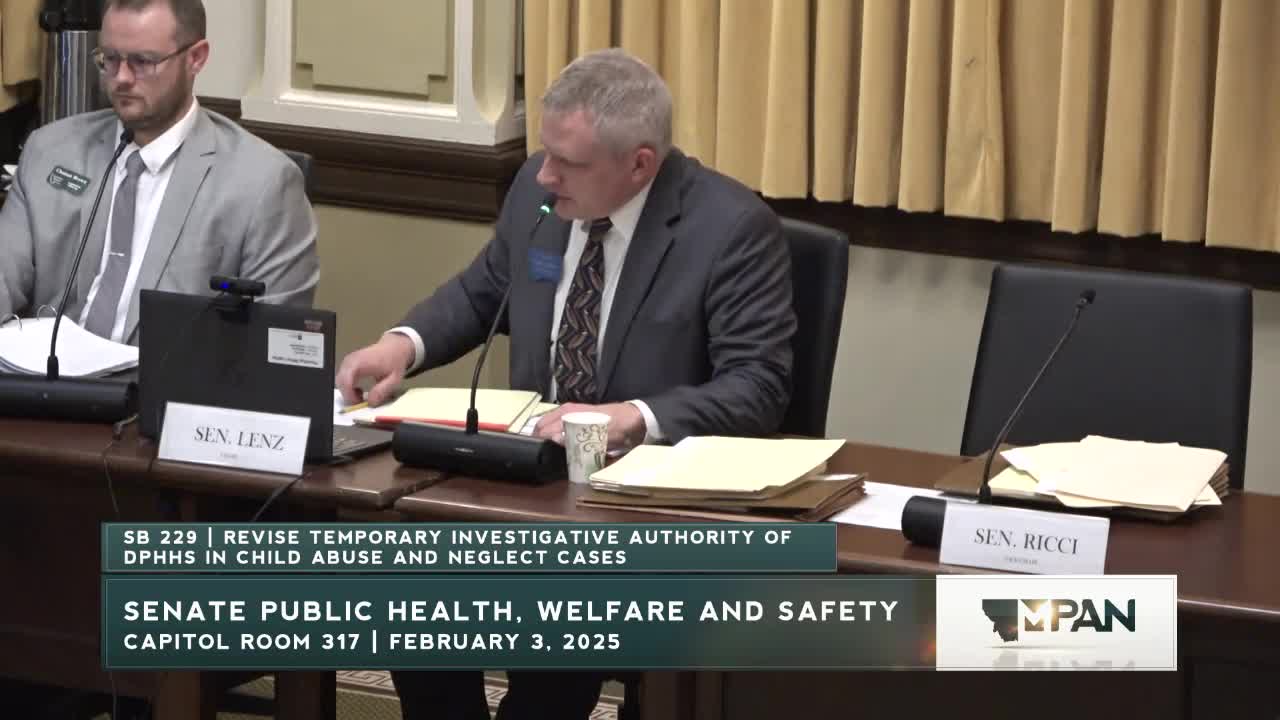
Senate Public Health Committee took testimony on Senate Bill 206, introduced in the Senate by Sen. Dennis Lenz on behalf of Sen. Fuller. The bill would define and codify the roles of a child-protection investigator and a child-reunification specialist in state law and set where the roles are described in statute.
Sen. Dennis Lenz told the committee the intent is to create a clearer separation between the person who conducts an investigation and the person who works on reunification, so parents removed from their children do not have to engage with the same worker who completed the removal. “What I'm trying to do with this . . . is not put parents in the situation where the social worker that took their child is the same social worker that then they have to work with,” Lenz said when introducing the bill.
Nikki Grossberg, division administrator for Child and Family Services at the Department of Public Health and Human Services, appeared as an informational witness and said many local offices already separate intake/investigative duties from ongoing reunification work. Grossberg warned the statutory change could strain resources in rural areas where staffing is limited. “We would need additional staff in areas that we actually have a really hard time hiring staff,” Grossberg said, noting the division has submitted a fiscal-note request and that vacancies and turnover could limit implementation even if positions were authorized.
Committee members and witnesses discussed prior attempts to assign a single worker to a case for the entire lifecycle. Grossberg recalled the state previously tried a “one worker, one case” approach and found the combined responsibilities overly demanding and prone to turnover; the department returned to separating investigative and ongoing duties. Committee members asked whether the bill would require an appropriation or be phased by population; the sponsor said he planned to propose amendments that would limit implementation by population thresholds to reduce fiscal strain.
The bill also includes timing tied to an expiring temporary section of law (identified in committee as 41-3-102) and an effective date of July 1, 2025, to align with the expiration of temporary statutory language that references the Montana Indian Child Welfare Act. Staff explained that some temporary language in current law is set to expire June 30, 2025, and the bill’s nontemporary sections would take effect July 1, 2025.
No formal vote was taken at the hearing; the sponsor said he will offer amendments and will notify the committee before executive action the following week.