Get Full Government Meeting Transcripts, Videos, & Alerts Forever!
Get email alerts on the Environmental Policy Mepa Ghg topic
No spam. Unsubscribe anytime.
Committee hears wide-ranging testimony on bill to set MEPA greenhouse-gas sideboards after Held decision
Summary
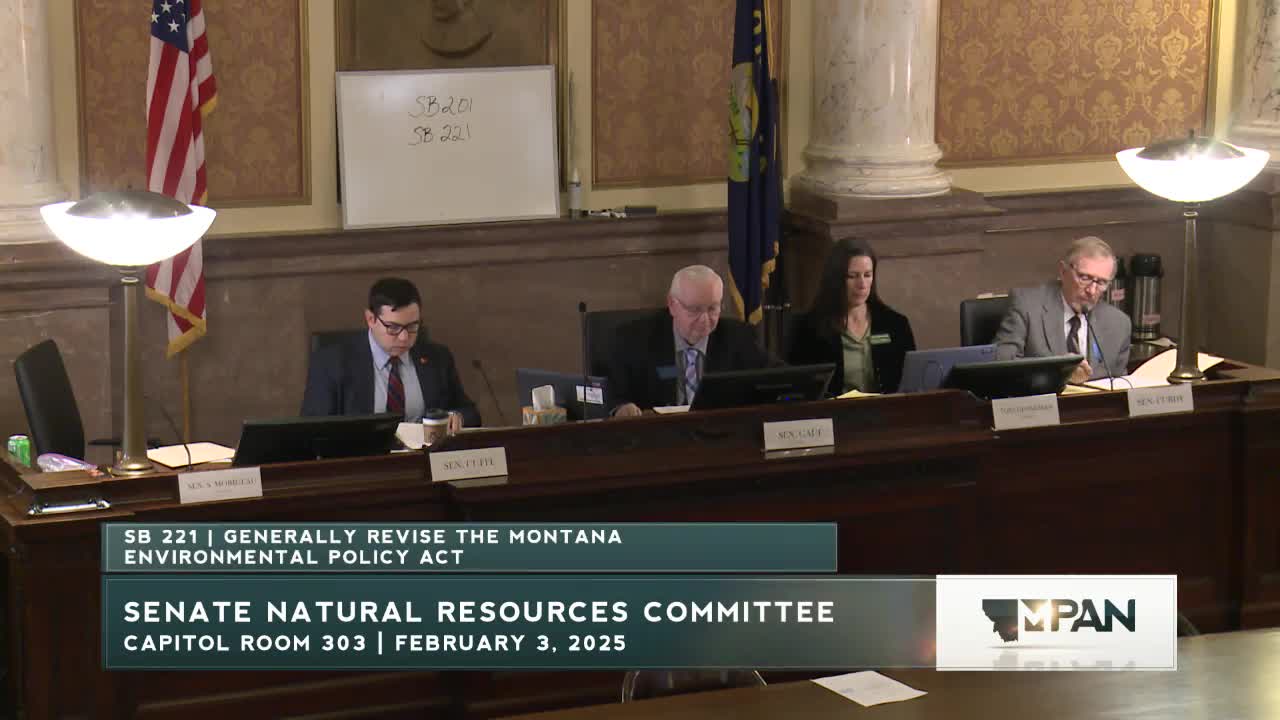
Senator Greg Galt opened a lengthy Senate Natural Resources Committee hearing on Senate Bill 221, which would direct DEQ to issue guidance and narrowly define when greenhouse-gas assessments are required under MEPA following the Held v. State of Montana decision.
Senator Greg Galt, R-Central Montana, opened a Senate Natural Resources Committee hearing on Senate Bill 221, a bill intended to respond to the Montana Supreme Court’s December 2024 decision in Held v. State of Montana by directing how agencies should assess greenhouse-gas (GHG) emissions under the Montana Environmental Policy Act (MEPA).
Sponsor Galt told the committee the bill would "right size" the state’s response to the Held ruling by defining greenhouse gases, specifying when GHG assessment is required, and directing the Department of Environmental Quality to develop public guidance. "This bill provides the DEQ with the direction it needs to provide for regulatory certainty to address the court ruling," Galt said.
Sonia Nowakowski, director of the Department of Environmental Quality, testified in support, saying the bill would give agencies "reasonable sideboards" and require DEQ to prepare guidance for public comment. "Senate Bill 221 provides that direction," she said, arguing the bill would limit analysis to emissions and impacts "approximately caused by the proposed action" and focus agency resources on fossil-fuel activities most likely to generate significant GHG impacts.
Industry groups and local economic organizations provided wide support. Testimony in favor came from the Treasure State Resources Association, Montana Chamber of Commerce, Montana Building and Construction Trades Council, Montana Mining Association, Northwestern Energy, DNRC, the Montana Coal Council, city and county chambers, and major trade associations; proponents said the bill would restore permitting predictability and protect jobs and investment. Todd O'Hair of the Montana Chamber and Jay Reardon of the Building Trades urged the committee to approve the bill as a way to avoid protracted litigation and provide clear permitting expectations.
Many proponents stressed a narrow focus: several supported limiting analysis to activities such as fossil-fuel production and excluding distant upstream or downstream combustion effects. Daryl James of Westmoreland Mining described SB 221 as a "Goldilocks bill" that "doesn't do too little; it doesn't do too much," and urged a balanced, procedural approach that preserves MEPA as a disclosure process rather than a regulatory veto.
Opponents — including the Montana Environmental Information Center, Montana Conservation Voters Education Fund, Montana Audubon, the Blackfeet Tribe and Northern Plains Resource Council — said the bill unduly narrows MEPA and would prevent agencies and the public from learning about reasonably foreseeable, cumulative and downstream greenhouse-gas impacts. Anne Hedges of the Montana Environmental Information Center said the bill’s sideboards amount to "blinders" and warned that narrowing the definition of "proposed action" to exclude upstream and downstream impacts would "gut" MEPA’s core public-information function.
Other opponents emphasized practical harms if upstream and downstream emissions are excluded, including effects on agriculture, recreation and tribal hunting and gathering rights. Patrick Yawake, representing the Blackfeet Tribe and others, testified the bill would weaken government-to-government consultation and tribal awareness of off-reservation impacts. Environmental witnesses cited studies projecting job losses in recreation and agriculture and maps showing habitat losses for species such as greater sage-grouse under warming scenarios.
Several committee members asked technical and constitutional questions. Senator Flowers pressed the DEQ director on the bill’s use of the term "proximate" impacts and how that squares with MEPA’s historical inclusion of indirect and cumulative effects; Nowakowski replied DEQ would draw on prior MEPA work-group work and case law to craft defensible guidance focusing agency effort where impacts are most directly tied to the proposed action. Opponents argued the bill would invite litigation and not settle the constitutional issues raised by the Held decision.
No committee vote was recorded at the hearing. The sponsor closed by asking for consideration of the bill; members indicated divergent views and multiple follow-ups were requested. DEQ said it would reconvene the MEPA work group and offer draft guidance for public notice and comment if the legislature provided the direction the bill proposes.
Senate Bill 221 proposes to (1) define greenhouse gases consistent with national/international practice, (2) require GHG assessments for designated fossil-fuel activities, (3) limit agency review to impacts "approximately caused" or "proximate" to the proposed action unless required by federal partners, and (4) require DEQ to issue guidance subject to public notice and comment. Supporters argued those sideboards will reduce litigation and provide predictability; opponents said the limits are inconsistent with the state constitution and MEPA’s disclosure purpose.