Get Full Government Meeting Transcripts, Videos, & Alerts Forever!
Get email alerts on the Child Protection Temporary Authority topic
No spam. Unsubscribe anytime.
Bill would restrict child removal authority tied to temporary investigations, sponsor says
Summary
Senate Bill 229 would bar Department of Public Health and Human Services from using temporary investigative authority to remove children; sponsors said courts must separately approve removals outside immediate-emergency provisions.
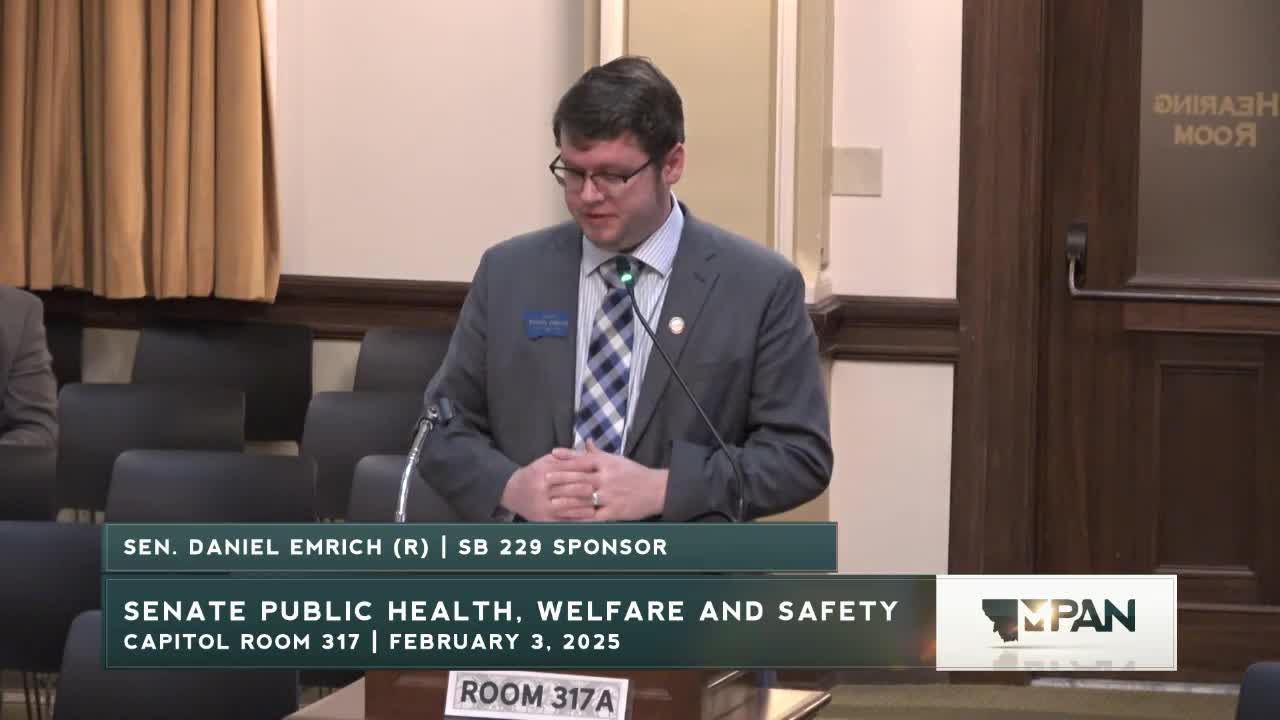
Senate Public Health Committee heard Senate Bill 229, a measure to clarify that the Department of Public Health and Human Services’ temporary investigative authority may not include authority to remove a child except under immediate-emergency removal provisions. Sen. Daniel Emrich, the sponsor, explained the bill’s purpose and answered committee questions.
“It's entitled an act to revising the temporary investigative authority of the Department of Public and Human Services in child abuse and neglect proceedings, prohibiting the removal of a child pursuant to a temporary investigative authority,” Sen. Daniel Emrich said when introducing the bill. Emrich told the committee that courts have, in practice, sometimes granted removal authority when approving temporary investigative authority and that the bill would require the department to petition the court separately under the emergency protective-services statute (40-3) if it seeks removal outside immediate-emergency provision.
An informational witness from the department, Nikki Grossberg, division administrator for Child and Family Services, told the committee the department routinely seeks emergency protective services authority alongside temporary investigative authority and that the operational practice would not necessarily change under the bill. “We also always ask for emergency protective services hearing or emergency protective services authority when we ask for temporary investigative authority,” Grossberg said, describing current court practice and the department’s process for removing a child when necessary.
Committee members asked how the process works now and whether the bill would change operations. Grossberg explained the department’s investigation authority derives from statute cited in testimony (identified as 41-3-202 in hearing exchange) and that, in practice, the department frequently requests emergency protection concurrently with temporary investigative authority so removal authority is available if needed. Emrich said the bill seeks to restore clearer court oversight by ensuring removal authority is obtained separately unless exigent circumstances permit immediate removal under current emergency statutes.
No proponents or opponents appeared in the record beyond the informational witness, and the committee took no formal vote during the hearing. Emrich noted a related House bill was under consideration that could eliminate the temporary investigative authority entirely; he told the committee that if that House bill passes, the purpose of SB 229 could be superseded.