Get Full Government Meeting Transcripts, Videos, & Alerts Forever!
Get email alerts on the School Health Epinephrine topic
No spam. Unsubscribe anytime.
Senate committee considers bill to allow nasal epinephrine in Montana schools
Summary
Senate Bill 211 would add epinephrine nasal spray to the list of emergency drugs schools may keep, a change proponents said is less invasive and could reduce delays in treating anaphylaxis; no formal vote was taken at the hearing.
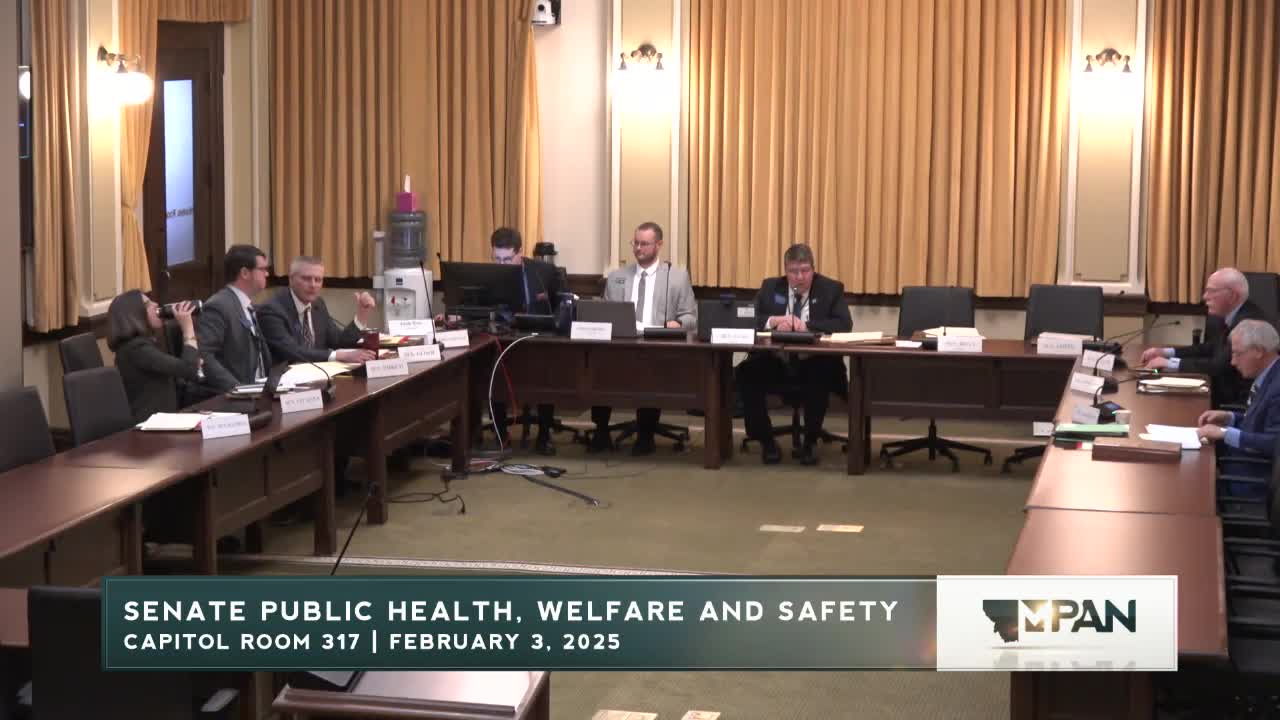
Senate Public Health Committee members heard testimony on Senate Bill 211, a bill to add epinephrine nasal spray to the list of emergency medications schools may keep and administer, at a Senate Public Health hearing. Sen. Cora Newman, the bill sponsor, opened the hearing and described personal and clinical reasons for the change.
The bill would amend existing school-health code (listed in the bill as sections 20-5-420 and 20-5-421) to permit an epinephrine auto-injector or an epinephrine nasal spray to be stored in schools in a secure, easily accessible location and used in emergencies. “This is a bill . . . revising the emergency use of epinephrine in a school setting to include nasal spray,” Sen. Cora Newman said as she introduced the measure and described a past anaphylaxis event involving her son.
Proponents told the committee that nasal epinephrine is an FDA-approved, single-spray option that produces comparable blood levels to injectable epinephrine and may reduce hesitation to treat. “In studies, nasal epinephrine produces the same blood levels of epinephrine as the auto-injected form,” said Dr. Marion Coomer, a retired pediatrician testifying for the Montana Chapter of the American Academy of Pediatrics. She described the spray as “given with 1 spray and 1 nostril.”
Health associations and school-nursing advocates testified in support. Stacey Anderson, representing the Montana chapter of the American Academy of Pediatrics, urged the committee to update state code to reflect the availability of nasal epinephrine. Vicky Byrd, CEO of the Montana Nurses Association and speaking for the Montana Association of School Nurses, said a nasal spray is “much less invasive than the injectable pen” and compared it to prior legislation that authorized nasal naloxone in schools. Jean Branscum, CEO of the Montana Medical Association, noted the product’s federal approval: “This is a medication that has been approved by the US Food and Drug Administration for emergency treatment of allergic reactions for both adults and the pediatric patients.”
Witnesses and committee members discussed operational details and prevalence. Lisa Flanagan, president of the Montana Association of School Nurses and a school nurse, said the state does not keep a registry of which schools carry epinephrine and that the number of doses administered statewide is not tracked. Committee members asked whether sprays are single-use and how many doses schools receive; Coomer replied that each container provides one spray and that product-purchase programs can supply two sprays per purchase and that some manufacturers offer limited free units to schools.
The bill text includes an immediate effective date and specifies that auto-injectors and nasal sprays must be kept in secure, easily accessible locations and that use and storage would be guided by medical professionals and school policy. No formal vote or motion occurred during the hearing; committee discussion was limited to questions and testimony.
The hearing record does not show formal opposition. The committee adjourned without taking final action on SB 211; the sponsor and proponents said they hope the committee will move the measure forward for further consideration.