Get Full Government Meeting Transcripts, Videos, & Alerts Forever!
Get email alerts on the State Budget topic
No spam. Unsubscribe anytime.
Legislative panel reviews DPHHS Office of Inspector General budget, oversight work and fraud recovery
Summary
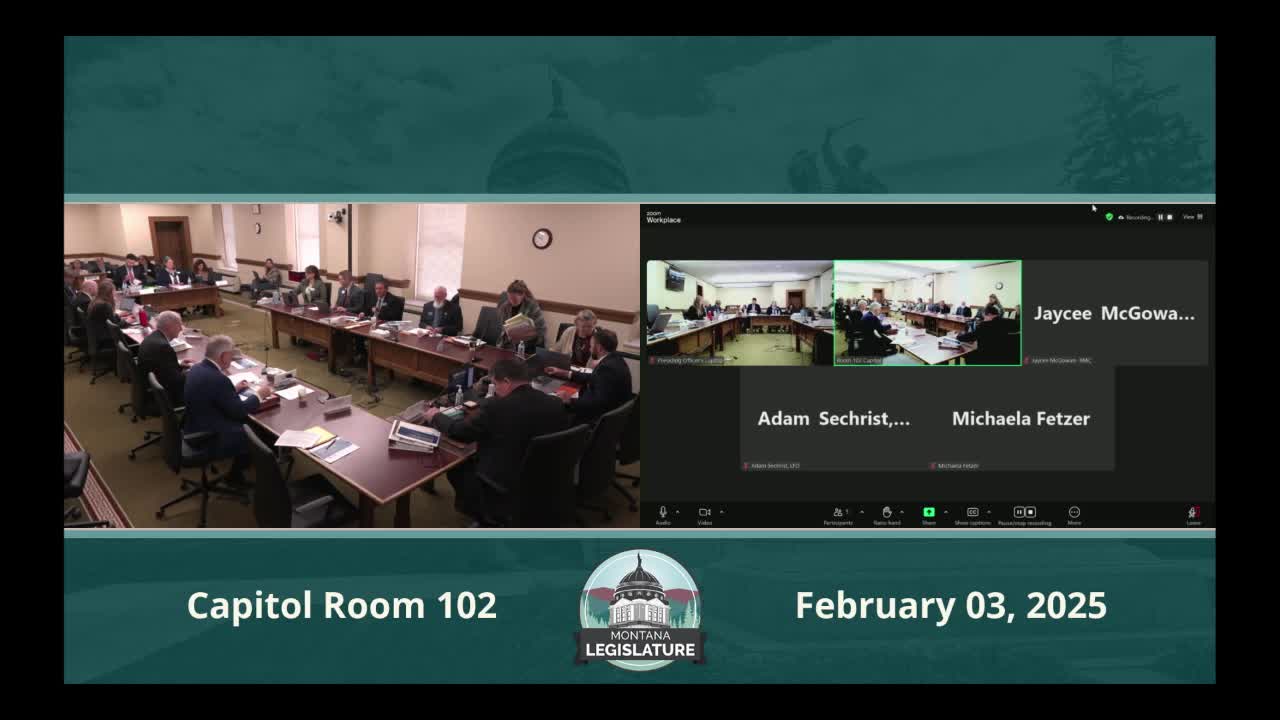
The Section B Committee on Thursday reviewed the Montana DPHHS Office of Inspector General’s budget request and program work, where agency staff described modest biennial increases, a federal funding majority and fraud‑recovery and certification functions that returned millions to Medicaid.
The Section B Committee on Thursday heard a budget presentation and program overview from the Montana Department of Public Health and Human Services Office of Inspector General (OIG), which requested a modest increase in its biennial budget and highlighted program work ranging from certification surveys to Medicaid third‑party liability recoveries.
The inspector general, Michelle Truax, told the committee the OIG “is administratively attached to DPHHS” but operates separately to preserve survey and enforcement integrity. The OIG described three bureaus—Certification, Licensure and Program Compliance—and a program support section that manages federal grants and community needs assessments.
The Legislative Fiscal Division analyst presenting the budget, Mr. Secrest, told the committee that the OIG’s request reflects a 4.7% increase from the 2025 base into the 2026–27 biennium, including an 8.2% rise in personal services and a 5.7% reduction in operating expenses. He said, “the entire appropriation for OIG is HB 2 authority,” and that the OIG’s funding mix in the request is roughly 27.8% general fund, 10.4% state special and 61.8% federal funds.
Why it matters: the OIG regulates and certifies hundreds of health and residential facilities; it also runs program‑compliance units that aim to prevent fraud and recover Medicaid dollars. During fiscal 2024 the division expended 96.9% of its appropriation overall; it used 99.4% of general funds, 69.4% of state special revenue and 97% of federal funds, Secrest said. The division reported that it expended 107.7% of its personal services appropriation and 56.1% of its operating expense appropriation in FY24.
Program work and results - Certification and licensure: The Certification Bureau conducts on‑site surveys on behalf of the Centers for Medicare & Medicaid Services (CMS), and CMS approves certification reports and enforcement letters for certified facilities. The Licensure Bureau conducts state licensure and renewal surveys for more than 1,100 facilities (roughly 900 health care facilities and about 200 community residential facilities), agency staff said.
- Program Compliance: The OIG’s Program Compliance Bureau includes six subunits that investigate recipient fraud (intentional program violations, or IPV), perform Medicaid eligibility quality control (MAQC), conduct provider retrospective reviews (SIRS), and manage third‑party liability (TPL) work. Heather Smith, who oversees program compliance, said TPL efforts produced about $272 million in cost avoidance in state fiscal year 2024 and roughly $12.4 million in collections and recoveries.
- Quality and error measurement: Staff described the federal PERM (Payment Error Rate Measurement) reviews and the state’s MAQC work. The PERM cycle is conducted every three years; Montana’s eligibility error rate shown in the presentation was 0.94% for the most recent cycle, and material differences between PERM and MAQC reporting methods were discussed.
- Grants and projects: The OIG said it received a multi‑year award to start a Frontier EMS Leadership Academy (the agency described this as approximately $250,000 per year for five years) and a separate grant (roughly $424,000, agency staff said) to add IP‑tracking and other tools to the CHIMES eligibility system to help detect online public assistance fraud.
Committee questions and follow‑up requests Committee members pressed the OIG and budget staff for more detail on operating expenses, which agency staff said are driven primarily by travel for inspectors (about 30% of operating costs) and rent (about 30%), with the remainder in repair and maintenance, communications, supplies and software maintenance. Staff said some operating budget figures reflect an “orphan” state special appropriation that moved with medical marijuana responsibilities to the Department of Revenue in 2021 and was not fully reconciled in prior budget builds.
Law‑enforcement and referral practices also drew sustained questioning. Vice Chair Mercer asked whether OIG uses prescription drug monitoring data; Michelle Truax replied, “We do not use that data at all in any of our investigations,” and agency staff confirmed OIG does not currently integrate the controlled‑substance prescription registry into SIRS or other compliance work. The committee sought details on referrals for prosecution and False Claims Act matters; program compliance staff said many recipient fraud cases go to administrative disqualification hearings and that roughly 20 egregious cases are being worked with federal partners; the office could not provide a complete prosecution pipeline during the hearing and agreed to follow up with documentation.
Requested follow‑up from the OIG and agency budget staff included: a bureau‑level breakdown of budgeted positions (PBs) by section; a vendor/account‑code level description of software maintenance and other operating contracts; the dollar total of outstanding recoverable debts and the portion collected in FY24; a detailed breakdown of IPV referrals and prosecution outcomes; and more granular MEQC/eligibility error data (including whether applications originating through the federal marketplace can be separated for analysis).
What did not change No formal actions, votes or bill decisions were recorded during the hearing. Committee members requested additional materials; the Chair scheduled a joint meeting with Section F for the following morning.
Ending The committee concluded by asking staff to supply the requested breakouts and supporting documentation; members said they would review the materials before the next meeting. The OIG agreed to provide the detail and to follow up on prosecution and referral pathways.