Get Full Government Meeting Transcripts, Videos, & Alerts Forever!
Get email alerts on the School Funding topic
No spam. Unsubscribe anytime.
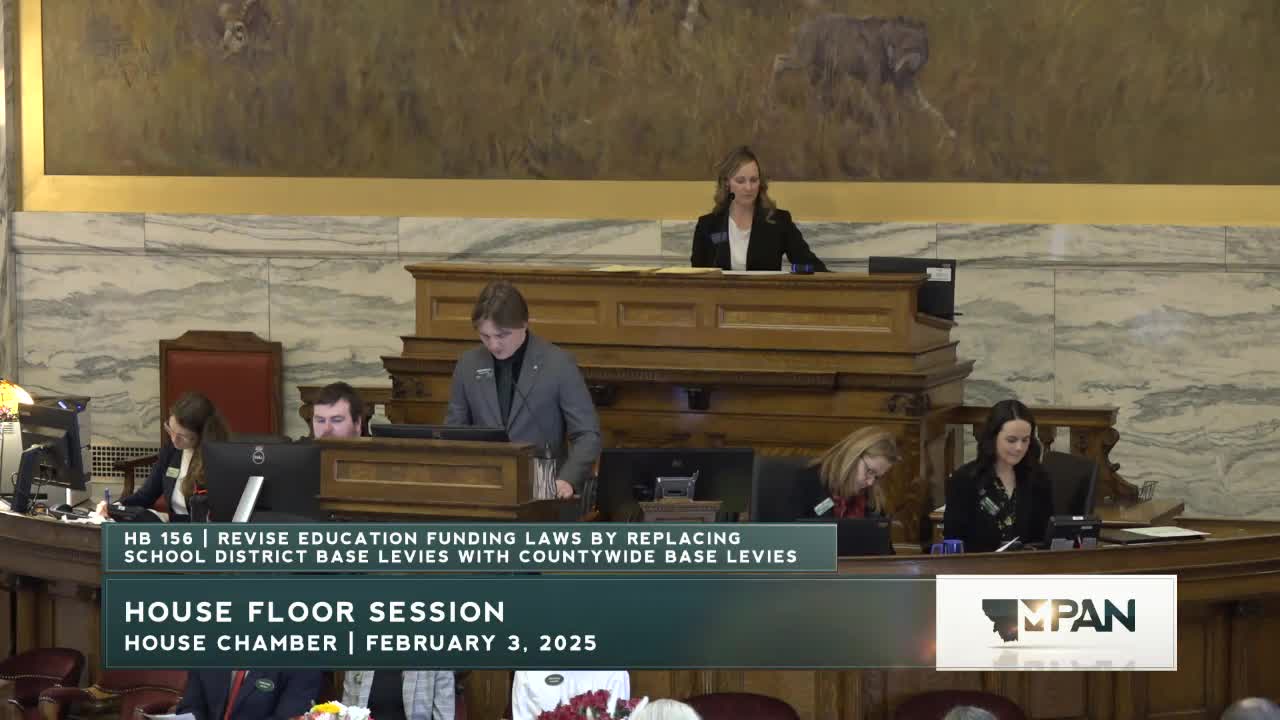
House approves shift to countywide base levy to reshape school funding formula
Summary
House Bill 156 would replace district base levies with a countywide levy aggregated at the county level to change guaranteed tax base aid distribution; the House recommended passage on second reading 80‑20 after extended debate on winners and losers among districts.
Representative Beattie introduced House Bill 156, a lengthy rewrite of school funding statutes that replaces the current district guaranteed tax‑based aid (GTB) base levy with a countywide base levy aggregated at the county level.
Beattie told members the change would aggregate taxable value and enrollment at the county level, producing a single mill rate applied across school taxing jurisdictions within a county. He said advantages include ‘‘more equitable distribution of guaranteed tax base aid across the state,’’ modest property tax reductions for most districts, increased flexibility for districts to use non‑levy revenue such as oil and gas or coal gross proceeds to buy down other levies, and elimination of certain tuition payments created under 2023 public school choice legislation.
Multiple representatives asked technical and geographic questions about winners and losers. Beattie acknowledged his office’s modeling showed tax increases in 67 of approximately 302 taxing jurisdictions, affecting roughly 5% of the state’s students; he gave examples including an 8‑mill increase in parts of Dawson County and a 4‑mill increase in areas of Carbon County. He said most districts would see an average net change of about minus 7 mills statewide when revenue‑use flexibility is considered.
The committee recommended do pass on second reading; the recorded vote was 80 ayes and 20 noes.
Why it matters: the bill would alter how base school funding is raised and redistributed across counties and districts. The change is structural and affects taxation, distribution of state aid, and how districts may apply non‑levy revenue.