Get Full Government Meeting Transcripts, Videos, & Alerts Forever!
Get email alerts on the State Budget topic
No spam. Unsubscribe anytime.
Montana Department of Labor to return $3.6 million to general fund, seeks authority to use state special revenue
Summary
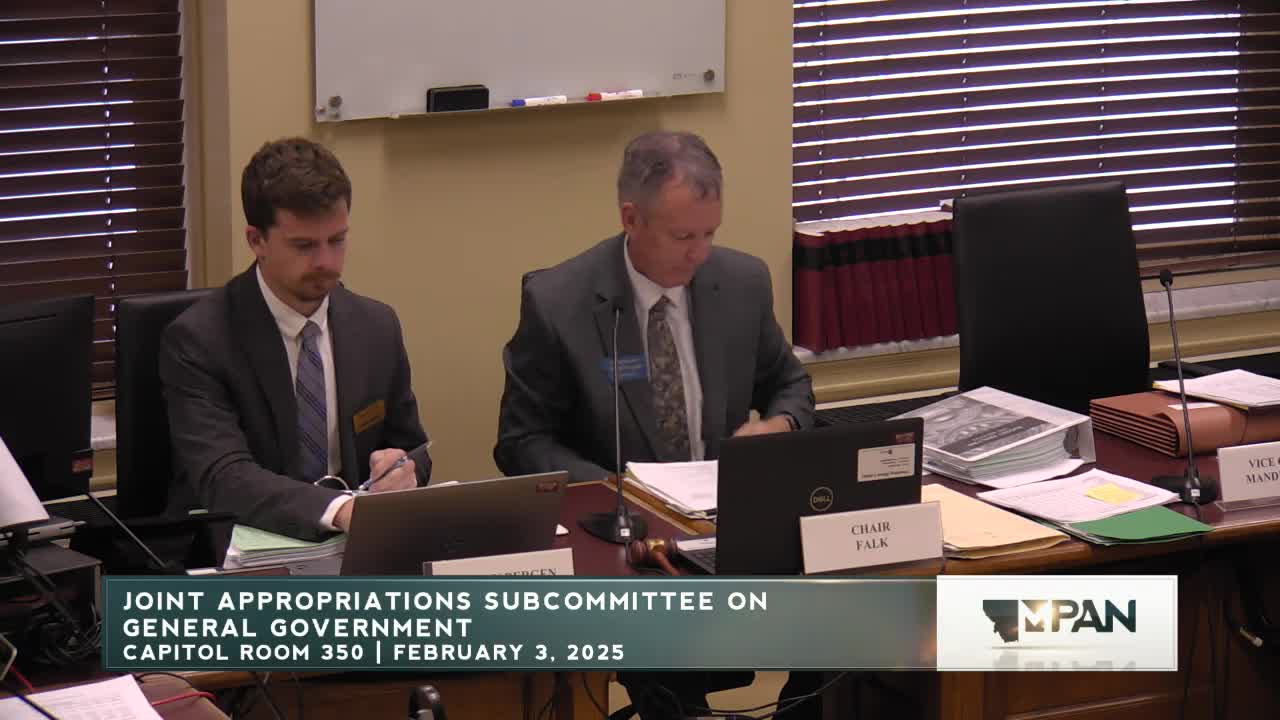
Department of Labor and Industry Commissioner Sarah Swanson told the Legislature's appropriations subcommittee the agency will not seek new general-fund dollars for the coming biennium, proposes returning $3.6 million to the state general fund and asks authority to realign spending to existing state special revenue.
Sarah Swanson, commissioner of the Montana Department of Labor and Industry, told the Legislature's Subcommittee on Appropriations that the department will not request new general-fund dollars in the 2027 biennium and is proposing to revert $3,600,000 back to the state general fund.
Swanson said the return is possible because of operational efficiencies, technology modernizations and ongoing business-process reviews. “We are not asking for any new dollars this year. Rather, we're returning those $3,600,000 to the general fund and we're simply asking for authority to better utilize the state's special revenue that exists within the department today,” Commissioner Sarah Swanson said.
The department budget presented to the subcommittee shows 747 positions budgeted, 656 of which are currently filled and roughly 91 vacancies being held open pending program-by-program business-process evaluations. Swanson told legislators the vacancies are intentionally unfilled while the agency determines which roles are still needed after recent technology upgrades and reorganizations.
Why it matters: the department administers workforce programs, professional licensing and unemployment insurance statewide; how the agency funds those functions affects service delivery timing, rate-setting for employer taxes, and the state's ability to respond quickly to layoffs and employer demand. Committee members pressed staff on how the department reduced baseline OTO spending by 13.1% and where savings were realized.
Budget and program details presented to the committee included: a proposed reduction in general-fund use with a shift toward state special revenue accounts; a multi-division reorganization to centralize some services (including a plan to integrate the Governor's Office of Community Service into the department to relieve general-fund pressure); and continued investments in technology to modernize citizen-facing systems.
Asked about turnover and hiring, Swanson told the committee that hiring is improving, with some recent recruitments drawing dozens of qualified applicants, and that overall turnover has declined year over year. On the information-technology consolidation with the state's SITSD, she said the consolidation has reduced statewide infrastructure costs despite transition pains.
The department's presentation also previewed several decision packages the subcommittee will consider, including increased personal services authority across divisions, additional state special revenue authority for adult basic education if state plan changes pass, and ongoing software maintenance funding for the Montana Unemployment System Environment (MUSE).
The subcommittee asked the department to return with detailed charts and methodology underlying claims of real wage growth and other data points. The department agreed to supply those follow-ups at a later hearing.
Ending: Committee members scheduled follow-up hearings to review decision-package detail, fund balance materials and any statutory language required to move WIOA adult-education responsibilities or the transfer of administratively attached programs.