Get Full Government Meeting Transcripts, Videos, & Alerts Forever!
Get email alerts on the Higher Education Policy topic
No spam. Unsubscribe anytime.
University system outlines shared policy goals on affordability, student success and tribal partnerships
Summary
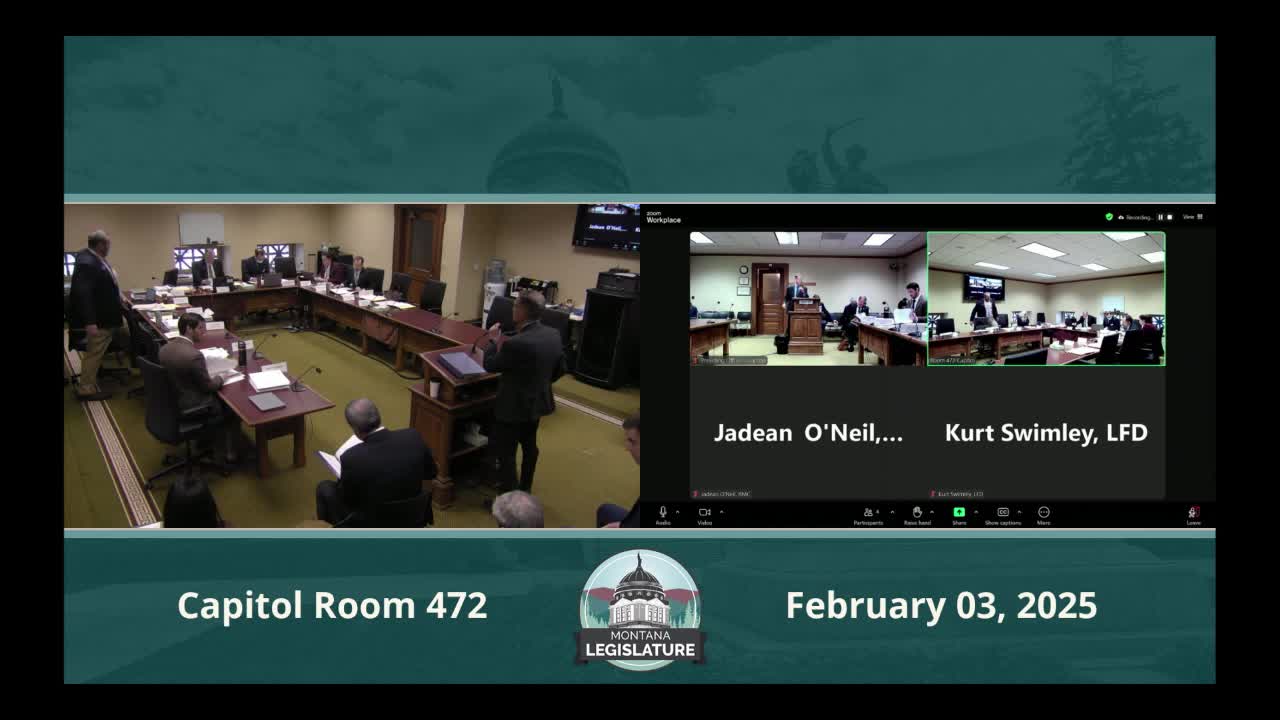
Deputy commissioners and system staff updated the Joint Appropriations Subcommittee on Education on a set of shared policy goals including improvements to the Apply Montana portal, student-success initiative "Montana 10," free-speech guidance, credit-for-prior-learning pilots, expansion of the Digital Academy, and stronger tribal-college ties.
The Office of the Commissioner of Higher Education (OCHE) presented the legislature’s Joint Appropriations Subcommittee on Education with a progress report on shared policy goals, highlighting work on financial-literacy tools, student success initiatives, free-speech training, proficiency-based learning, online course access, and tribal college partnerships.
OCHE Deputy Commissioner Tyler Trevor and Deputy Commissioner Joe Thiel told the panel the system has concentrated resources on data and a single online application portal, Apply Montana, to help students compare costs, financial-aid options and program-to-career wage outcomes. "We have a long history of developing goals and objectives. We're proud of them," Trevor said. Thiel added that updated financial-aid dashboards and centralized FAFSA outreach were recent priorities.
The report said Apply Montana now integrates Montana scholarship information and program-level wage data drawn from the Department of Labor and Industry (DLI) and, where available, U.S. Census postsecondary employment outcomes to show 1-, 5- and 10-year earnings and whether graduates work in-state or out of state. "We've matched all of our programs across the MUS to DLI labor market information," Thiel said, describing side-by-side views of programs and Montana wage outcomes.
Thiel highlighted the Montana 10 student-success pilot, which the system expects to expand, and said system data have been used to calculate performance-funding metrics that factor into state allocations.
Free speech and campus policy compliance were another focus. OCHE said it conducted a systematic review of campus free-speech policies, provided statewide training for campus leadership and created a resource hub on the Montana University System (MUS) website for campuses addressing First Amendment situations.
On proficiency-based education, OCHE described work on credit-for-prior-learning pathways under a "year to career" pilot that maps industry, military and workplace experience to campus credit. Thiel said established assessments such as Advanced Placement, International Baccalaureate and CLEP are part of the approach and that campuses also use internal assessments or portfolios for nonstandard prior learning.
The Digital Academy and dual-enrollment expansion were included in the briefing. OCHE said it has moved to a single learning-management system and expects transition of more than 30,000 courses by summer. The Digital Academy has expanded dual-enrollment pathways, including new educator-preparation options delivered across MUS institutions.
Thiel also described a notable increase in Native student enrollment across the system: a 25% rise over the last decade and a 5-percentage-point increase in the past year, accompanied by higher completion rates. OCHE attributed growth in part to partnerships with tribal colleges and expanded access through the Montana online course exchange; the office named Salish Kootenai College and Stone Child College as new partners in prior-learning and course-exchange efforts.
Career and technical education (CTE) work included a push for "sprint" degrees—compressed programs delivering the same content in roughly 50–75% of the usual time with industry partnerships and internships. OCHE reported six sprint-degree programs launched and three more expected within six months, and it described a Western Montana partnership with Great Falls Public Schools to enroll paraeducators in a bachelor of elementary education that combines work and coursework.
Finally, OCHE said it remains engaged with the education-workforce data governance board and is exploring models used by other states to show students upfront which state scholarship programs and careers they are likely to be eligible for.
Committee members asked for more detail on Apply Montana's return-on-investment data and on veterans' credit pathways; OCHE pointed to use of American Council on Education (ACE) military-credit recommendations and said campuses are directed by Board of Regents policy to recognize such recommendations. The chair asked OCHE to propose refined shared policy goals for committee consideration after the subcommittee completes budget work.
OCHE emphasized its intent to keep building data infrastructure, expand dual-enrollment and continue partnership work with tribal colleges and school districts.
As a next step, OCHE and the subcommittee indicated they would continue to develop and refine shared policy goals and bring specific decision packages back for executive action during budget deliberations.