Get Full Government Meeting Transcripts, Videos, & Alerts Forever!
Get email alerts on the Infrastructure Dnrc topic
No spam. Unsubscribe anytime.
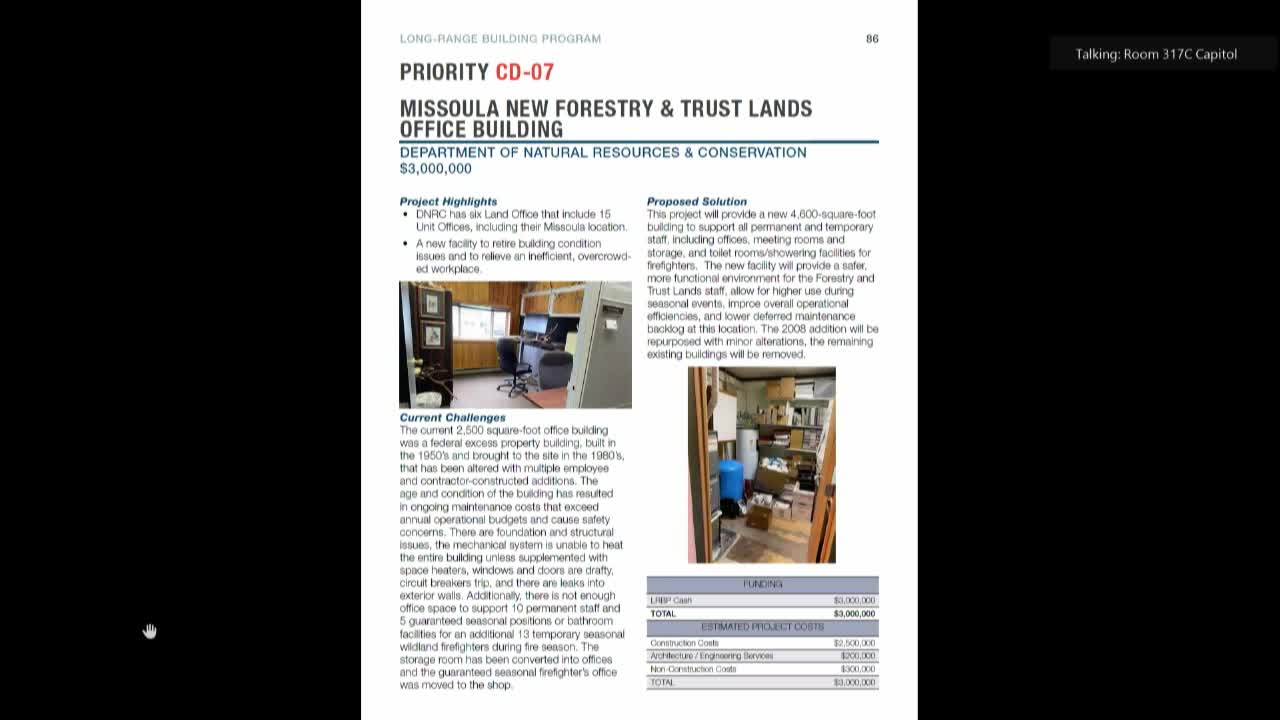
DNRC seeks new Missoula office, bunkhouses in Helena, Libby and Plains to support firefighters and trust‑lands work
Summary
The Department of Natural Resources and Conservation asked the committee to fund a new Missoula forestry and trust‑lands office and three bunkhouses for seasonal firefighters in Helena, Libby and Plains, citing aging facilities and recruitment/retention needs.
The Department of Natural Resources and Conservation asked legislators for capital funding to replace failing office space in Missoula and to build three new bunkhouses that DNRC officials said will improve living conditions and firefighter readiness.
Randy Stevens, planning manager for the A&E Division at the Department of Administration, presented DNRC’s list and described the Missoula New Forestry and Trust Lands office as a $3 million request intended to replace an overcrowded, failing facility. Stevens said the department had “squeezed as much space out of their existing building as possible” and that most of the older building will be removed with a portion repurposed.
DNRC also requested three bunkhouses (listed as CD 8, CD 9 and CD 10) for Helena, Libby and Plains — budgets of about $3.86 million, $4.2 million and $1.93 million were cited — to provide sleeping areas, separate showers and kitchens for seasonal firefighters and other staff. Wyatt Frampton, deputy division administrator for Forestry and Trust Lands, said many of the existing structures are occupied nine months of the year and in some locations housing options near the work sites are very limited: “many of these structures are occupied 9 months out of the year,” Frampton said, and bunkhouses reduce the scramble for temporary housing while improving after‑hours response capability.
Committee members repeatedly questioned the per‑square‑foot costs and urged DNRC and administration staff to compare private‑sector construction and to consider project packaging to attract more competitive bids. Stevens and Catherman (A&E) said the agency attempts to package similar projects to reduce design and procurement costs but that site‑specific civil and geotechnical work can drive up fees for each location.
Why it matters: DNRC’s bunkhouses are pitched as a personnel‑management and readiness tool for wildfire seasons; the Missoula office project supports ongoing trust‑lands management, public services and forestry staff operations.
Next steps: Committee members requested further cost comparisons and prototype drawings for prototype bunkhouse designs that could be replicated across sites. DNRC staff agreed to provide more information as the committee moves to workings on House Bill 5.