Get Full Government Meeting Transcripts, Videos, & Alerts Forever!
Get email alerts on the Water Infrastructure topic
No spam. Unsubscribe anytime.
Joliet details $92 million program to accept Lake Michigan supply; council to consider donated tank site
Summary
City staff outlined a multi-year capital program to accept Lake Michigan water that includes storage tanks, pumping stations, pipelines and a new utilities garage. Council will consider a land donation for a southeast elevated tank and will see loan documents and contract warranties in coming months.
Allison Swisher, director of public utilities, and program staff presented a multi-year plan on Feb. 3 to connect Joliet to a Lake Michigan water supply and reconfigure the city’s distribution system.
The presentation said Joliet will shift from groundwater treated at 11 treatment locations fed by 26 wells to a system receiving water at four delivery points. To move and store that water, staff described roughly $92,000,000 in Joliet-only capital improvements split into work packages that include elevated tanks, ground tanks and standpipes, booster pump stations, transmission mains, rehabilitation of existing pump facilities, and demolition or repurposing of obsolete well sites.
City staff said the program’s first construction contracts to be advertised this spring will be two 1,000,000-gallon elevated storage tanks (work package 0802), with bidding scheduled for February 2025 and a council contract-award recommendation expected in May 2025. Initial booster pump and pressure-reduction work (0803) is slated to be advertised in October 2025 with council approval of a contract expected in February 2026. Other packages described construction phasing through 2029 and a project to remove or repurpose redundant wells after the Commission water supply is active.
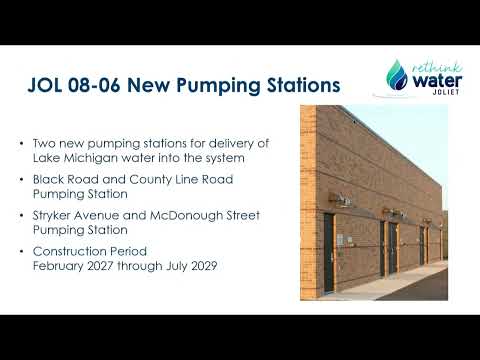
Joe Johnson, a member of the program team, said the city has staged projects to meet agreement requirements and to provide pressure and fire-flow capacity in areas distant from the new delivery points. He described site locations discussed in the presentation, including elevated tanks near Black Road and Bronk Road, a southern tank near Compass Boulevard and Route 53, a ground tank at Black Road and County Line Road with a companion pumping station, and improvements clustered near Ridge Road and Caden Farm Road. The team also described improvements near Ingalls Avenue, Morgan Street (a pressure-reducing facility), Bluff Street, Marion Street and a receiving point at McDonough/Striker Avenue.
Staff said a new consolidated water and sewer garage, roughly 52,000 square feet, will be built on a recently acquired site along Meadow Avenue south of I‑80 to support operations, training and equipment storage. Construction for that facility is planned to begin in summer 2026.
On financing, staff said the city is pursuing a mix of funding sources. Joliet already has a WIFIA loan for development and design and is working to close a WIFIA construction loan application for up to $86,000,000 (about 49% of anticipated Joliet-only costs) with a financial-model interest-rate assumption of roughly 4.25 percent. Staff said Illinois EPA (IEPA) State Revolving Fund (SRF) loans are being pursued for as much as $125,000,000 of program work where eligible; the city also expects to use revenue bonds if needed and noted SRF allotments and rankings are set by IEPA.
Staff reported that the 2023 City Council-approved water supply agreement with the City of Chicago is being assigned to the Grand Prairie Water Commission; that assignment is expected to come to council for approval in April. Staff said coordination with Chicago is ongoing and that construction in Chicago will begin this spring, with neighborhood outreach planned in the Durkin Park area.
A resident speaking during "citizens to be heard" tied the water presentation to broader development concerns, urging the council to consider the groundwater impacts of large warehouse developments and retention ponds. The resident said retention ponds are dug deep, tapping underground springs, and expressed the view that pumped pond water ultimately reduces local groundwater availability. "We need to stop … adding more warehouses," the speaker said, adding that more development will increase local water demand and costs.
City staff highlighted several near-term council items related to the program: a resolution to accept a land donation for the southeast elevated water storage tank (Northpointe / TCIH Holdings, LLC) on the Feb. 4 council agenda; a March 4 agenda item for WIFIA loan documentation and a supplemental indenture required for the federal loan; and a May 6 agenda item for the warranty of the construction contract for the two elevated tanks.
No council votes on the water program occurred during the Feb. 3 pre-council meeting; staff presented the design, funding strategy and schedule and flagged the specific items that will come before council for formal action in coming weeks.
Implementation risk: staff said the program depends on external funding allocations (IEPA SRF, WIFIA) and coordinated timing among multiple communities in the Grand Prairie Water Commission. The team said it is staging projects and coordinating with partner communities to avoid competing for SRF allocations and contractor capacity.
Next steps: staff will advertise work package 0802 in February 2025, return with a contract-award recommendation in May 2025, advertise 0803 in October 2025, and bring contract approval to council in February 2026. The assignment of the Chicago water-supply agreement to the Grand Prairie Water Commission is expected before council in April, and staff said construction in Chicago will begin this spring.