Get Full Government Meeting Transcripts, Videos, & Alerts Forever!
Get email alerts on the Water Resources topic
No spam. Unsubscribe anytime.
Private firm proposes recycling Maxon effluent to supply TVA and Nucor; council raises aquifer and community concerns
Summary
Colossus XAI told the council it plans to divert up to 20% of Maxon wastewater, polish it to cooling‑water standards with ceramic membranes and sell it to TVA and Nucor, reducing aquifer demand. Council members urged community outreach and asked about permits, oversight and benefits to the city.
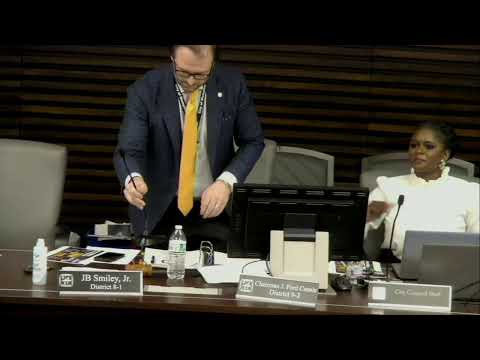
A private company, Colossus XAI, told the City Council Feb. 4 it plans to build a wastewater polishing facility on city‑owned land adjacent to the TE Maxon treatment plant that would treat an estimated 20% of Maxon’s effluent and sell treated water to industrial customers including TVA and Nucor.
Mark Carroll, the project engineer for Colossus XAI, described a planned facility that would “polish” Maxon effluent using a ceramic membrane‑based membrane bioreactor, producing water for cooling towers and industrial use. Carroll said the plant would “reduce the demand on the aquifer by approximately 9%” and that the firm has signed letters of intent with TVA and Nucor to purchase the treated water. He said the company’s plan would make the Maxon site an asset rather than solely a wastewater discharge point: “Instead of just being a wastewater treatment plant that does a fantastic job…we will take that water and we will process it to a higher quality.”
Colossus representatives said the project would sell water to industrial partners at a discount (reported as roughly 90% of the potable water rate) to create a financial incentive for off‑aquifer supply. Carlton Osborne, the city’s manager of real estate, said the city received an appraisal of $820,000 for a 13‑acre parcel and the proposed purchase price matches that appraisal; proceeds would be returned to the sanitary sewer enterprise fund.
Council members praised the potential to reduce aquifer withdrawals but repeatedly pressed for more community outreach, environmental permitting details and financial protections for the city. Councilman Ford — whose district contains the site — insisted that city staff hold a neighborhood meeting and that Colossus meet with impacted residents. Several councilmembers asked whether the city would retain any control over the property (a reversion or right‑of‑first‑refusal) if the project were abandoned; city staff said such clauses could be added to the purchase agreement and deed.
Administration officials explained the state permitting path: a modification of Maxon’s TDEC permit to allow non‑potable reuse, and a separate state operating permit for a reuse distributor. Carlton Osborne said the city would require deed provisions and had recommended sale proceeds be used for the sanitary sewer enterprise. Carroll said the best‑case construction timeline could bring the facility online next summer, though he acknowledged that permitting and construction could take longer.
Environmental and neighborhood advocates raised questions during committee discussion about public notice, impacts on nearby residents and the adequacy of oversight. Councilmembers asked Colossus to provide examples of similar projects and more technical documentation before the sale is finalized and before the council considers approval. City staff said the sale would be brought to council for final approval if the purchase offer proceeds.